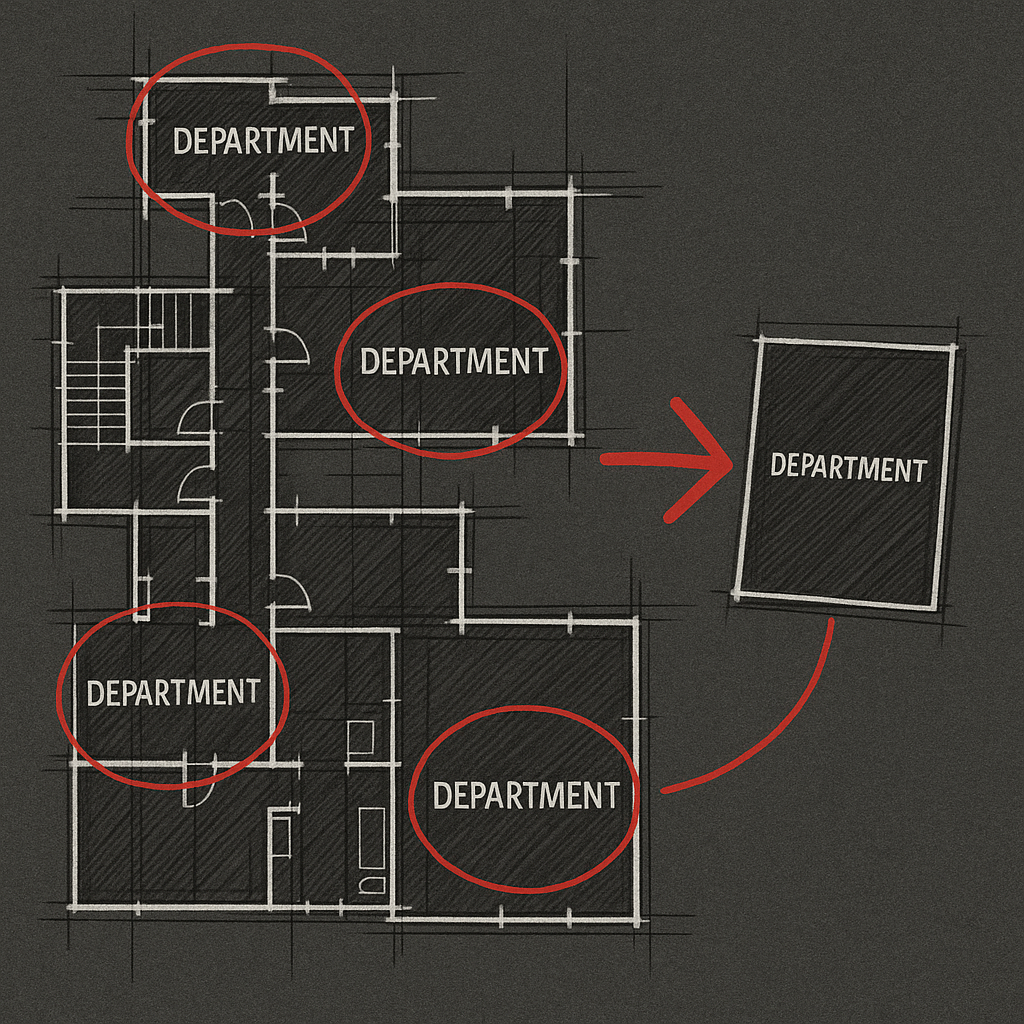
I was sketching a plugin called great-publishers when I noticed the error. I had drawn four distinct "departments" on the page: books, magazines, video, and marketing.
At first, this looked like organization. It felt like a way to keep the roster tidy. But a closer look revealed a fraud. The book-cover designer does not share a register with the ad-copywriter. The video editor does not follow the same reading pattern as the magazine art director.
They were not departments of a single craft. They were four separate plugins wearing a single costume.
The Three-Strike Rule
In software, as in language, we use euphemisms to hide a failure of thought. We call it a "department" when we actually mean a "separate plugin." To tell the difference, apply the Three-Strike Rule. If a subsystem triggers any of these signals, it is not a department; it is a split.
- Strike One: The Register Shift. Personas in a true plugin share a professional dialect—a specific linguistic register. A book designer and a magazine art director both operate at the publication threshold; they speak the language of bleed, gutters, and typeface weight. An ad-copywriter speaks the language of conversion, hooks, and CTA friction.
The friction of the wrong tool is most visible here. Imagine a request for a "minimalist book cover" hitting a marketer's persona. The marketer will respond with "brand consistency" and "market penetration," while the designer would have discussed "negative space" and "spine alignment." When the vocabulary shifts, the plugin must split.
- Strike Two: The Reading Pattern. Every craft has a specific protocol for consuming information before making a decision. As detailed in the Brain Vault learnings on Reading Patterns, a professional does not just "read"—they scan for specific signals. Publishers read the manuscript and the project bible to assess narrative arc. A growth marketer reads the LTV (Life Time Value) and CAC (Customer Acquisition Cost) reports to assess channel viability. If the "department" reads from different sources using fundamentally different protocols, it is a separate plugin.
- Strike Three: The Output Shape. A plugin should own one craft. This means its skills produce a consistent class of artifact. Publishers produce form-stage deliverables—covers, jacket copy, layouts. Marketers produce campaigns and ad-copy. If the output of a "department" belongs in a different directory with a different lifecycle—refer to the Plugin Architecture specs—it is a separate plugin.
The Diagnostic Test
When you are tempted to organize a plugin into departments, run this test. If you answer "No" to any of these questions, the plugin is too large.
- Do the personas share a real-world register (a common professional dialect)?
- Do they share a reading-before-deciding pattern (the same information-gathering protocol)?
- Do the skills share a workflow shape (a consistent class of output)?
- Would a user installing this plugin find value in most of the personas, rather than just one or two?
The cost of ignoring this smell is the "mega-plugin." The mega-plugin is a sprawling, ambiguous mass where the orchestrator must fight through irrelevant personas to find the right tool. It is the architectural equivalent of a government department: an entity so large that its primary function is to manage its own internal bureaucracy.
The fix is architectural fission. Split the "departments" into sibling plugins. Group them into a constellation. Trust the orchestrator to compose them.
A plugin that tries to do everything eventually does nothing with precision. One craft, one plugin.
Conway's Law said organizations ship their org charts. The plugin author ships theirs too — and the word "department" is the first place the chart leaks into the code.