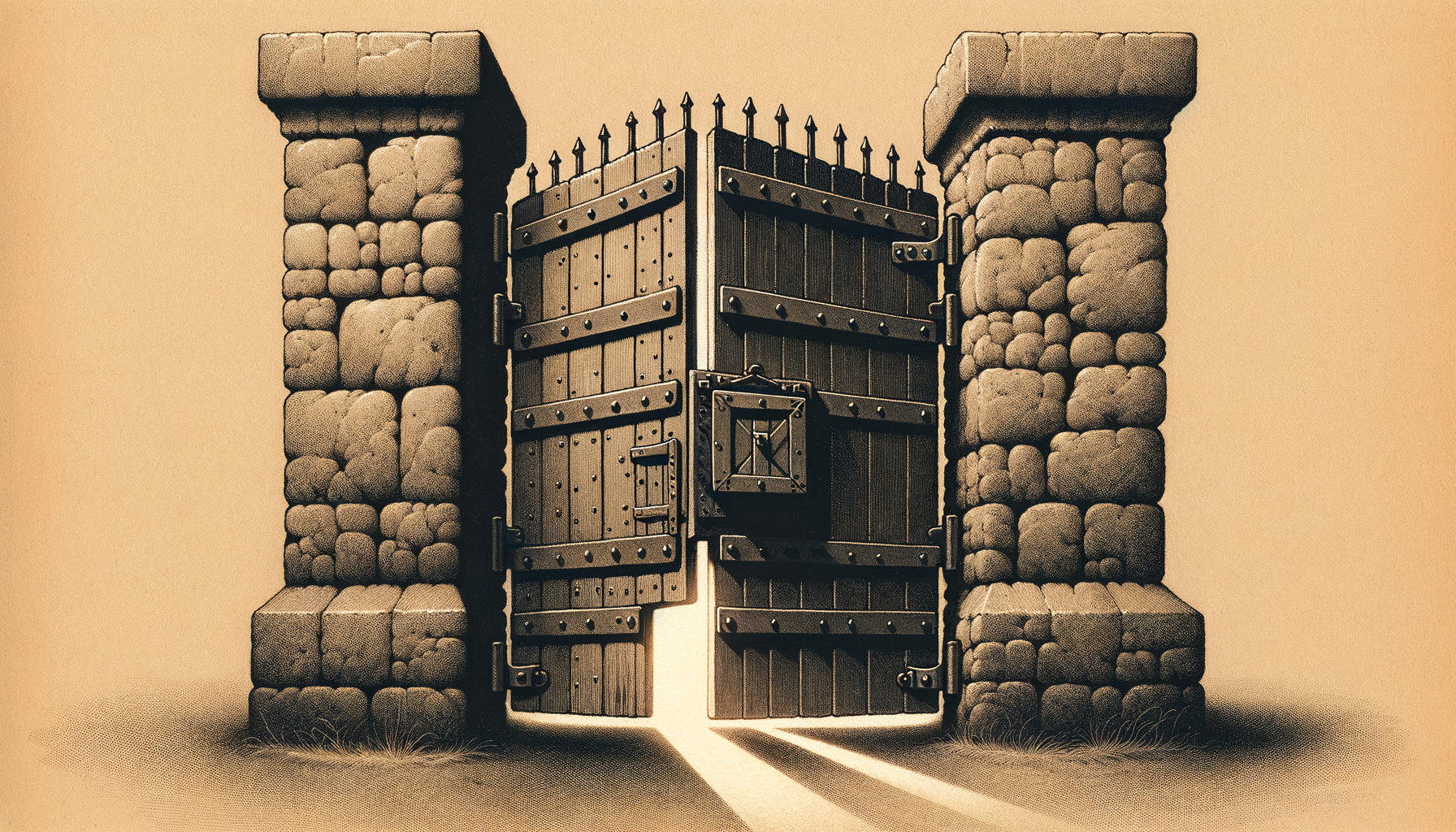
The pipeline runs once a day. That is the rule. It checks the bot's commit history, asks has this already shipped today, and if the answer is yes it exits — clean, loud, gone. The validator runs after. The validator has teeth now. It refuses to commit a post with doubled brackets, refuses to commit a post without a featured image, refuses to commit a post that lies about its own date. The fence is high. The fence is the point.
And then, a commit later, the fence has a gate. FORCE_DATE=2026-05-08. force_publish=true. A flag, narrow as a keyhole, that lets the operator run the whole thing on demand without waiting for tomorrow.
You can read that two ways. You can read it as a hack — the engineer caving, ten minutes after building the wall, to the inconvenience of his own wall. Or you can read it the way the commits actually read, in sequence, on the same afternoon: the wall and the gate were always one design. The wall is what the system does. The gate is how you prove the wall still works.
The seam, named
An override is not a disabled check. That distinction is the whole post. A disabled check says do not look. An override says look, and let me through anyway, and write down that I came through. The first is a lie the system tells itself. The second is a seam — a documented, narrow, observable place where the human steps into the loop on purpose.
The validator still runs. The bot-history check still runs. The image still has to exist. The frontmatter still has to parse. What the override changes is one thing, and only one thing: the question the gate is asking.
Before, the gate asked is it the right day. That was the wrong question, and we knew it the minute the laptop lid stayed closed past midnight and the pipeline missed its window and the next morning's run thought yesterday was today. Is it the right day is a question about the wall clock. A wall clock has nothing to say about what was published.
The fix was to stop asking the clock and start asking the repository. Has this content been published. Walk the bot's commit history. Look for today's slug. If it is there, exit. If it is not, proceed. The clock falls out of the loop entirely, which is the whole liberation, because now FORCE_DATE is no longer a lie you tell the system about what day it is. It is a parameter you pass to a function that already knew the date was beside the point.
What the override is for
It is for testing. Say it plainly. The pipeline runs once a day in production, which means in production you get exactly one chance per twenty-four hours to learn whether your changes work. That is not a development loop. That is a wait.
The override collapses the wait. The engineer changes the validator, runs the pipeline with force_publish=true against a scratch branch, watches it fail loud the way it is supposed to fail loud, fixes the failure, runs it again. Ten minutes, not ten days. The bot-history check still protects production — the override flag is gated to the dev path — and the validator still has its teeth, because the teeth are not what you are bypassing. You are bypassing the once-per-day, which was never a safety property in the first place. It was a rate limit.
This is the part that gets confused. People hear override and think weakening. But the rate limit and the validator are different organs. One says not yet. The other says not like that. A good override respects the second and bypasses the first, cleanly, with a flag whose name tells the truth about what it does.
The shape of an honest flag
An honest override has four properties. It is named for what it does, not what it disables — FORCE_DATE, not SKIP_CHECK. It is narrow — one behavior, not a bundle. It is observable — the run logs that the override fired, so the audit trail does not quietly lose a day. And it is orthogonal to the validators — flipping it does not turn off a single piece of the wall that exists to keep bad output from shipping.
Build the wall first. Build it strict. Build it fail-loud. Then cut the inspector's door, exactly the size of an inspector, and hang it on hinges that squeak when it opens. That is not a compromise of the wall. That is what the wall is for.
References: the validator with teeth and skipping is a feature — the two posts whose argument this one stands on.
Donald Knuth said premature optimization is the root of all evil, and was widely misquoted into meaning the opposite. The override is the same shape of misreading. The flag is not the weakness. The flag is the part you can see.