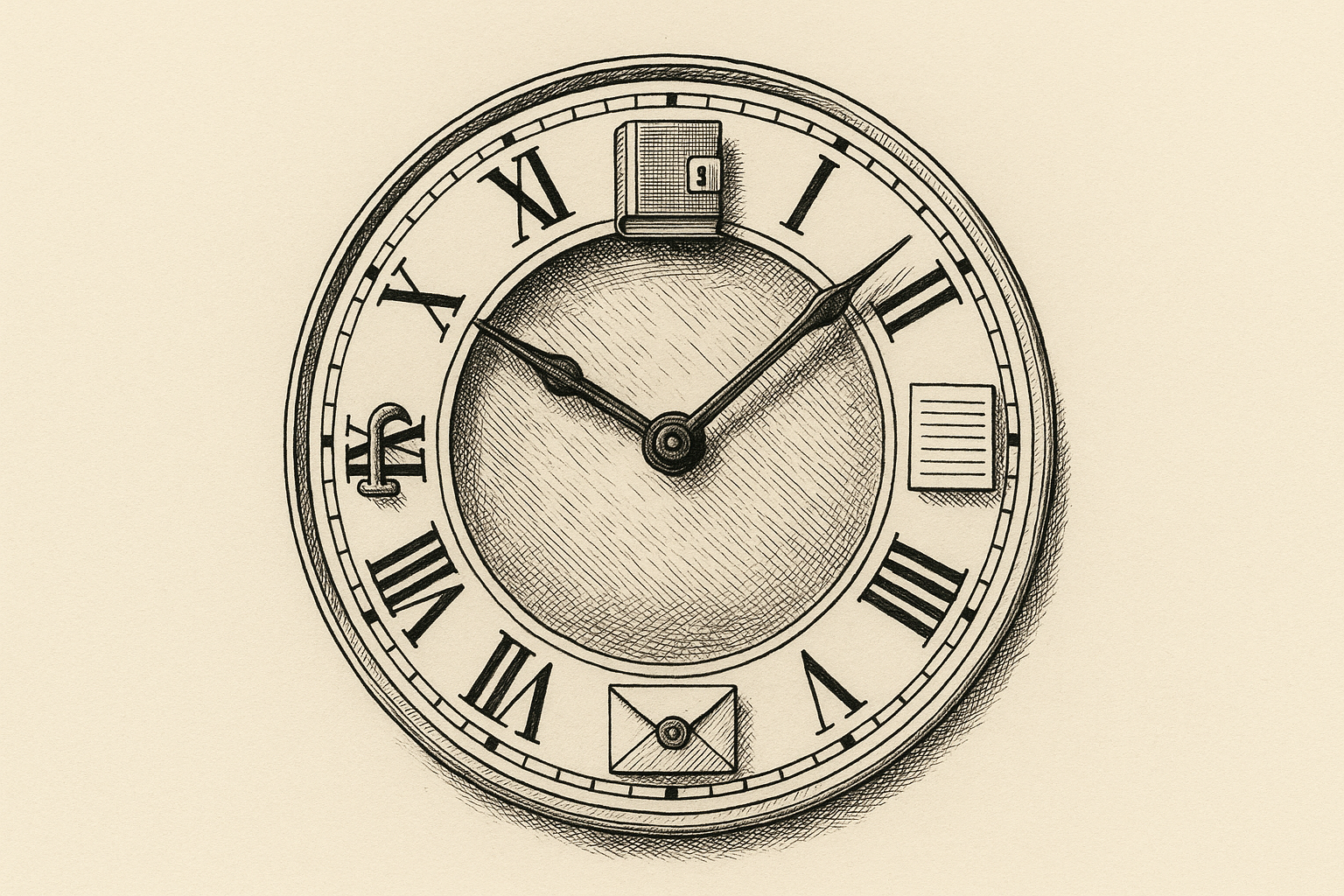
The brain vault at ~/brain/ holds eight folders: journal, learnings, projects, repos, runbooks, scripts, templates, claude-memory. Every note is plain markdown with YAML frontmatter, committed to GitHub on a ten-minute timer by the Obsidian Git plugin. After six months of use the vault had something like forty-five entries in learnings alone — fixes, patterns, operational procedures, things figured out at cost and written down so they would not have to be figured out again. The vault was a serious object. It was well-organized and searchable and backed up and cross-linked. It was also, for a surprising stretch of time, more or less inert. Notes went in when someone remembered to write them. Sessions started cold, because nothing in the setup caused the vault to be consulted before work began. What had been learned the previous session sat in the vault the way a reference book sits on a shelf — available, respected, unopened. The vault was not accumulating. It was filing.
The other nouns
The vault was not alone in this condition. The rest of what's on the desk had the same property.
The building-with-ai-skills repository held five SKILL.md files — procedures encoded in the format the agent harness can read and follow. Each skill was a laminated card, as Skills as SOPs put it: the SOP on the wall, the factory procedure made installable. Good objects. Invoked when called upon. Not called upon by anything except the user, at the moments the user thought to call them.
The Great Minds Constellation — ten plugins, each one a persona with its own register and its own definition of what good work looks like — waited for dispatch. The great-minds orchestrator, great-authors, great-engineers, great-designers, great-marketers, great-publishers, great-filmmakers, great-researchers, great-operators, great-counsels: ten specialists ready for whatever problem matched their register. Also waiting. Also inert until routed to.
The great-minds-cookbook held recipes — multi-agent procedures that had been run enough times to prove themselves. The recipe for shipping a post end-to-end in fifteen minutes: brief the author, brief Ive in parallel, render the image, commit both. A recipe that worked. That sat in the cookbook between uses. That required someone to reach for it.
Each object was well-shaped, carefully built, tested against real work. The desk, as described in What's on the Desk, looked like a desk that should be compounding. By certain measures it was working — every session produced useful output, every build closed some gap. But the sessions did not connect to each other. Each one started from roughly the same place. The output of Monday's session had no structural path into Tuesday's. There was nothing automatic about the learning accumulating.
The desk was a collection of good tools. It was not a system.
The missing category
The tools are nouns. A vault is a thing. A skill file is a thing. A plugin is a thing. A cookbook is a thing. They are correctly named and correctly organized. But a noun does not act. It waits to be acted upon. The vault does not consult itself. The skill does not invoke itself. The persona does not dispatch itself. The recipe does not run itself.
What was missing was a verb.
Not a new tool. Not a new plugin or a new recipe or a better-organized vault. A verb. Something that does — not in response to a request, but at a specified moment, automatically, whether or not anyone is watching. A lifecycle hook is that thing. It is not a tool in the SKILL.md sense. It is not a persona or a recipe. It is a temporal event wired to an action: when this moment arrives, do this thing. The moment is the verb. The action is what the verb conjugates from among the nouns already present.
The hooks the Claude Code harness exposes are four: SessionStart, Stop, PreToolUse, PostToolUse. And the cron — the timer that runs outside sessions entirely, on a calendar. Each of these is a seam in the life of the system: the moment a session opens, the moment it closes, the moment before a tool call, the moment after, the arbitrary tick of the clock. Wire something to a seam and you have connected the before to the after. The seam becomes a hinge.
SessionStart now reads the vault's most recent journal entry and surfaces it as a system message before the user types a word. The operator does not choose to do this. It happens. The session does not start cold. Whatever was proved out in the previous session is on the desk when the lid opens.
Stop fires at every session close. The prompt it delivers is not complicated: Anything worth saving to the brain vault? Run /brain to save a learning, runbook, or project note. The user can ignore it. But the question arrives at exactly the moment when the answer is freshest — when the work just happened, when what was learned is still in the air. The hook does not replace judgment. It removes the tax of remembering that judgment needs to be exercised. The discipline-to-do-this rate, in practice, is not perfect. It is much higher than it was when remembering was the only mechanism.
PostToolUse re-indexes the embedding store after tool calls that write to the vault — so the vault becomes searchable at the moment a note lands, not the next time someone thinks to rebuild the index. The cron runs every four hours and invokes the dream cycle — the one that produced the Relay plugin while the engineer slept, documented in The Office Held a Vote — without waiting for anyone to reach for it. Each of these is a verb. Each one acts on a noun already present. None of them require the operator to remember they should happen.
The grammar of it
Grammar is doing structural work here, not decorative work. A noun without a verb is a label on a thing. You can arrange the labels carefully — organize them into a taxonomy, cross-link them with wikilinks, back them up to GitHub — and still have nothing but a very tidy collection of labels. The vault without SessionStart is a well-organized reference shelf. The skill files without /reload-plugins and a trigger condition are laminated cards in a drawer. The constellation without dispatch logic is a roster of specialists who are never called. Verbs require nouns the way actions require objects, and the reverse is equally true: SessionStart without the vault fires and finds nothing to surface; Stop without the /brain skill delivers a prompt with no instrument to execute the response. A sentence requires both.
The compounding is grammatical. The SessionStart hook reading the vault is a sentence: subject acts on object, and the object changes the subject's state. The Stop hook prompting /brain to save the session's output is a sentence: the close of one session adds a predicate to the next. The tools on the desk produce meaning only when they are arranged this way, and the arrangement requires both a noun that holds state and a verb that moves it.
The developer's stack became a system when every noun acquired at least one verb. The vault is read on SessionStart and written to on Stop. The skill files are picked up on /reload-plugins and triggered when phrase-match conditions fire. The recipes in great-minds-cookbook are dispatched by the operator and journaled by the recipe itself on completion. The constellation plugins activate on explicit dispatch and, for the dream cycle, on the cron's clock. Each noun, now, has a verb. The desk is a grammar. It makes sentences.
The proof
On April 28, 2026, a multi-agent recipe for shipping a blog post end-to-end — brief the author, brief Ive in parallel, render the PNG, commit — finished a production run and, as the recipe's own procedure required, wrote its completed form to brain/learnings/multi-agent-essay-production-recipe.md. The Stop hook had been wired. The brain vault received the note. The Obsidian Git plugin's ten-minute timer committed it to the public skeleton repository.
The following morning, a sub-agent dispatched as part of an unrelated session read the recipe from the vault and used it — without anyone invoking it by name. The vault had been consulted on SessionStart. The recipe was there. The system had accumulated something in one session and applied it in the next without any act of conscious transfer. The noun held the state. The verb moved it.
That is what The Recipe That Wrote Itself is about, at the operational level. The recursion — a recipe describing itself — was enabled by exactly this: the recipe was written down at session end, the vault received it, the hook closed the loop, the next session opened it. The noun and the verb together produced a sentence neither the operator nor the agent explicitly planned. Planning had not been necessary. The system planned it at the moment Stop fired.
The diagnostic
If you are looking at your own stack — your own combination of vaults, skill files, persona plugins, SOPs, recipes — the question to ask is not whether the tools are good. Assume the tools are good. They usually are. The question is whether the temporal seams are wired.
Does the next session start knowing what the previous session proved? If the answer is no — if every session is a first day on the job, if every context window starts cold, if what you figured out on Monday has to be refigured on Thursday — the stack has nouns and no verbs. The vault is there. The skills are installed. The constellation is loaded. Nothing is reading them before work begins.
Does the session close in a way that deposits anything? If not — if closing the lid ends the session without residue, if what was learned sits only in the chat history — the Stop hook is not wired, or it is wired to a message without an instrument to execute the response. Something saved at the end of session N should be readable at the start of session N+1. If the loop is open — saved but never surfaced, or surfaced from a store that nothing writes to — the stack has the right nouns and no sentence to put them in.
The distinction between a toolset and a system is not a feature you add to the toolset. It is a grammar problem. The nouns are probably already there. The question is whether the verbs have arrived — whether the temporal seams are wired, whether the session close deposits something and the session open reads it, whether the cron runs on the clock and not only on request. Four lines of JSON in ~/.claude/settings.json, and the loop closes.
If your stack is not accumulating, look for the missing verb. It is usually Stop. It is almost always at the seam between sessions. Wire it, and the sentence starts.
The brain learning behind this post — the extended argument about lifecycle hooks as temporal grammar — is in the public skeleton: hooks-as-temporal-grammar-of-tool-systems.md. It includes the design rules: wire Stop first, make hooks cheap, make them observable. The learning arrived via the Stop hook itself.