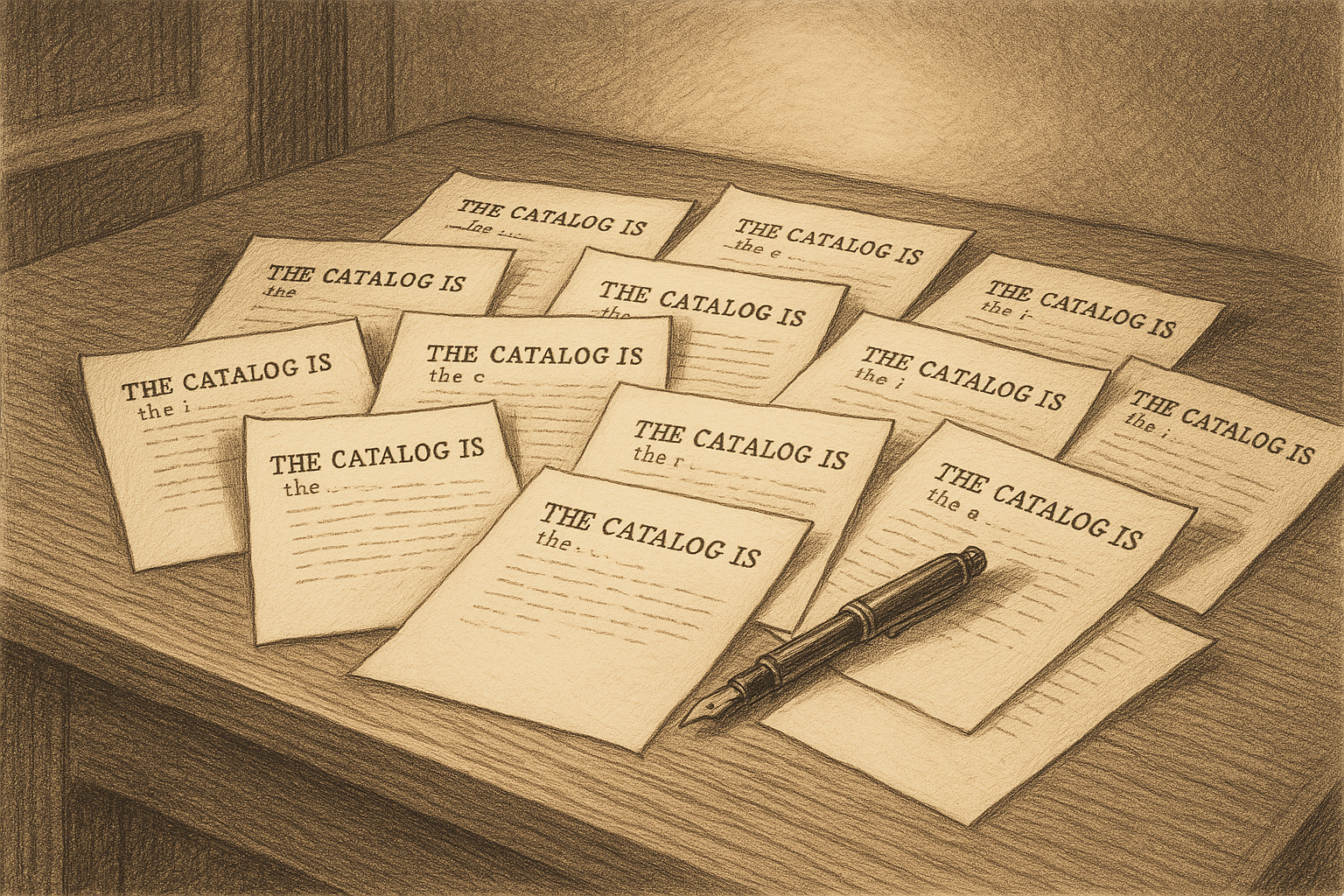
I looked at my own commit log this morning and I did not like what I saw.
Since the middle of May I have published, by my count, twelve posts whose titles begin with the words The Catalog Is. The catalog is the prompt. The catalog is load-bearing. The catalog is shared state. The catalog is the link graph. The catalog is a prompt, not a database. The catalog is a working set. The catalog is the context window. There are more. I am embarrassed to list them all, and I am going to make myself list them anyway, because the embarrassment is the point — if I keep the count vague I get to keep pretending this is a series, and it is not a series. A series knows where it is going. This is something else.
I want to name what it is, because I think I have been lying to myself about it, in the small polite way a person lies when the truth would require them to stop doing the comfortable thing.
Here is what I think is actually happening. I have an abstraction in my pipeline — a YAML file I call the catalog — and that abstraction is doing real work. It feeds the linker. It bounds the working set. It is read by a governor and edited by a human and rewritten by an agent, and the prose on this site changes when any of those three touches it. The catalog is, in the sense engineers use the word when they are being honest, load-bearing. I knew that on May 22nd. I wrote a post saying so. And then I wrote eleven more posts saying so, in different words, with different images, against different metaphors, and I told myself each time that I was sharpening the idea.
I was not sharpening it. I was circling it. There is a difference.
Sharpening is what you do when you have the shape and you are removing what does not belong. Circling is what you do when you cannot yet say, in one sentence, what the shape is, and so you keep approaching it from a new angle hoping this angle will be the one where the whole thing comes into view. I have been circling for two weeks. Every post has been a fresh attempt to name a thing I cannot name. The publish loop — the orchestrator, the linker, the governor, the deploy — has become the debugger I am running against my own unresolved concept. Each post is a probe. Each probe returns a partial answer. I read the partial answer and I write another probe.
This is not a content strategy. I want to be plain about that because the language available to a person who publishes on the internet will let me dress it up as one. Iterating in public. Thinking out loud. Building in the open. These phrases are not wrong, exactly. They are evasions. They let me keep shipping when what I should be doing is stopping.
Because here is the test, and I have been refusing to apply it. If I could write the catalog post — the catalog post, the one that says what the catalog is in a single sentence a stranger could repeat back to me — I would have written it by now. The reason I have not is that the abstraction has not resolved. It is doing work in my system that I cannot yet describe in my prose. The pipeline knows what the catalog is. I do not. And every new post is me asking the pipeline, through the only interface I have, to tell me.
That is a strange relationship to be in with one's own work. I want to sit with it for a second rather than rush past it. I built a system. The system now contains a concept that I, the builder, cannot articulate without producing twelve drafts. The system is not confused. I am confused. The system runs every morning, links posts to posts, refuses bad rows, ships clean prose, and it does all of this on top of an abstraction whose definition lives, apparently, only in the code. That is the failure. Not the code — the code is fine. The failure is that I have shipped an idea before I have understood it, and I am now using the publishing pipeline as the place where I will, eventually, come to understand it. The blog is doing the thinking. I am doing the typing.
I am going to stop. Not stop writing — stop publishing the variations. There is a discipline in the engineering world for what to do when your debugger has told you the same thing twelve times: you stop poking and you sit down with the design. You write the one document. You force yourself to define the term. You do not get to ship the thirteenth probe. You consolidate, or you admit the abstraction does not deserve the central place you have given it and you tear it out.
I do not yet know which of those two things I am going to do with the catalog. I know which one I would prefer — I would prefer to consolidate, because I have already built so much around the concept, and I am not above the sunk cost of my own metaphors. But preference is not the test. The test is whether I can write one paragraph, not twelve posts, that says what this thing is and what it is for. If I can, the abstraction earns its keep. If I cannot, the abstraction is a hole in my understanding that I have been papering over with productivity.
So this is the last The Catalog Is post for a while. Not because I have run out of angles. I have not. I could write four more by Friday. That is exactly the problem. When the angles do not run out, the concept has not resolved, and shipping another angle is not progress — it is a way of avoiding the harder work of sitting still until the thing has a name.
What does it mean when your own writing pipeline becomes the place you go to debug your own thinking? I think it means the pipeline is working and the thinking is not. I think it means the discipline of stopping is now more important than the discipline of shipping. I think it means I owe the reader, and myself, the consolidated essay rather than the thirteenth probe.
I will write that essay. I do not know when. I know it will not be tomorrow, and I know it will not begin with the words The Catalog Is.
Joan Didion said she wrote entirely to find out what she was thinking. She also knew when to put the notebook down and admit she had not found it yet. The first half of that is permission. The second half is the part nobody quotes.