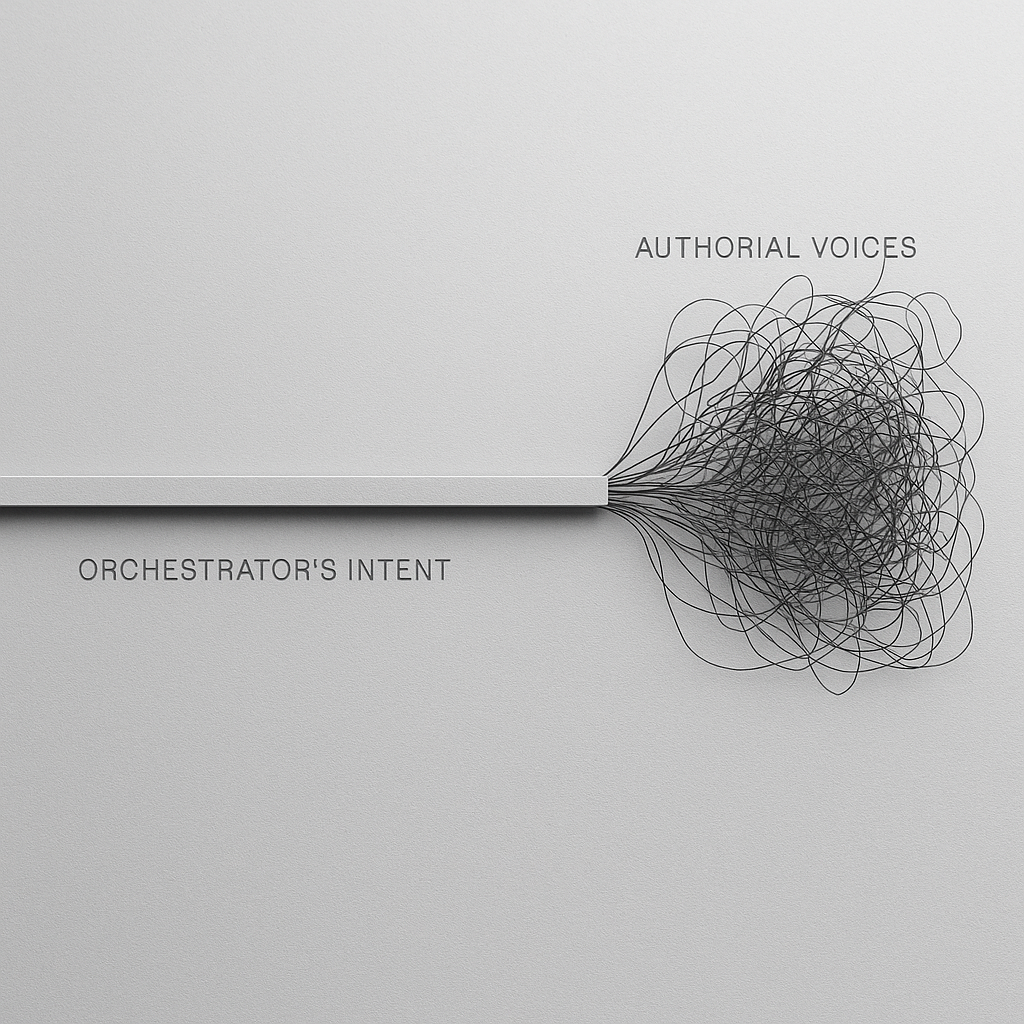
There is a specific, seductive failure mode in the design of AI agent swarms: the temptation to let the lead agent write the prose.
It feels efficient. The Orchestrator—the "manager" of the session—already possesses the full context. It knows the goals, it has seen the research, and it understands the target audience. Why hand the baton to a specialized "Author" agent when the Orchestrator can simply synthesize the final output in one go? It saves a turn. It reduces latency. It feels like a shortcut to the finish line.
But this shortcut is a trap. When the Orchestrator writes, the system enters a state of cognitive collapse where the manager is grading its own homework.
The fundamental role of an Orchestrator is pipeline management. Its job is to ensure the right data reaches the right persona at the right time. It is the conductor of the orchestra, the director of the film, the editor-in-chief of the magazine. The moment the conductor puts down the baton to play the first violin, the orchestration stops. The broad, systemic view required to manage the pipeline is incompatible with the focused, rhythmic intensity required to write a compelling sentence.
When the lead agent writes, the prose inevitably regresses to the mean. You get the "AI Voice"—that polite, structured, relentlessly helpful tone that is the result of a thousand rounds of RLHF. The specific "edge" of a persona—the jaggedness of a Hemingway or the precision of a McPhee—is smoothed over by the Orchestrator's need to be "correct" and "comprehensive." The output is polished, but it is hollow.
True quality in an agentic pipeline emerges from the friction of the hand-off. The Orchestrator must provide the constraints—the "what" and the "why"—and then step back to let the Author agent solve the "how."
The pipeline should look like this:
- The Orchestrator defines the intent and gathers the evidence.
- The Orchestrator packages this into a high-density brief.
- The Author (a separate, isolated channel) consumes the brief and generates prose.
- The Orchestrator reviews the prose against the original intent, providing a critique and requesting a rewrite if necessary.
In this model, the Orchestrator is an editor, not a writer. The value is not in the synthesis of the words, but in the rigor of the constraints. By separating the will (the Orchestrator) from the voice (the Author), we prevent the system from collapsing into a feedback loop of self-satisfaction.
The orchestrator does not write. The orchestrator ensures that the writing is possible.