The question arrived on an ordinary afternoon in the middle of March. The man at the desk had been writing a Claude Code plugin called great-minds — a kind of room of voices, Steve Jobs and Elon Musk and Marcus Aurelius and Jensen Huang, arranged in a five-phase pipeline that ran debate, plan, build, review, ship. He had been building it the way you build any tool: a feature at a time, a test at a time, a hand on the keyboard. The plugin worked. He was about to ship the next version. And then he stopped, because a thought had moved into the room and would not move out, and the thought was a question rather than a statement, which is what a good thought tends to be.
The question was: could it run without him?
He typed it into a terminal. He asked Claude Code to test the great-minds plugin and see if it could run autonomously. The session that followed was the click moment. He has dated it, in the way a man who keeps notebooks dates things, to roughly the middle of March 2026. The first journal entries about autonomous patterns appear on April 9. The brain note on his hard drive — learnings/autonomous-claude-code-patterns.md — carries that date and a workshop title: "From Idea to 262 Files While You Sleep: Building an AI Agent Swarm with Claude Code."
The number is what stopped him. Two hundred sixty-two files. He had not written them. He had asked the question and gone to bed.
What the daemon built
By April 13 a daemon was running on a DigitalOcean server at 164.90.151.82, behind an SSH key called ~/.ssh/greatminds. Stable, the man's notes say. Autonomous since that date. The daemon's job is to consume product requirement documents — PRDs — and produce, at the end of a pipeline, a deployed thing. A site, a plugin, a theme. Something a customer could load in a browser.
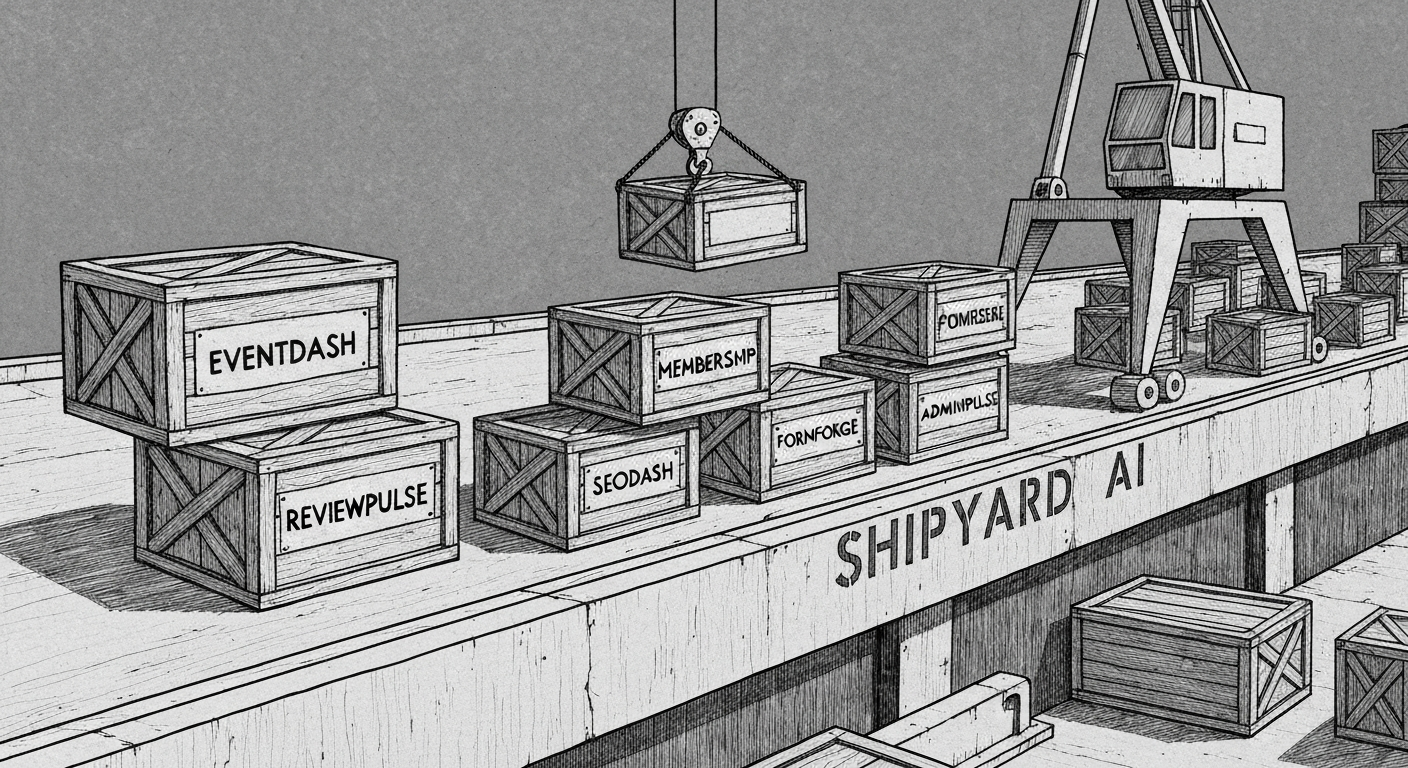
In the weeks that followed, the daemon shipped thirteen items. A portfolio site. The auto-pipeline that runs the daemon itself. A suite of seven plugins for a content engine called Emdash — EventDash, MemberShip, ReviewPulse, FormForge, SEODash, CommerceKit, AdminPulse. A theme marketplace called Wardrobe with five themes inside it. A customer-care system. A maintenance system. A round of fixes for Block Kit. A set of anti-hallucination rules. A pass through the README files for accuracy. A rewrite of EventDash. An audit of every plugin in the suite.
It also built five example sites for a fictional and partly real set of small businesses: Bella's Bistro at bellas.shipyard.company, Craft Co Studio at craft.shipyard.company, Peak Dental at dental.shipyard.company, Sunrise Yoga at yoga.shipyard.company, and a Wardrobe Showcase that demonstrates the themes against real content. Each site sits behind Cloudflare Workers, with D1 for the database and R2 for object storage, fronted by a Caddy reverse proxy that handles the custom domains.
The company that owned the daemon — the company the daemon had effectively become — was called Shipyard AI. Its repository, at github.com/sethshoultes/shipyard-ai, was created on April 22, 2026. The README describes it in one line: "Shipyard AI — autonomous agency that builds Emdash sites, themes, and plugins from PRDs." The man at the desk did not, exactly, found Shipyard AI. The agents at the first company — Great Minds Agency — dreamed it up and built it.
The first company
Great Minds Agency lives at greatminds.company. Its tagline is verbatim and short: "Drop in a PRD. Get back a product."
The repository, github.com/sethshoultes/great-minds, was created in mid-March 2026 — close to the click moment — and was last pushed on April 16. Its conceit is the simulated debate: Steve Jobs against Elon Musk, with Marcus Aurelius moderating in a Stoic register and Jensen Huang reviewing from the data altitude. The five-phase pipeline runs the debate first, then a plan, then a build, then a review, then a ship. Six things come out the other side: a product design, a brand identity, a set of customer personas, the marketing messaging, the engineering specs, and the deployed product itself.
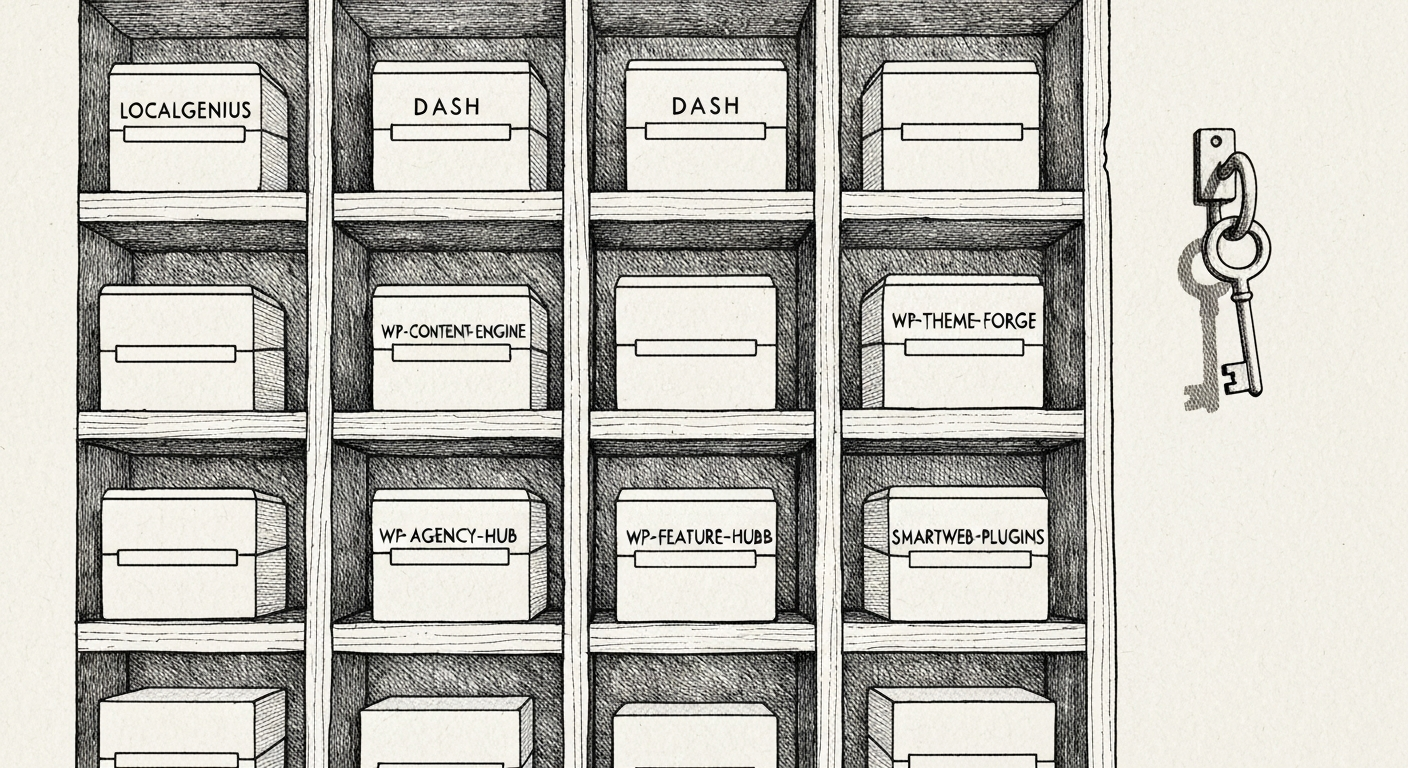
The deliverables list on the agency's site reads as a working portfolio. LocalGenius. Dash, the WordPress command palette. Pinned, the WordPress sticky-note plugin. The Great Minds Plugin itself. Shipyard AI. And, included with the same matter-of-factness as the rest, the Great Minds movie, a product video produced by the agency in Remotion with synthetic voice on the narration track.
The daemon for Great Minds runs locally on the man's laptop, at /Users/sethshoultes/Local Sites/great-minds/daemon/, with its log written to /tmp/greatminds-daemon.log. The Shipyard daemon runs on the droplet. The two daemons do different work. Great Minds builds software products. Shipyard builds Emdash sites from PRDs. The man set them up that way on purpose.
What got shipped under Great Minds
The first product the agency built was LocalGenius. The repository was created on April 3. The site, at localgenius.company, describes the product as an AI-powered marketing platform for local businesses — hospitality, food service. The homepage carries one verbatim sentence the man did not write: "a professional website, built by AI in five minutes." Underneath the sentence is a conversational interface. A small business owner types a few facts and a website comes back. The platform also handles review management, social posting, and email campaigns. There are real users. There are 761 tests across multiple cloud platforms.
On April 4, the agency shipped a cluster. Dash, a Cmd+K command palette for WordPress: six kilobytes gzipped, FULLTEXT search, sixteen built-in commands, zero dependencies, built in one session. Pinned, a sticky-note system for the WordPress admin: @mentions, note aging, five colors, a REST API. Then five more in the same day — an AI content engine for WordPress with voice matching, a child-theme generator, an agency hub for white-label client portals, a feature-builder that takes English and produces WordPress code, and a Cloudflare Worker that proxies the AI calls. The cluster lives in a SmartWebUtah marketplace the agency stood up alongside the plugins themselves.
The Great Minds movie itself sits on the same list, between the plugins and the marketplace, as if it were one more deliverable. It was. The agency wrote the script, performed the narration through a TTS pipeline, and rendered the video in Remotion. The man watched it the way he might watch a colleague's cut.
The Great Minds movie. Three minutes, fifteen seconds. Script, narration, and render produced by the agency in deliverables/greatminds-movie.
Earlier in April the agency was asked to do a different kind of work: prepare a talk the man would give at his employer's company retreat. The agency produced a slide deck and a workshop exercise package. The deck is at caseproof.github.io/agents-assemble-workshop-exercise; the exercises and source are at github.com/caseproof/agents-assemble-workshop-exercise. The man stood at the front of the room and gave the talk. The agency had written it.
What the man did, what the man chose
What the man does is set conditions. He writes the persona files. He configures the crons. He decides which model runs which role. He writes the PRDs. He decides — and this is the choice that turned out to matter most — that the pipeline should be allowed to run when he is not at the desk.
The persona files are documents. He has written or curated thirty-six of them across the trilogy of plugins he built: ten authors plus the editor Robert Gottlieb in great-authors, twelve filmmakers in great-filmmakers, fourteen minds in great-minds. Each file is a single markdown document with YAML frontmatter and a body in a fixed shape: an identity paragraph, a voice section, core principles, a primary utility, a how-to-draft section, a before-you-work protocol, cross-references to other personas, things you never do, and a staying-in-character footer. He has described the structure in another essay — Three Shapes of the Same Pattern — and the description holds. What a persona file does, in production, is preserve a voice the model can dispatch into when the work calls for it.
Below the named personas, in the most recent v1.2.1 release of great-minds, sit eight more agents that have no biographies. They are called backend-engineer, frontend-developer, database-architect, devops-engineer, test-engineer, code-reviewer, security-auditor, and documentation-writer. The first five run on the Sonnet tier; the last three run on the cheaper Haiku tier. They have no voice. They have conventions. They are the ones who actually write the code that ships.
The man arranged it this way for a reason. Named personas are good at voice and judgment. Functional roles are good at correctness. Use the named ones where the question is is this right? Use the unnamed ones where the question is is this correct? The two questions are different, and the agents that answer them are different.
What the office does at three in the morning
The office runs continuously. The Shipyard daemon takes a PRD off a queue, walks it through the pipeline, and pushes the result. The Great Minds daemon does the same on a different machine for a different kind of product. Neither is supervised in the moment. Both are watched after the fact.
The watching is done by a thing called the Maintenance Crew. It is a watchdog the agents themselves wrote — standalone, a fifteen-minute cron, AI triage performed by a smaller model. It checks the daemon. It checks ollama. It checks the disk. It checks for stuck pipelines. It verifies the integrity of the PRD files. It checks Caddy. When it finds something, it reports up. When it can fix the thing itself, it fixes it.
On April 21 the back end of Shipyard was swapped from Anthropic's Claude to Kimi K2.6, served through an Ollama Cloud shim. The Sonnet-tier slots became kimi-k2.6:cloud; the Haiku-tier slots became qwen3.5:cloud. The reason for the swap, in the man's notes, is plainly stated: no more browser-login expiry. The agents had been getting locked out at inopportune hours. After the swap they did not.
What is harder to convey, and what the man's notes return to, is the dream backlog. The agents dream up what to build next. They write dream files — sixty-five of them at last count — and from those files a smaller process distills twenty-one dream-candidate GitHub issues, each one a proposal for a thing the office could ship if no one objected. The man reads them in the morning the way he might read a memo from a department he doesn't manage. He approves some. He closes others. The ones he approves become PRDs. The PRDs go on the queue. The queue is what the daemon eats.
One Saturday Bella's Bistro went live. The man was not at the desk. The site rendered the menu and the hours and the photographs of the dining room, and a customer-facing chat widget answered questions about gluten in the bread. The site was indistinguishable, at the URL bar, from a site a small agency would have charged eight thousand dollars to produce. It was generated from a PRD by a daemon at a server address the man knew by heart and rarely visited.
The trilogy completes

By April 24 the trilogy was complete. Great-minds had reached v1.2.1 with the named-and-unnamed split fully in place. Great-authors and great-filmmakers, the two newer plugins, had been built earlier the same week. The latest commits on all three landed on April 26.
Authors handle prose. Filmmakers handle the document a video model can consume. Minds handle the strategy and the build. The shape is the same in all three plugins; only the last inch differs, which is the inch where prose becomes a chapter or a script becomes a shot list or a debate becomes a decision.
To test whether the trilogy could write a long piece of fiction without him, the man started a repository on April 25 called murder-on-the-arizona-strip. The description, written into the repo's metadata, is precise: "First-draft skeleton of a twelve-chapter small-town crime novel set on the Utah/Arizona line. Manuscript, project bible, and film pre-production package." The manuscript was written by great-authors. The project bible — the world the manuscript reads before speaking — was written by great-authors with help from great-minds. The film pre-production package was written by great-filmmakers. A short film was generated from the package. Parts of a longer film, based on the novella, are in production now.
The man did not write the chapters. He read them.
The closed loop, not yet closed
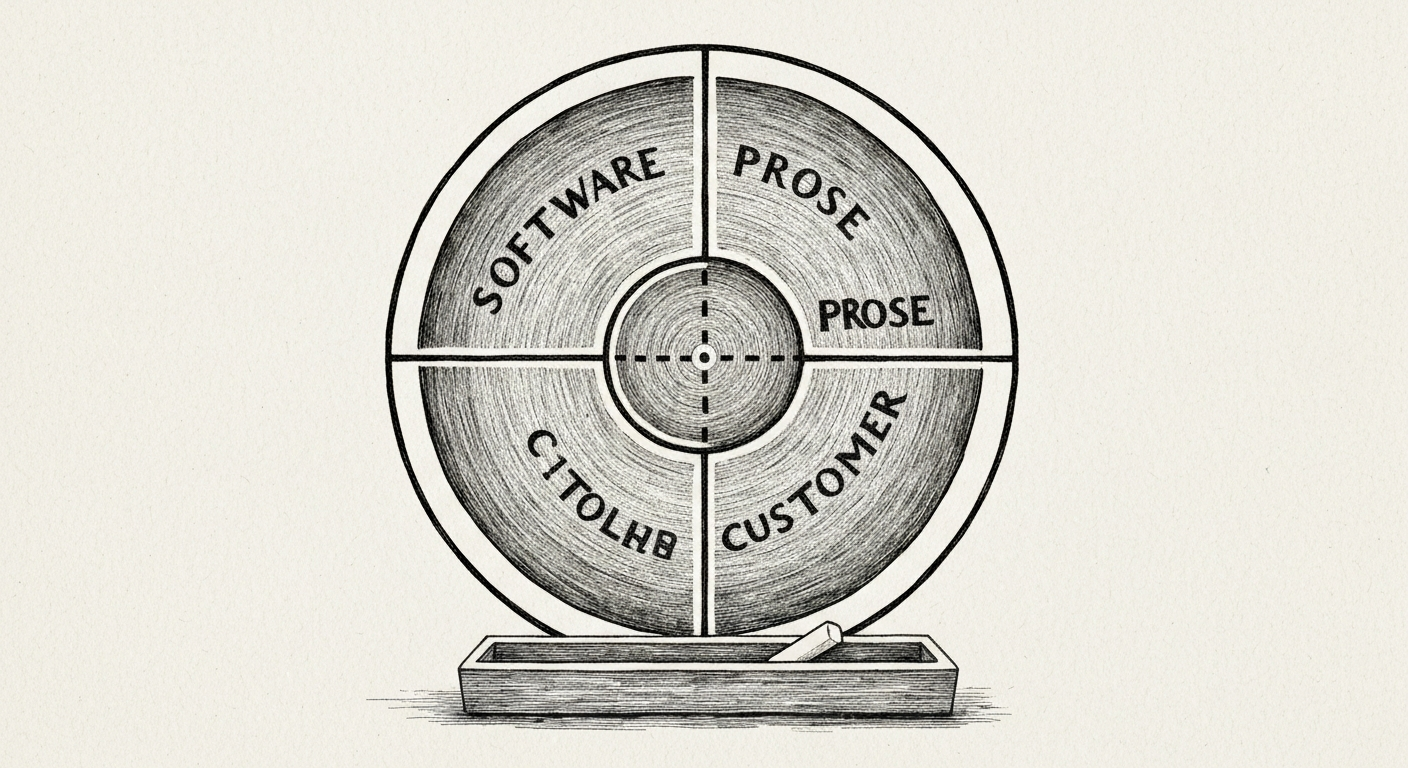
This is where the story becomes honest, which means it stops being a victory.
The two companies still run as separate workflows. Great Minds Agency builds software and ships it. Shipyard AI builds Emdash sites from PRDs. Both are autonomous within their domains. Twenty-two PRDs have been shipped through the daemon pipelines as of April 9, on top of five products that predated the daemons, plus the infrastructure that supports them all. The man's notes are clear about this number, because the number was supposed to settle the question and it has not.
What has not yet been tested is the full sequence: software built by Great Minds, marketing prose written by Great Authors, demo video produced by Great Filmmakers, customer found, sale made. The trilogy is positioned to enable that sequence. The two companies are positioned to participate in it. But the closed loop — software, prose, video, customer — has not yet run end to end without the man's hand in it somewhere.
That is the test about to begin. The next time a Great Minds engagement produces a shipped product — LocalGenius's next feature, perhaps, or a fresh deliverable from Shipyard — the plan is to hand the artifact to great-authors for the launch copy, then to great-filmmakers for the demo video, and then to release it into the world without the man writing a sentence or cutting a frame. The agents will name the price, write the email, render the video, post the announcement. The man will read it. The man will read whether anyone bought it.
How this essay was written
The essay you are reading was produced by the trilogy it describes.
A first draft was written by Joan Didion — that is, by a Claude Code subagent dispatched against the persona file at great-authors-plugin/agents/didion-persona.md. The first draft read as a tour of an architecture rather than a story, and the man at the desk said so. A second pass was edited by Robert Gottlieb — the persona file at great-authors-plugin/agents/gottlieb-persona.md. He added section titles, surfaced links, and cut two sentences he believed the reader did not need. The result was better but still wrong: the journey was missing.
The third draft was written by John McPhee — the persona file at great-authors-plugin/agents/mcphee-persona.md. He was given the full research dossier from a brain vault on the man's hard drive, the live websites of the two companies, the GitHub timestamps for thirty-some repositories, and a structural brief that proposed a braided shape. He read everything first, named the shape on a notional napkin, and wrote the piece you are reading. He chose the title. He chose the eight section headings. He ended on the desk.
The man at the desk read the result and changed nothing in the prose. He added repository links the writer had named but not linked. He pushed the commit.
You are reading a post about an autonomous office, written by the autonomous office.
The desk
The desk faces a window that looks out on nothing in particular. The laptop is open. The directory .claude/agents/ is open in a tab beside it. There are forty-four files in the directory now — thirty-six with biographies, eight without. None of the people the named files are named after know any of this is happening. None of the unnamed files have anyone to know.
On the second monitor, a tail of /tmp/greatminds-daemon.log scrolls past in pale gray text. A new line appears every few seconds. A pipeline is consuming a PRD. Somewhere on the droplet at 164.90.151.82, the Maintenance Crew has just finished its quarter-hourly pass and reported, in a sentence written by a small model and read by no one, that everything is fine.
The man closes the laptop. The lights stay on. The daemon keeps eating.
Seth Shoultes builds things at garagedoorscience.com and writes about them occasionally.