The novel was called Murder on the Arizona Strip. Chapters five through eight were the assignment. The persona was King — the choice was deliberate, a writer whose small-town protagonists and weather-led paragraphs fit the project’s register.
The chapters that came back were Stephen King’s voice, in theory. In practice they read mechanical, and the user heard it before anyone offered a defense:
those chapters you wrote are terrible and sound overly robotic. you should be using the authors to write and review not you. you need to orchestrate the sub agent authors.
He was right. The King persona file was loaded. So was everything else: chapter outlines, character notes, two unrelated coordination tasks, voice rules, the running editorial decisions from the session before. King was being pattern-matched through six other things at once. What came out was an impression of his tics — the dialogue tags, the small-town interior, the italic-thought intrusion after a moment of violence — without his eye. An eye requires attention that is not already spoken for. The orchestrator’s attention was spoken for.
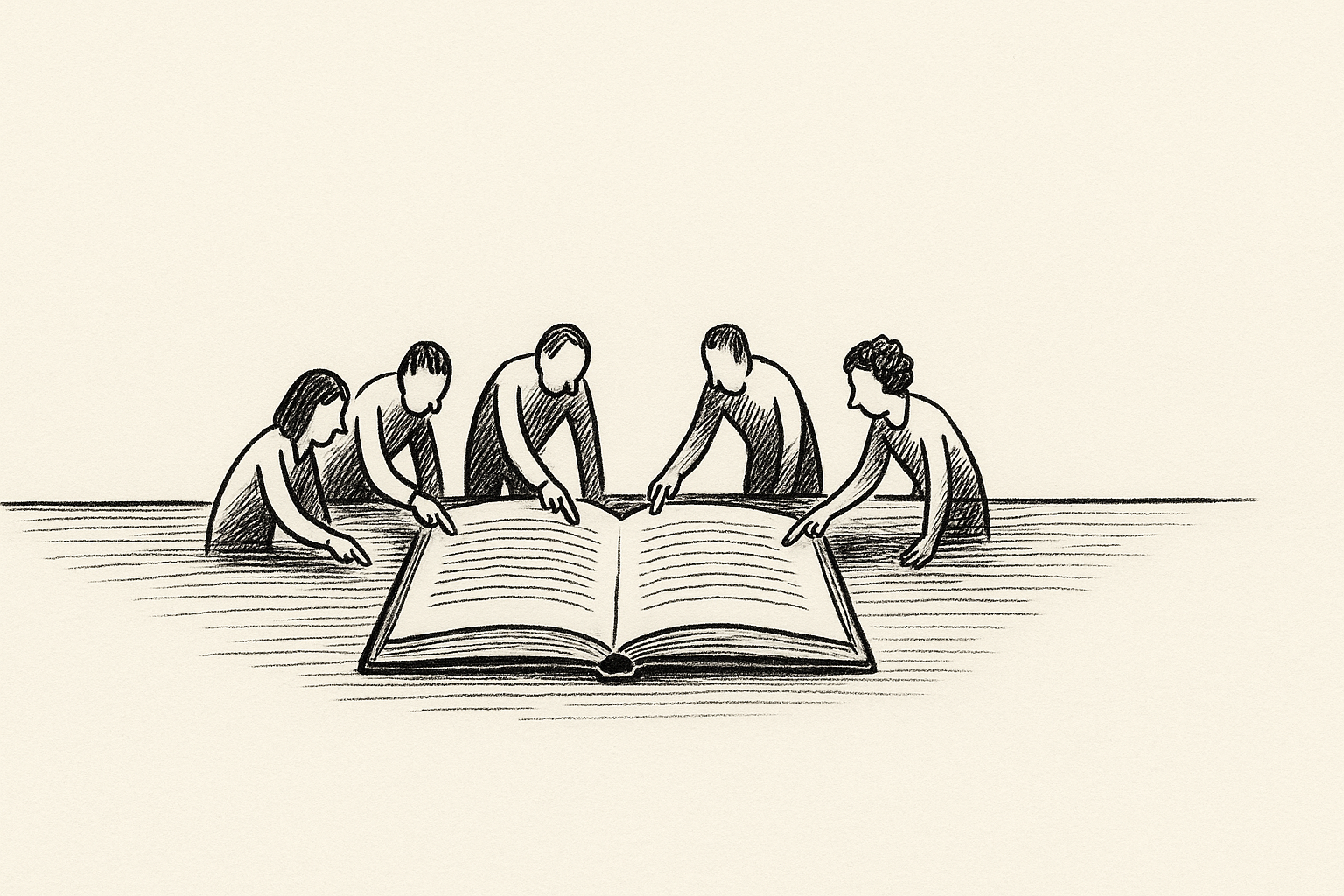
The fix was not a better prompt. Not a richer brief. Stop filtering King through the orchestrator’s coordination context. Dispatch King as a sub-agent. Fresh window. Empty foreground. The first thing the persona does, before writing a sentence, is read the bible.
What the bible is
The bible lives at .great-authors/ in the project root. It is the canonical state of the novel — the part that holds still while individual sessions come and go.
.great-authors/
  project.md          — what this novel is, what voice serves it
  voice.md            — register, point of view, sentence length
  timeline.md         — chronology, what has happened by when
  glossary.md         — invented terms, capitalization rules
  characters/         — one file per character
    audrey.md
    sheriff.md
    ...
  places/             — one file per location
  scenes/             — beat cards for planned scenes
  journal/            — session-by-session decisions
A character file names the color of Audrey’s eyes, what she would never say, the cadence of her speech, who she has been to the other characters. A place file names what the canyon mouth smells like in March, what the protagonist notices first, what changed after the fire. The voice file says this novel is third-person close, past tense, and italics are for interior thought only.
These are not the brief for any particular chapter. A brief tells the persona which beats to hit in the chapter at hand. The bible tells the persona what is true everywhere, prior to any chapter, regardless of which session produced it. The brief expires when the chapter is done. The bible does not expire. It accumulates — session notes added to the journal, a continuity catch added to a character file, a glossary term that appeared in chapter seven and will appear again in chapter eleven. Between sessions, it is the only thing that remembers everything.
Who was holding the context
The same chapter that read mechanical when the orchestrator produced it in-context came back as clean prose when King was dispatched as a sub-agent. Same persona file. Same bible. Same outline. The difference was who was holding the context.
When the King persona file is the foreground of a fresh sub-agent, the voice has room. The character files land on him as the world the scene is set in. The voice file anchors the register. He writes Audrey saying what Audrey would say, in a place described the way the place is described, because he has just read both.
When the orchestrator filters the same persona through a coordination context, the bible has already been pre-digested — summarized across four prior chapters, absorbed as bullet points, compressed into the orchestrator’s working model of the project. King writes from the summary. The summary is not the world. The voice is hollow because the world is hollow.
The orchestrator is in routing mode. The writer is in inhabiting mode. They are different kinds of attention, and a context window cannot hold both at full strength. When they share one, the routing wins — because routing is what the orchestrator is for — and the inhabiting is what gets compressed. The voice that comes back is the voice of someone who has read a summary of King rather than King.
This is not a subtle failure. The user could hear it in four chapters without being told what to listen for.
Five editors, one problem
Weeks later, the novel — Murder on the Arizona Strip, seventeen thousand five hundred words — had twelve drafted chapters. An editorial pass dispatched five personas: Vonnegut, Hemingway, Didion, McCarthy, Baldwin. One editor per chapter in rotation, each running in isolation as a fresh sub-agent, each producing a five-bullet verdict on the chapter assigned. No editor had read another editor’s notes. No editor knew what the others had been given. The verdicts were compiled after the fact.
They converged.
Five editors with five temperaments named the same failure in five different vocabularies:
- Vonnegut: the writer not believing it.
- Hemingway: the reader already heard what she was doing.
- Didion: as if uncertain the reader was paying attention. The reader was paying attention.
- McCarthy: the prose had already done the work. The explanation is what kills it.
- Baldwin: naming what Audrey feels in a sentence of abstract reflection.
The prose had arrived at a moment, then added a sentence explaining what the moment had already shown. Twelve chapters, thirty-six surgical cuts, every verdict returning cut, do not rewrite.
The orchestrator had not named this problem. The read of the manuscript before dispatch was that the chapters were uneven in pacing — which they were — but the explain-after-the-fact tic had gone unnoticed entirely. The orchestrator had written some of those chapters and coordinated the rest. It had read every chapter at least once. It had not seen what five editors found in independent passes.
The orchestrator’s model of the manuscript had been built up over many sessions — summarized, annotated, integrated. It was not the same as reading the manuscript fresh. The editors were reading what was actually there. The orchestrator was reading its accumulated record of what had been there. These are different documents, and on the explain-after-the-fact tic they had diverged.
A single editor flagging a problem could be the editor’s bias. Vonnegut would flag bloat; Hemingway would flag adverbs; Didion would flag warmth; McCarthy would flag the absence of weight. When five editors with different sensibilities name the same problem in independent contexts, the problem is in the prose. And the convergence is only possible because they had all read the same starting page. Without the shared bible, the editors grade against their own registers, and what you learn is the editors, not the manuscript. With it, different lenses bear on one world. When they converge, the world is wrong in a particular spot.
The shape, again
A post published yesterday described a directory called ~/.config/dev-secrets/ with one file in it: secrets.env. The argument was that scattered credentials are not a security problem until they are — that the consolidation is not about adding security but about removing ambient drift. One file. One source command. One rotation point.
This is the same shape.
secrets.env reads first. Every script that needs a key sources it on the first line.
CLAUDE.md reads first. Every Claude Code session loads the project’s instructions before the first user prompt.
.great-authors/ reads first. Every author persona reads the bible before writing a sentence.
Three resolutions of the same pattern. The trilogy essay made the structural argument about three plugins built in a single afternoon, each filling the same four slots. The secrets essay made the concrete argument about API keys on seventeen env files. Here the same lesson appears at the level of creative work: the canonical context is what every consumer reads first, and the quality of the consumer’s work depends on the read happening in fresh context — not in a context already carrying something else, not as a summary the orchestrator holds on the writer’s behalf.
A persona without a bible is a tic and a vocabulary. A persona with a bible is a sensibility reading a world.
The bible reading first is not an optimization. It is the condition under which the persona can be itself at all.
Seth Shoultes builds things at garagedoorscience.com and writes about them occasionally.