Chapter 5
Hurricane
She woke at four-twelve.
Not the alarm. The alarm was set for four-thirty, and these eighteen minutes were hers — not a gift, not rest, just the space between sleep and the next thing she had to do. She lay still on her back and listened. The house settling in the cold. The refrigerator running through its cycle. The cottonwood in the backyard that her mother had planted the year Audrey left for Vegas, which was now thirty feet tall and never quiet when there was any wind at all, and at four in the morning in late November there was always wind.
She got up. She didn’t turn on the bedroom light.
In the kitchen she turned on the under-cabinet light and stood at the counter and watched the coffee maker run. The light was small and yellow and made the kitchen look like itself at this hour — not a place where someone was awake, just a place where a light had been left on. The construction trucks hadn’t started up Bluff Street yet. It was too early even for that.
She poured the coffee into the mug — WORLD’S OKAYEST DEPUTY, the sister’s gift, the joke that had stopped being one — and stood at the table instead of sitting down in her chair. She did not sit down. The chair across from hers had her jacket on it the way it always did, and the two chairs together at the small table made a shape she wasn’t ready for at four-twelve in the morning. She stood at the counter.
She thought about Linnea Aspen. She had played back what the woman had said on the phone — if I’m not there you’ll know because I won’t be — enough times now that it had gone smooth from handling. A woman who had thought a thing through completely before she said it. Who had built the shape of every possible outcome before she opened her mouth. Audrey recognized the habit because it was hers too, the Vegas habit, the thing you learned when a wrong choice at an apartment door meant somebody died. You ran the moves before you ran them. You lived in the plan before you lived in the room.
She rinsed the mug in the sink. She left the under-cabinet light on.
She was out the door at five-twenty.
The drive to Hurricane was State Route 9 west, then south through the wash country — an hour for forty miles, because the land in between required it. She took it at road speed. The Tahoe’s headlights picked up the road edge and dropped it and picked it up again. The November sky had not made up its mind yet about how much gray to allow.
The road was empty. No oncoming lights, no taillights ahead, just the Tahoe and the desert and the pale cut of the Virgin River Gorge to the north, its walls going from black to gray as the sky lightened. She found the cholla in the headlights and stayed with it — not silver the way people wrote about it, but a kind of rough dark that caught the light wrong, so each plant looked like it had been surprised. Then the BLM signs at the pullouts, the white on brown fading at different rates depending on which way each sign faced. She went through them one at a time and did not let her hands go still on the wheel.
South of the interchange the land changed. The scrub thinned and the washes crossed the road every mile or so, the cuts visible in the headlights, the road dropping into each one and climbing back out. This was the Arizona Strip’s northern edge — not the Strip proper, but close enough that you could feel the scale of it. The sense that the land was doing something on its own schedule that had nothing to do with the road, and the road was just a line someone had drawn across it and hoped would hold.
She went over the bridge at the Santa Clara River. She crossed into Hurricane at a quarter to seven.
The park was at 200 South and Main. She had mapped it the night before and she had the corner in her head, but she parked three blocks out the way she always parked — residential street, cul-de-sac, the single streetlight that wasn’t working. She sat in the truck for a moment after she turned the key.
The street was still. A dog somewhere, not close. The particular quiet of a small town at five before seven in the morning — the businesses not open, the schools not started, everyone either still in bed or on their way somewhere. She could hear her own breathing. She got out and walked.
Main Street ran north-south and the morning light came in from the east at an angle that put the west side of the street in the kind of half-shadow that made everything look slightly unconvinced. The hardware store. The barbershop. A gas station with its lights already on, the only lit thing on the block. She did not look at the hardware store yet. She looked at the end of the street and came down it at a deputy’s pace — unhurried, looking at nothing in particular, which was the same thing as looking at everything.
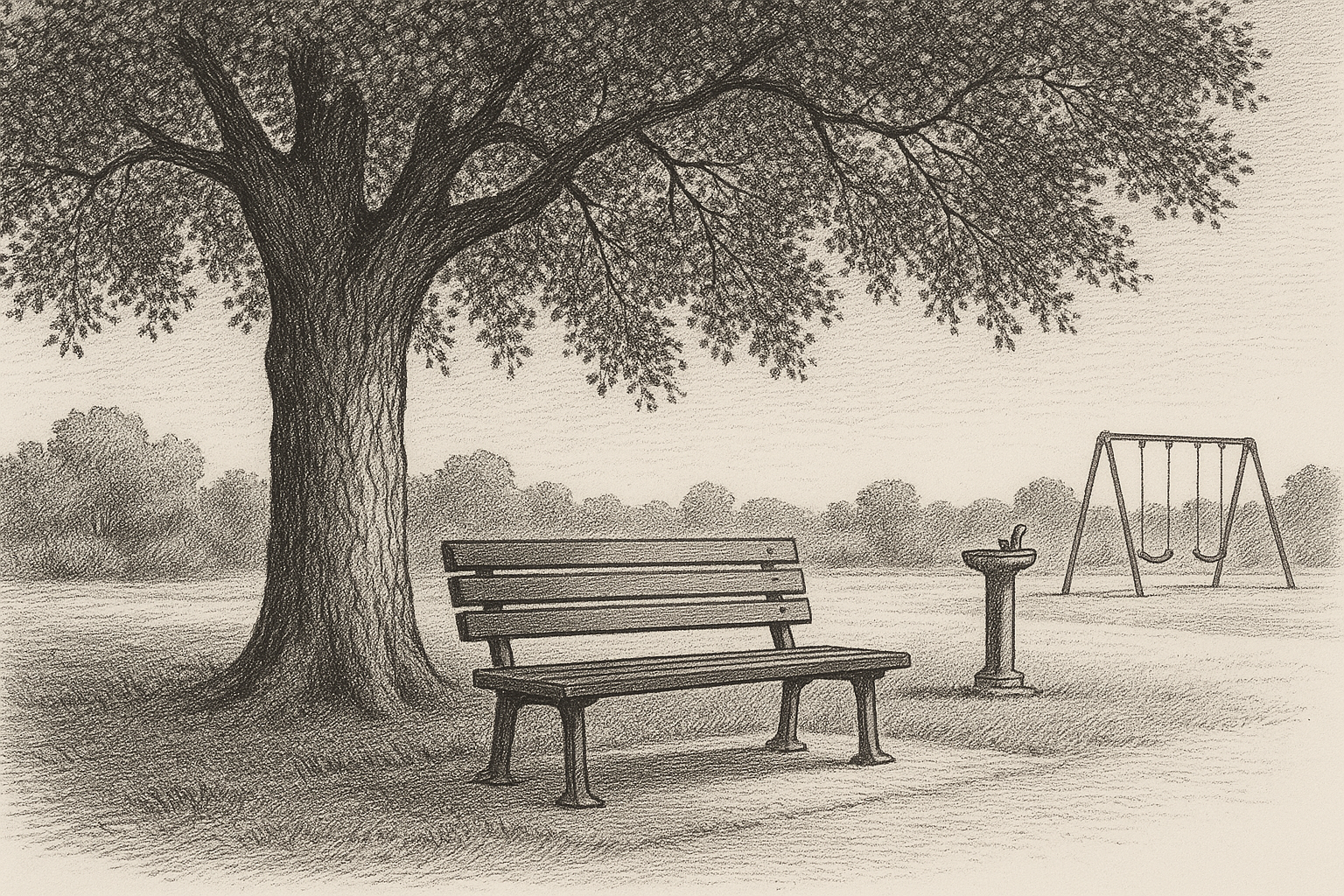
The park was exactly what Linnea had said: corner lot, two cottonwoods, a swing set and a play structure faded to old pine. A drinking fountain with a paper cup wedged under the spout by someone who had meant to come back. The November cold had the park to itself. The benches were wet with dew. The grass — what there was of it — had gone the color of straw.
The green bench was in the southwest corner, under the larger cottonwood. The cottonwood’s upper canopy was mostly bare now, and the morning light came through what was left of the leaves at an angle that made the light look like the idea of light rather than light itself — thin, scattered, doing its best. It was cold in the park. Not brutal cold, just the high-desert November kind that sat in the air and considered its options.
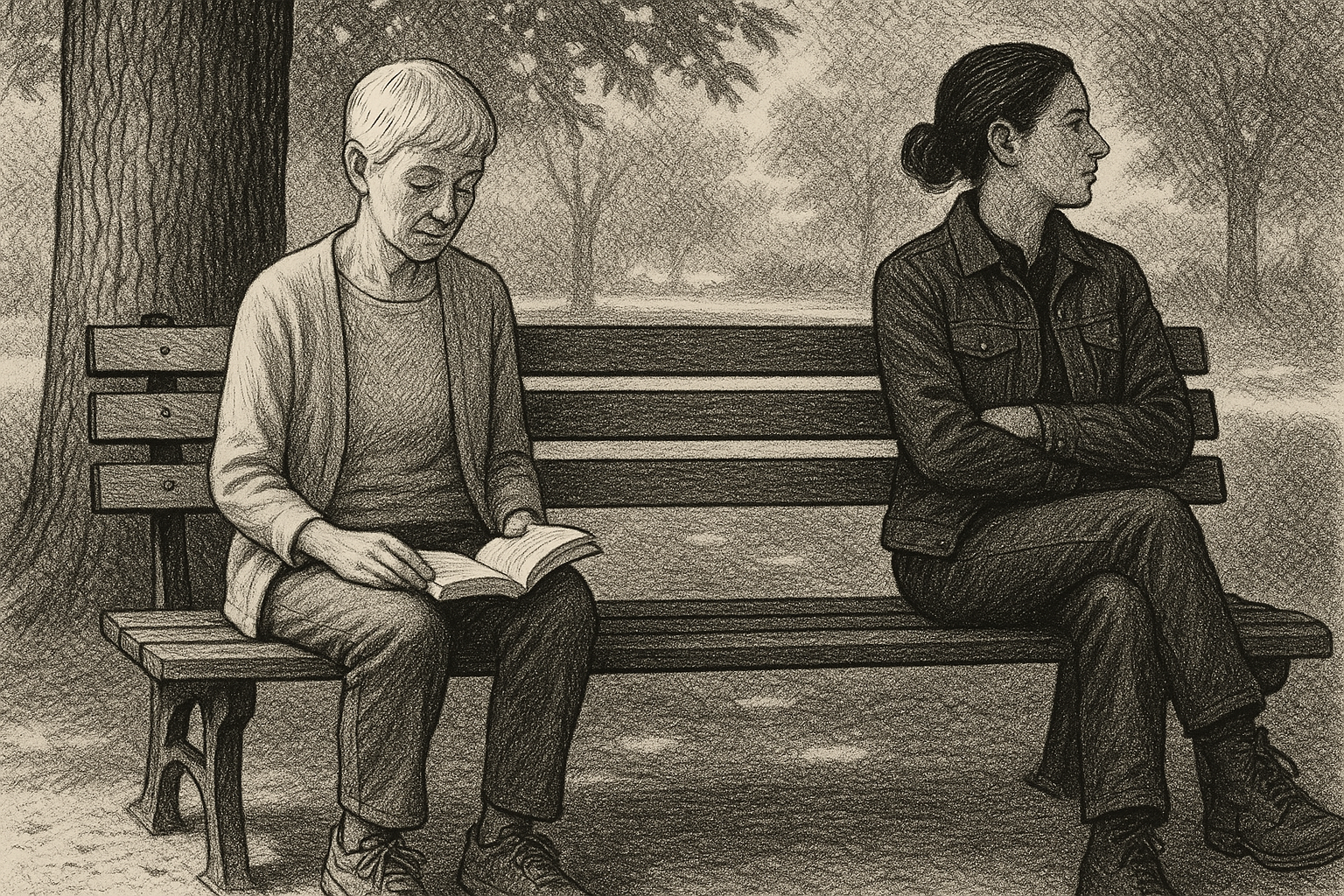
A woman of sixty-two in sneakers sat on the bench with an open book.
She did not look up as Audrey crossed the park.
A sparrow landed on the edge of the drinking fountain, considered the paper cup, and flew on.
Audrey sat down on the bench’s far end — enough room between them for a third person. She looked at the park’s perimeter. The corner she had come from. The entrance from the residential street to the west. The long sightline north along Main, all the way to where the street ended at the highway, which was two dozen storefronts and a parking lot and a space above the hardware store where the roofline changed. She found nothing to look at. She looked again. Empty lots were for people who were standing still. People moving didn’t look like people.
“Deputy,” Linnea said.
“Linnea.”
A car passed on Main. Silence returned. Linnea turned a page. She was not reading it.
“He’s chatty,” Linnea said. “The man with the dog. He comes through at seven-twenty and stays fifteen minutes at least. He knows me by name.”
“All right.”
“And there is a girl who runs the Main Street loop. Seven-ten, seven-fifteen. She runs without headphones. If she notices two women on a bench together she will not say anything because she never says anything, but she will notice.”
Audrey filed that. “Noted.”
Linnea turned another page. She was not reading it. “Did you have any company on the way in.”
“No.”
“You checked.”
“I checked.”
A pause. Not a teacher’s pause — something else. A woman who had learned to trust her own instincts against the evidence of a clear road and was still not satisfied. She set the book face-down on her knee.
“I have had the feeling,” she said, “for two days. It may be nothing. The last time I had it —” She stopped.
Audrey did not fill the silence.
“The last time I had it was five years ago, with Faith, and it was nothing. And Faith made it.” She picked the book back up. “Tell me that means something.”
“It means you pay attention.”
“It means I am sixty-two and I am possibly inventing a threat because a girl I cared for is dead and I want there to be someone watching. It could be either.”
“Yeah.”
“But you should know.”
“I know. Thank you.”
Another car on Main. A truck, diesel, running north. Audrey watched it until it was past the intersection and out of the sightline entirely.
“I have done this twice before,” Linnea said.
It was not the opening Audrey had expected — blunt, the way Linnea had answered the phone. She adjusted.
“Tell me.”
Linnea was quiet for a moment. The kind of quiet that wasn’t hesitation. She smoothed the cover of the book with the flat of her hand, one pass, and then she began.
“The first was eight years ago. A girl named Rebecca. Nineteen, same as Sariah.” A pause, not long. “She is twenty-seven now. She works at LDS Hospital in Salt Lake. She sends me a card at Christmas with a picture of whatever she is doing that year. Last Christmas it was a ski trip — Deer Valley, which is not a place anyone from her household ever expected to be, and she knew that when she chose it, and she sent it anyway.” Linnea’s voice was steady. But the way she held the book had changed — both hands now, not one. “I do not know what that picture cost her. I know what it is worth to me.”
She stopped. The park was quiet around them. A second sparrow arrived on the play structure’s peak, assessed the first sparrow’s territory, and landed one bar lower.
“The second,” Audrey said.
“Five years ago. A girl named Faith. She is in Phoenix. She does not send cards.” Another pause, and this one cost something. You could hear it without looking. “She is alive. I have a friend in Phoenix who knows her and tells me twice a year, when I ask. He does not ask me why I want to know. I do not explain.”
Both names hung in the cold November air. Rebecca, Faith. The names of girls who had made it. They weren’t said the way you said statistics. They were said the way you said names you have carried for years in a place where no one can see you carrying them.
Audrey understood, in the way she understood things she had not been told, that this was the first time Linnea had said these names out loud to someone who could fully hear them. Not to her son in Salt Lake, who didn’t know. Not to the woman in the book club, who suspected but hadn’t asked. To her. This deputy she had spoken to on the phone for four minutes the night before and never met until eight minutes ago.
She did not say this.
“Both made it,” Audrey said.
“Both made it.”
“What did you do differently with Sariah.”
Linnea set the book on her knee. She was not looking at the book now. She was looking at the play structure, at the two sparrows, at nothing in particular. “Nothing. The plan was the same plan. The Cedar City shelter takes girls. The code words work. The timing on a Wednesday morning is the timing that gives the most room — shift change at the compound, mail delivery, the hour when there is the most movement and the most noise. I did nothing differently.” She looked down at the book cover. “The household changed.”
“What changed.”
“I have a guess. I will not call it more than that.” She smoothed the book cover again — both hands this time, the motion of folding a letter you are not ready to send. “There is a woman in the Jessop house. The second wife. Marva. She is forty-one. She has a daughter who will be placed within the year. She runs the household’s practical life. I heard about her from Sariah in a call about three weeks before —” Linnea stopped. Set the book flat on her knee. “Three weeks before. Sariah said Marva had begun standing in the laundry while Sariah folded clothes. Not speaking. Just standing. It was a new thing.”
“Marva found out.”
“I think Marva found out enough. I do not know how.” She looked up for the first time since Audrey had sat down. Her eyes were light-colored — gray-green, the kind that changed with the light. Right now they were tired and direct and not asking for anything. “I will not put that name on any official paper. You may write it in your notebook and take it with you and I will not stop you. I will not sign a statement and I will not testify to this in a courtroom. Not because I don’t believe it. Because if I make that name official, I am no use to the next girl.”
Audrey looked at her. “You’re protecting your cover.”
“I am protecting the work.” Flat. Not defensive. “Write it in your notebook.”
Audrey wrote it. Marva Jessop, second wife, 41. Daughter, 14, pending placement. She capped the pen.
“You mentioned a sister,” Audrey said. “In the call last night.”
Linnea was quiet for a moment. She looked back down at the book. “I said there may be a sister.”
“Tell me.”
“Sariah was careful for nine months. She did not slip. She did not tell anyone in that house. She knew what it would cost.” Linnea smoothed the book cover again — the same motion, both hands, the way you smooth a letter you are about to fold. “But she was nineteen, and she was three weeks from leaving, and she loved the younger girls in that house the way older sisters love younger sisters — not wanting them to see it, not wanting them to carry it, but needing them to know. There is always one. The one she needed to know.”
“A younger sister.”
“Yes. I think she said something small. Not a plan, not a date, not anything useful. Something small and true. I’m going to be all right. Or something like it. And I think a younger sister heard her say it, and understood what it meant, and said nothing. And I think Marva was close enough to hear.”
Audrey thought about the curtain in the upstairs window that Jared had mentioned — moving twice. She had clocked it when he said it and she had not written it down. She wrote it down now.
“Which sister.”
“I don’t know the names of all the younger girls. I know Sariah. I know Jared. The others I know by position, not by name. The sister who heard — she is young. Thirteen, maybe fourteen. She is sitting in that house this morning.” Linnea set the book flat on the bench beside her, face down, no longer pretending. “She is not sleeping.”
“No,” Audrey said.
A silence opened between them that neither woman moved to close. The cottonwood overhead was shaking its upper branches in the wind that came off the hills at this hour, and the light through it was the new-morning light — thin, shifting, coming through bare branches instead of leaves, so it moved on the ground like something that had not made up its mind. The two sparrows had both left.
She thought Linnea Aspen had been carrying a version of this weight alone for nine years. The names in the cards and the names of the people who didn’t send cards. The morning walks to this bench with a book she was not reading. The book club and the lying and the woman who was adding something up that did not come out even.
She did not say this.
“The work you’ve been doing,” Audrey said. “Rebecca, Faith, Sariah. No one knows.”
“My son in Salt Lake does not know.” Linnea picked the book up. “The woman in my book club — we read last Thursday, she chose the book, it’s very good — she suspects something. She does not know what. She looks at me sometimes and she is adding something up that does not come out even. She is a good woman and she will not ask me until she does, and when she does I will decide what to say.” A pause, brief. “I have not had a friend in this town for nine years that I have not had to lie to. You are the first person I have told the truth to since before I started.”
Audrey sat with that.
“Does that feel different,” she said.
“Yes. Worse.” Said simply, without complaint, the way you say the road is wet. “I expected relief. There isn’t any. There is just — you knowing.”
“That’s usually how it works.”
“Is it.”
“Yeah.”
Linnea looked at her for a long moment. The gray-green eyes. Sizing something up or setting something down — Audrey couldn’t tell which. Whatever it was, she took her time with it. Then she looked back at the park, at the empty play structure, at the cottonwood with its last few leaves.
“How long have you been doing this,” Linnea said. “The job.”
“Twenty-three years.”
“And before this case. When was the last time it felt like the right thing.”
The question landed clean, without apology. A teacher’s habit — the real question, not the polite one. Audrey thought of saying a while and did not.
“I don’t know,” she said. “I’ve been trying to find out.”
“Mm.”
The sparrow came back. It landed on the drinking fountain and looked at the paper cup and flew on.
Both women watched it go.
Linnea set the book in her lap. Not face-down this time — just in her lap, holding it the way you held something you had stopped needing to use as a prop.
She did not say anything. Neither did Audrey. The cottonwood moved overhead. The light through it moved with it.
“You said you’re not near the line,” Audrey said. “The line between going and stopping.”
“I’m not.”
“Even now.”
“Especially now. Sariah is dead and the girl in her house who heard her say I’m going to be all right is still in that house. The line is not a comfort. It is just a fact.”
“All right.”
Linnea said, very quietly: “Were you near yours. Before this.”
Audrey looked across the park toward the street she had come in on. The streetlight on the cul-de-sac that wasn’t working. The houses with their curtains still drawn. She looked at them for a moment — just looked, the way you looked at something when a question was sitting in the air and you weren’t ready to answer it yet and you needed your eyes somewhere.
Her hands were in her lap. She turned one over and looked at the palm.
“Some days,” she said.
“And now.”
“Now I’ve got a case.”
Linnea nodded. Not satisfied — but not pitying, either. She didn’t offer anything to fill the space around what Audrey had said, which was the right thing to do with it. “Yes,” she said. “That is what it is.”
Neither of them spoke for a while.
At seven-fourteen the girl who ran the Main Street loop came through the park. Maybe twenty-five, ponytail, green shoes, not looking at the bench. Linnea watched her go. When she was past the cottonwoods Linnea said, without turning her head:
“There is one more thing.”
“Tell me.”
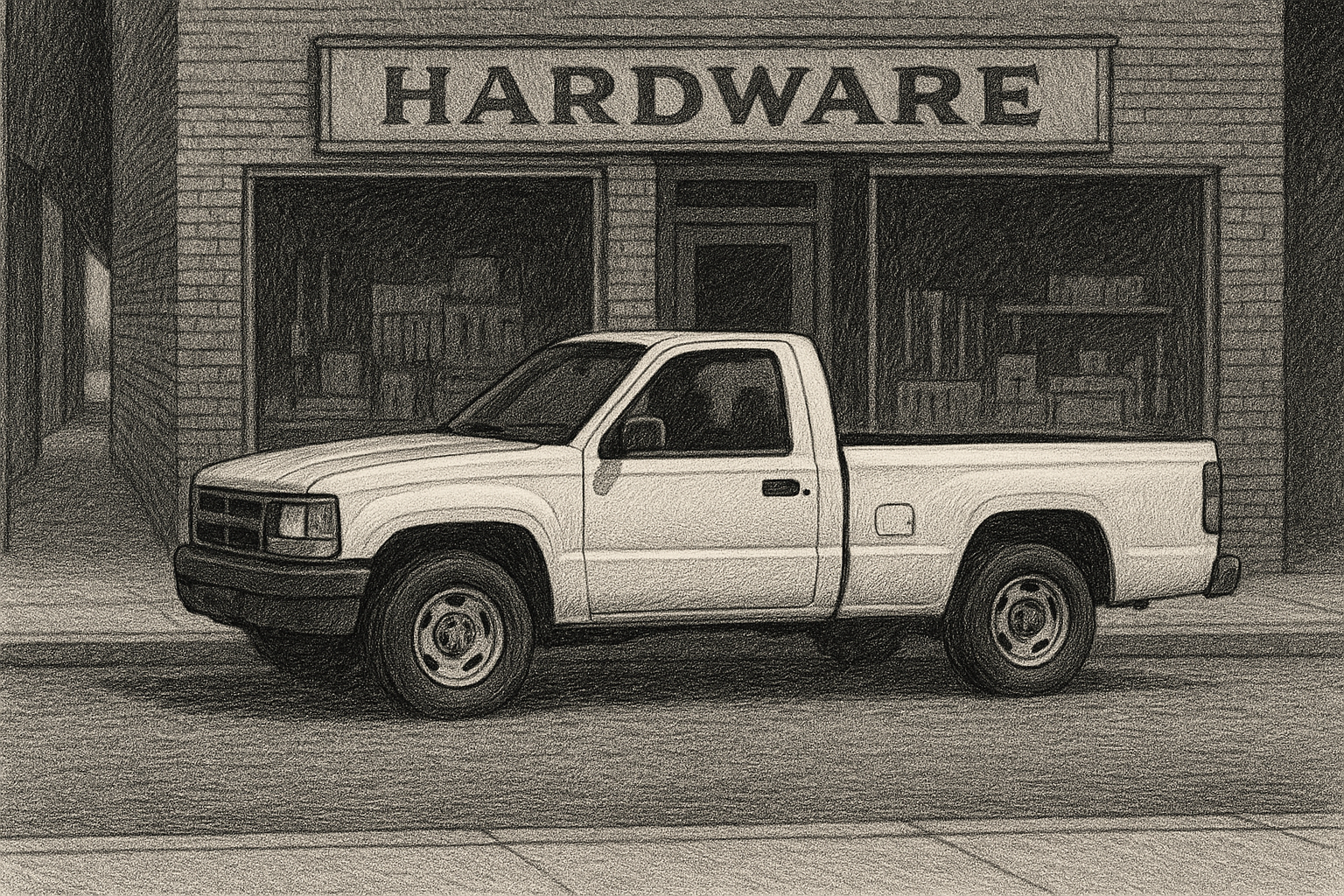
“I have been making the same walk every morning for seven years. The same park. The same bench. Same time.” A pause. “This morning, on my way in, I passed the hardware store on Main. There is a truck I have not seen before. Parked facing north, which is the direction you came from. It was there at six fifty-five. It was there when I sat down.” She turned the page of the book. Still not reading it. “It may be nothing. People park trucks in front of hardware stores.”
Audrey felt the change in the air — the particular quality of a park that has just stopped being just a park. She looked north along Main without making it look like looking. The long sightline. The hardware store was up there somewhere. Two blocks, maybe a little more.
“Make and model.”
“White. Full-size. Not new. I could not see the plate from the sidewalk. I was not going to stop and look.”
“Which side of the truck was facing you.”
“The passenger side.”
Audrey thought. Passenger side to the sidewalk, nose pointing north, parked on the east side of Main. Which meant the driver’s side was against the curb. Which meant anyone sitting in the driver’s seat was facing directly south. Down the length of Main Street, past the two-block gap, to the park entrance.
“Where on Main.”
“Two blocks north of here. In front of the hardware store.”
Which put the driver with a clean sightline directly south to the park’s entrance on Main. Clean enough that at this distance you would not be able to see two women on a bench under a cottonwood, but you would see everything that moved in and out of the entrance.
In twenty-three years you learned what surveillance looked like from inside the thing being surveilled. This was what it looked like.
“All right,” Audrey said. She stood. “I’m going to walk west along 200 South when I leave. Not back the way I came in.”
“Yes. That would be better.” Linnea opened the book to a new page — not the page she had been holding, a different one entirely, further back. As if she had finally found her place. “Go now. Don’t wait for the man with the terrier.”
Audrey went.
She did not look at the truck on Main as she crossed the intersection at 200 South. She looked instead at the hardware store’s window and in its reflection she found what she was looking for: a white truck, full-size, mid-nineties, a dent in the passenger panel. Behind the windshield a shape that was not moving and was not doing anything that would attract attention except being there. The cab looked empty from here except for that shape, but shape was enough. She had the angle and the sightline and the dent.
She did not slow. She did not speed up. She walked west on 200 South at a deputy’s pace for two more blocks. Then she turned south. Then east on the next residential street. She came around the block to the cul-de-sac from the north, reaching the Tahoe from the direction she had not come from.
She got in. She wrote the truck description in her notebook below Marva Jessop’s name: white full-size, mid-90s Ford, dent passenger panel, no plate visible. Below that she wrote the cross-street and the time and the sightline. Then she sat.
The pearl-white Silverado in the Jessop driveway — the one that had been absent on her first visit and present on her second, which she had noted and not followed — was a 2014. Newer than this. Different make. But the same general size, the same general color if you were looking at both through the approximation of a hardware-store window reflection.
She did not know if the truck was anything. She did not not know either.
She started the Tahoe on the first try. Sat thirty seconds, watching the street, the cul-de-sac, the unlit streetlight that was going to stay unlit.
Then she drove.