Chapter 6
The Note
The papers Hugh Pinney emailed her at quarter past eight were not a warrant. They were a request from Mohave County for assistance in a noticing-of-next-of-kin matter, and Hugh had drafted them in the particular way that legal language gets drafted when the drafter knows the document won’t hold up to a challenge and also knows there isn’t going to be one. Audrey printed two copies. She put one in her jacket pocket and left the other on the passenger seat where someone opening the door could see it without being handed it.
She was back on 700 West by eleven.
She came around the long block before she parked, the way she’d come the first time, because the second visit to a property like this one is always in conversation with the first. The Tahoe, the road, the time of day — all of it was information the compound was already reading. She parked in the same spot. She did not look at the upstairs windows of the third house.
She already knew someone was there. She had known it from the moment she turned onto the block and the shadows behind the lace in that window went still.
You didn’t look up. That was the rule she’d made in Vegas and kept here — any job where you were depending on women letting other women in, you didn’t look up at their windows any more than you’d look up their skirts. You looked at the door. You let yourself be seen looking at the door.
She walked around the side of the chain-link and through the gap in the fence to the side door of the middle house, because the front door was for official business and she was not here today as an official. She knocked.
She waited.
Behind the door a child made some small sound and someone else moved, and then the door opened.
The woman was maybe forty. A dark blue prairie dress. Hair pulled back so tight it pulled at the corners of her eyes. She did not say anything. She did not step back from the doorway.
“I have papers,” Audrey said.
She held them out. The woman took them. Read them the way someone reads a legal document when they already have a lawyer inside their head doing the same reading — slow, front to back, not commenting. She handed them back.
“You are here as a courtesy.”
“I’m here as the law.”
The woman looked at her. Not hostile. Not deferential. Measuring.
“I did not say I disagreed,” she said.
She stepped back from the doorway.
She did not invite Audrey in. She also did not stay in the way. Audrey understood: she was allowed to enter on her own recognizance and the household was not going to be recorded as having welcomed her. She stepped through. The door closed behind her.
The kitchen was larger than any kitchen Audrey had been in this year. Three gas ranges. Two refrigerators standing side by side like something official. A pine table long enough for a classroom. The smell of bread in the air and yeast underneath it and under that the particular smell of a household that has been running on grief for thirty-six hours and is not going to let it stop the bread.
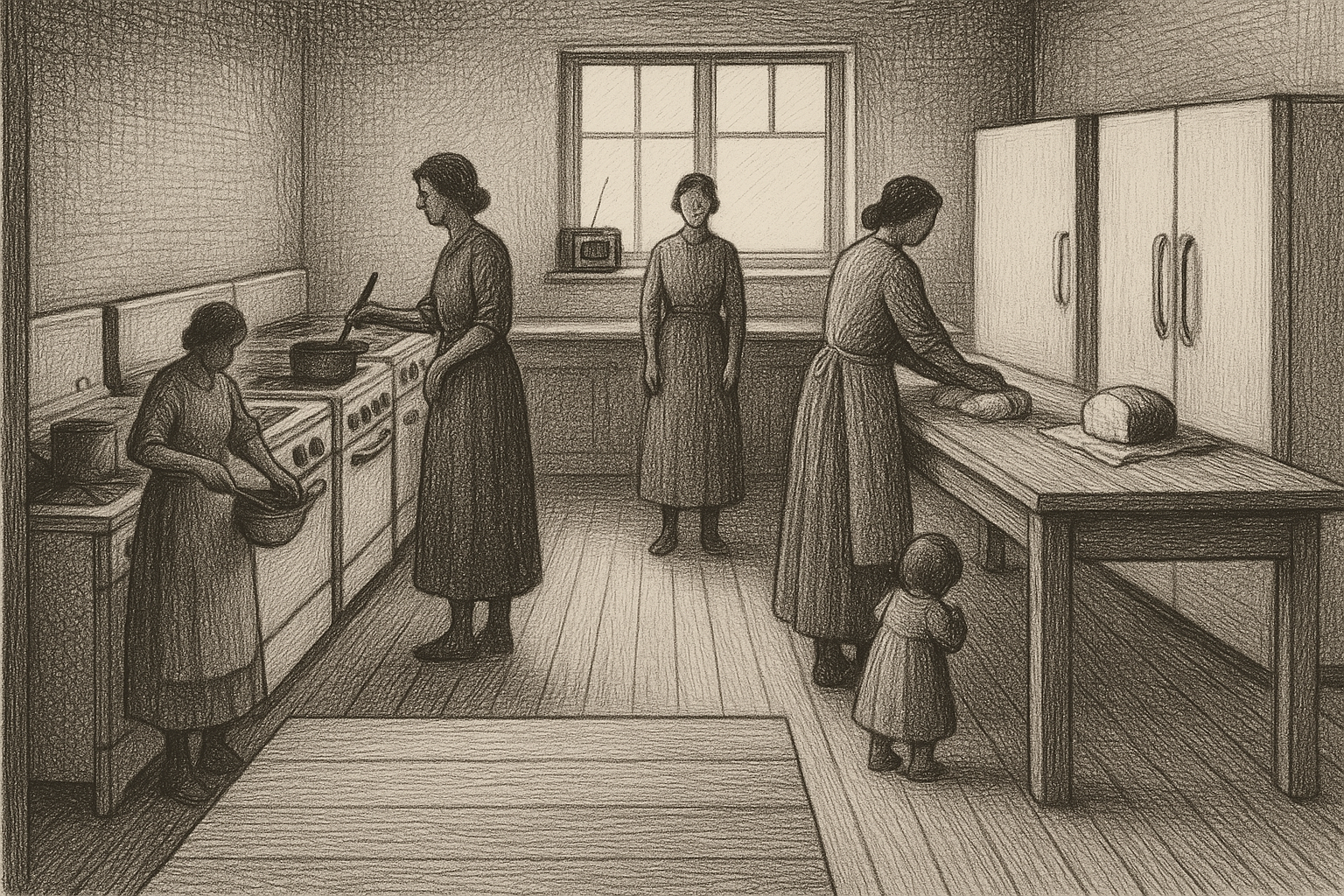
Two other women.
One of them was at the far counter — fifty or near it, her forearms working a ball of dough in a slow rhythm that had been going since before Audrey knocked and was going to go until the dough was done. She did not look up when Audrey came through the door. This was not a statement about Audrey. This was the dough.
The other was younger, late twenties, at one of the ranges with a wooden spoon in something brown and savory on a back burner. A toddler had both fists in the hem of her dress and was gumming a crust of bread and looking at Audrey with the frank animal attention of the very young. The woman did not look.
The radio on the windowsill above the sink was dark.
The first woman — the one who had let Audrey in — stood slightly forward of the other two, which was the arrangement the room had probably settled into the moment they heard the knock. She was the one who spoke. The other two were not going to be here, exactly.
“The senior wife is upstairs,” she said. “She will not come down. I speak for the household.”
“All right.”
“She is Sariah’s mother.”
“I understand.”
A silence that Audrey did not fill.
The woman’s eyes moved once toward the window, then back. “What do you have.”
“The body of Sariah Jessop has been identified. She’s in the custody of the Mohave County medical examiner. She’ll be released Friday. The county has arrangements for burial. There won’t be a bill. I’m here to ask whether the family wants to receive her, or declines.”
The kneading at the back counter didn’t stop. The wooden spoon in the brown pot went still for a moment, then resumed. Whatever the two women at the back of the kitchen were doing with their faces, they were doing it toward their work.
“The family declines,” the first woman said.
“All right.”
A pause. The woman’s chin came up a degree.
“This is not something we require other people to know.”
“I’ll record it. I don’t have to announce it.”
“There is a difference between recording and telling.”
“Yes.”
“We need you to understand the difference in practice. Not in principle.” She said in practice the way someone says a word in a second language they are more fluent in than the first. “People will ask. People from the church. The bishop. Family from Cedar City who haven’t heard. They are going to ask whether the household received Sariah for burial.”
“And you’re going to say the law had its own arrangements.”
“We are going to say the law had its own arrangements and did not require our consent. What your paper says is going to support that. We are asking you to not contradict it.”
“You’re asking me to keep a household appearance.”
“We are asking you to stay quiet about one thing you know.” Her voice didn’t change. “Surely that is not difficult for a deputy.”
Audrey looked at her.
“No,” Audrey said. “It isn’t.”
The woman walked her back to the side door. She did not speak to the other two women as she passed them and they did not look up. The woman in the dark blue dress opened the door, and Audrey went out, and the door closed before Audrey’s second step.
She walked toward the gate.
It was eight steps from the side door to the latch on the chain-link gate. Audrey took the first three at the pace of a deputy leaving a property with nothing accomplished — measured, not hurrying — because whatever was happening in the windows of this compound Audrey was not going to be the person whose walk said anything. The compound had read everything she’d done since she turned onto this block. She was going to give it a plain, unhurried deputy’s walk back to the street.
On the fourth step a girl came out from behind the far corner of the third house.
She was small — small for a thirteen-year-old, which was what she was. Light-brown hair parted in the middle and braided down the back, the braid thick and neat, the way braids are when someone other than the person wearing them has done them up. A long-sleeved cotton dress. Sneakers. She walked at an angle that would carry her past Audrey and across the packed-dirt yard toward the laundry shed, and she walked it the way a person walks a path they have walked a thousand times, looking at nothing in particular.
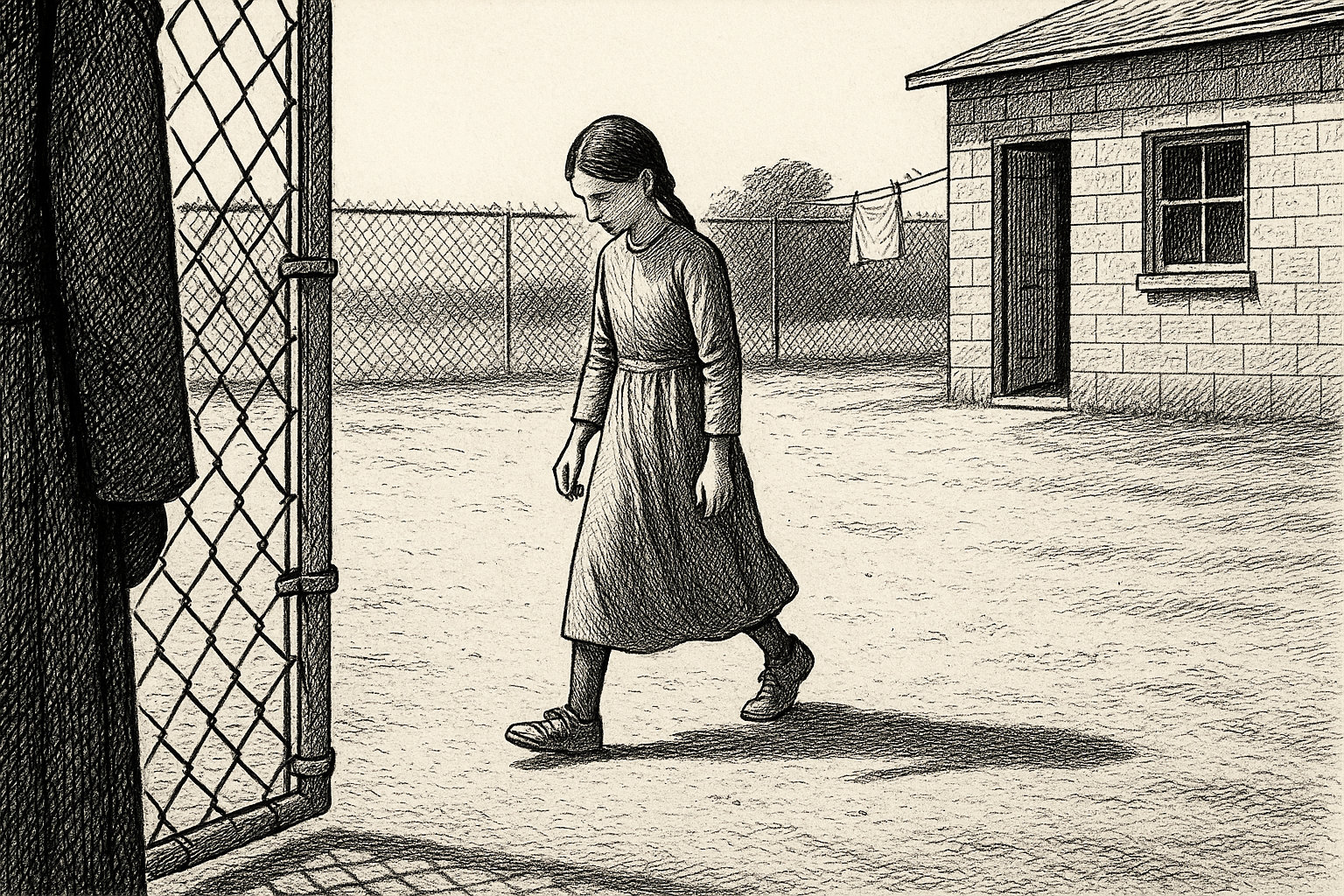
She did not look up.
She passed Audrey close enough to brush shoulders, if either of them moved an inch, and she didn’t brush shoulders, and as she passed she slid something small into the front pocket of Audrey’s denim jacket — the left one, the one Audrey never buttoned shut — in a motion so contained it could have been a fold in the fabric.
Both her hands went to the end of her braid in the same moment. She held it against her collarbone — both hands cupped around it, holding it to herself — for the three steps it took her to clear Audrey’s line of sight. Her eyes were on the ground the whole time. Then she let the braid go, and her hands went back to her sides, and she walked on toward the laundry shed without a backward look.
Audrey was on the seventh step.
She did not change her pace. She did not look toward the laundry shed. She did not reach for her pocket. She took the eighth step and put her hand on the gate latch and opened it and walked through and closed it behind her with the same care she would use on any gate belonging to anyone.
She got in the Tahoe. She pulled away from the curb without looking in the rearview at the third house. If there was still someone at that window, she was not going to give them her eyes.
She drove. Three blocks east on 700. Two south. One more east. Away from the compound in a route that was not a straight line, because straight lines were for people who hadn’t thought about who was watching. The streets through here were numbered and quiet and mostly empty in the late morning, which meant any car that followed her would have been visible inside a block. No car followed her.
She turned south on Center Street and pulled into the parking lot of a gift shop that was closed — shuttered, actually, the windows papered over, HOURS BY APPOINTMENT on a sign someone hadn’t taken down since they put it up. The lot was empty and the building’s back wall faced the street and there were no windows looking out onto the parking side.
She killed the engine.
The air in the cab was warm and close. Outside, the sun on Canaan Mountain’s face was the color it gets around eleven, when the shadows haven’t decided yet where they’re going. She sat with her hands in her lap for a moment.
Then she reached into the left front pocket.
A grocery receipt. Smith’s, by the logo, four months old, the thermal print on the face of it going pale where it had been folded — $43.18 in groceries, the itemized list gone faint. The receipt had been folded small and tight, the kind of folding you practice, and Audrey unfolded it slowly against her thigh.
On the inside, in ballpoint, one word. The hand was careful and young and had pressed hard, the way you press when you only get one chance.
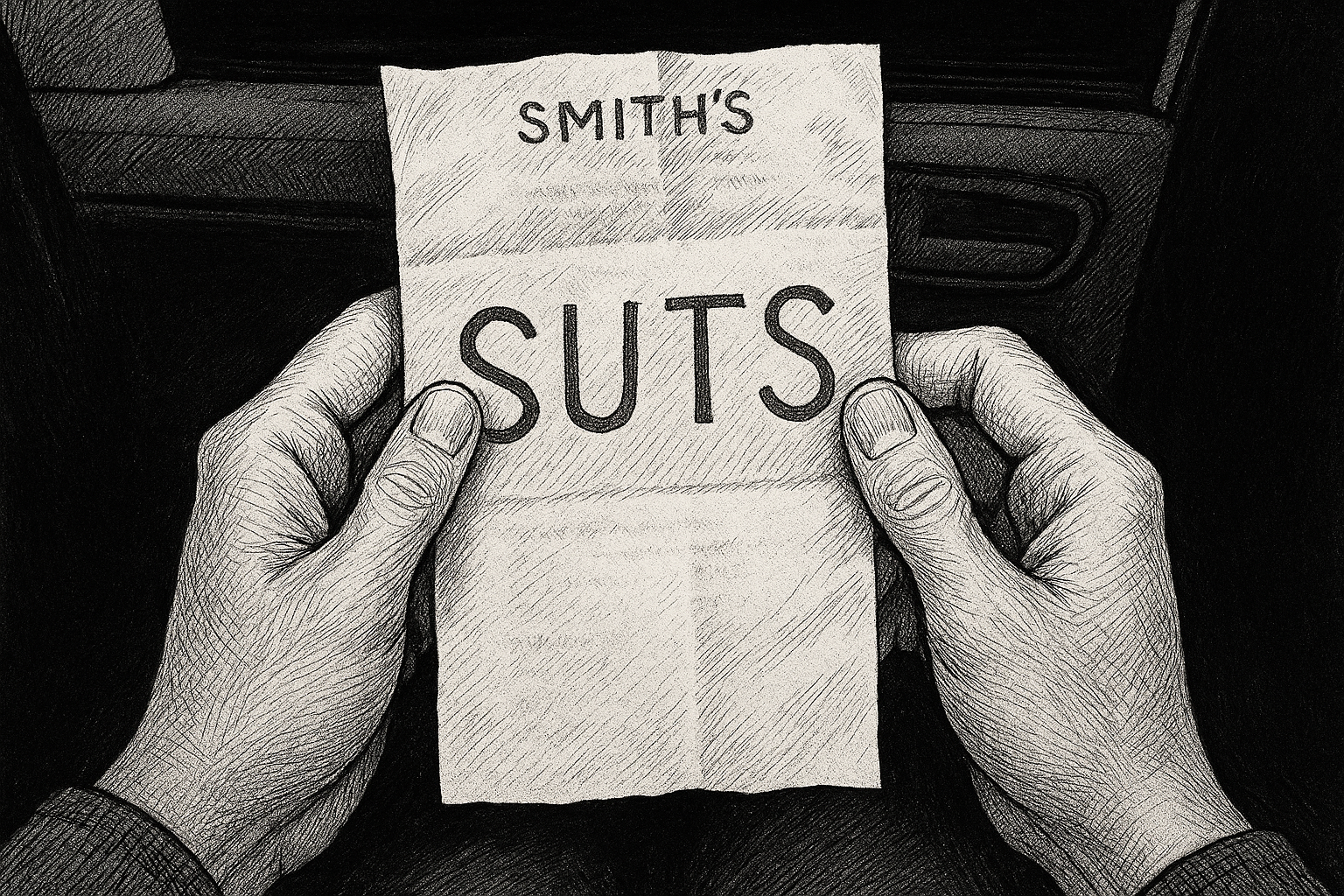
Marva.
She held the receipt.
Outside, someone somewhere on Center Street was running a table saw. A single clean keening that started and stopped and started again. Audrey sat with the word in her hand and the table saw going and the sun moving the way sun moves when you’re sitting still and time is doing what it does.
She had a name.
She had a thirteen-year-old girl who was still walking back to the laundry shed on that compound right now, both hands probably at her sides, and the note already gone, and her face arranged into nothing at all.
Audrey folded the receipt along its original lines. She put it back in her pocket. She buttoned the pocket.
She picked up her phone and called Hugh.
He picked up on the second ring. She said the name. He was quiet for a moment.
“I know the name,” he said. “Family services had a stop at that household in 2017. I’ve got the flag somewhere. Responding worker put a note in — said the woman of the house kept touching two fingers to her temple while she talked. Twice, like she was resetting something.” A pause. “Nothing came of it.”
“All right,” Audrey said.
She started the Tahoe.
The engine caught on the first try.