Chapter 8
Marva
Hugh got there at three-forty in the morning.
He brought a Mohave County deputy he introduced as Whittle — young, broad-shouldered, the kind of careful that comes from not wanting to be the one who messes up a scene. They worked the boot prints with flashlights, photographed the gravel, bagged Jared’s phone and the folded denim shirt from the passenger seat without discussing who had folded it or why. The boot prints went two miles east into BLM scrub, walking side by side for most of that distance, and then they didn’t — they ended at a leveled patch of gravel fifty yards off a two-track where another vehicle had been parked, probably for some time, the tires having pressed the small stones into a compressed rectangle that showed the weight. From there the gravel gave back nothing. Nothing in the brushline. Nothing at the edge of the track.
Whittle walked the perimeter twice and came back and said, “That’s a planned hand-off.”
“Yes,” Audrey said.
“Who graded that patch.”
“I don’t know yet.”
He nodded. He was not yet thirty. He had the look of someone running the math on what he was in the middle of and deciding it was over his head without making it over his head.
Hugh sent Audrey home at six.
She didn’t argue. She drove back to St. George in a state that was not quite sleep but not quite waking, the road and the dark working together in the way they do after the forty-hour mark. Bluff Street at seven in the morning was already loud — garbage truck on the corner, a woman with a stroller on the sidewalk, a kid on a bike she had to slow for. She parked and sat in the cab for a moment before she got out.
Inside, she sat on the edge of the bed and took her boots off.
She lay down on top of the covers with her jacket still on.
She was asleep before she had finished deciding to be.
—
She woke at twenty past nine.
No alarm. The light through the curtains was flat and direct and the temperature in the room had risen. She lay there for a moment looking at the ceiling, doing inventory the way a body does it when it’s had barely enough sleep to know what it’s missing — the particular ache behind the eyes that wasn’t pain yet, not exactly, but was auditioning for pain. Her throat was dry. Both hands had a faint tremor she hadn’t noticed the night before, or hadn’t noticed she’d noticed.
She sat up.
She drank a glass of water at the kitchen sink. She did not look in the mirror. She put on the same clothes she’d been wearing the night before, because the night before’s clothes were still the right clothes and there was no time for any other consideration.
She was in the records office at the Washington County Sheriff’s department by ten.
—
The fluorescent light over the records desk had been buzzing for as long as Audrey could remember working in this building, which was not long but felt longer. She spread the file in front of her, poured a cup of coffee from the communal pot in the break room down the hall — it was the late-morning pot, brewed two hours ago, the kind of coffee that would outlast the apocalypse — and she sat down and she read.
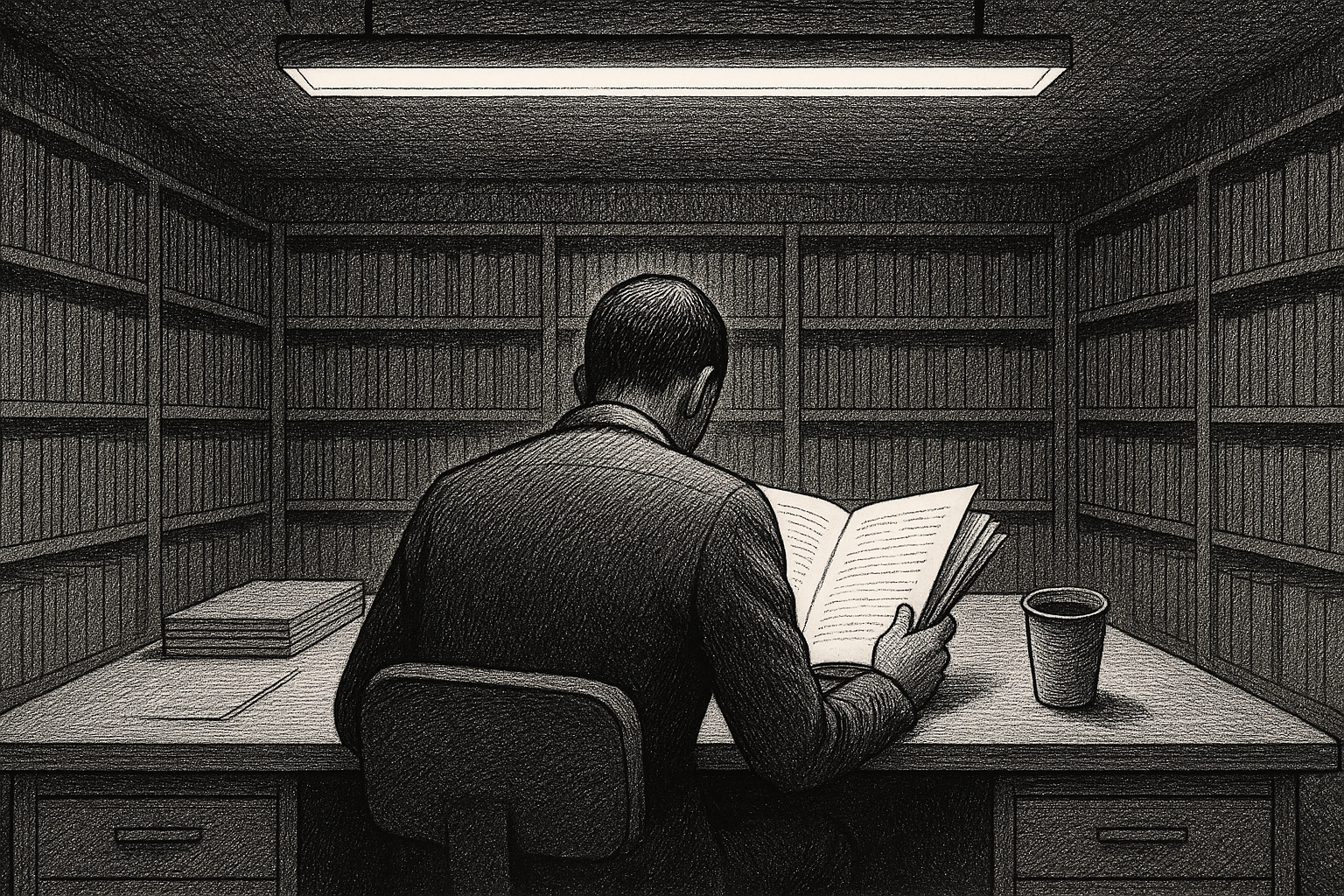
Marva Jessop, born February 1985, Colorado City, Arizona. Father Wendell, mother LeAnn. Married Brigham Jessop in November 2003. Second wife. No note on who the first wife was at the time of the marriage; Audrey would have to pull that separately. No criminal record. No traffic citations. Not a speeding ticket, not a parking fine, nothing. Audrey had known cops who put more paperwork into the world than that in a single month.
She turned the page.
One interaction on record with law enforcement — not Washington County. Mohave County, August 2017. A deputy named Tollman had taken her statement as a witness at a non-fatal vehicle accident on State Route 389. Standard form. Address, age, account of events. At the bottom, in the field where deputies wrote notes about witness cooperation, Tollman had written: cooperative and articulate.
Audrey read it twice.
She held a cup of terrible coffee and she thought about Deputy Tollman, who had probably been doing his job in an ordinary way on an ordinary afternoon and had written those two words because that was the positive end of the cooperation scale and the woman in front of him had cleared the bar. Cooperative. Articulate. Unusually composed, was what that meant. Answered every question I asked and didn’t volunteer anything I hadn’t asked for, was what that meant.
She did not write it down.
The Mohave County records package included a dashcam clip from the same stop — fourteen seconds, Tollman’s cruiser angled in behind a sedan, Marva standing at the passenger door while a second deputy worked the driver’s side. The clip was low resolution, the timestamp burned into the corner. At the eleven-second mark Marva turned toward Tollman with something to say, and before she spoke she lifted her right hand to her temple — once, twice — then lowered it. Answered the question. Audrey watched it twice. She did not know what it meant. She kept reading.
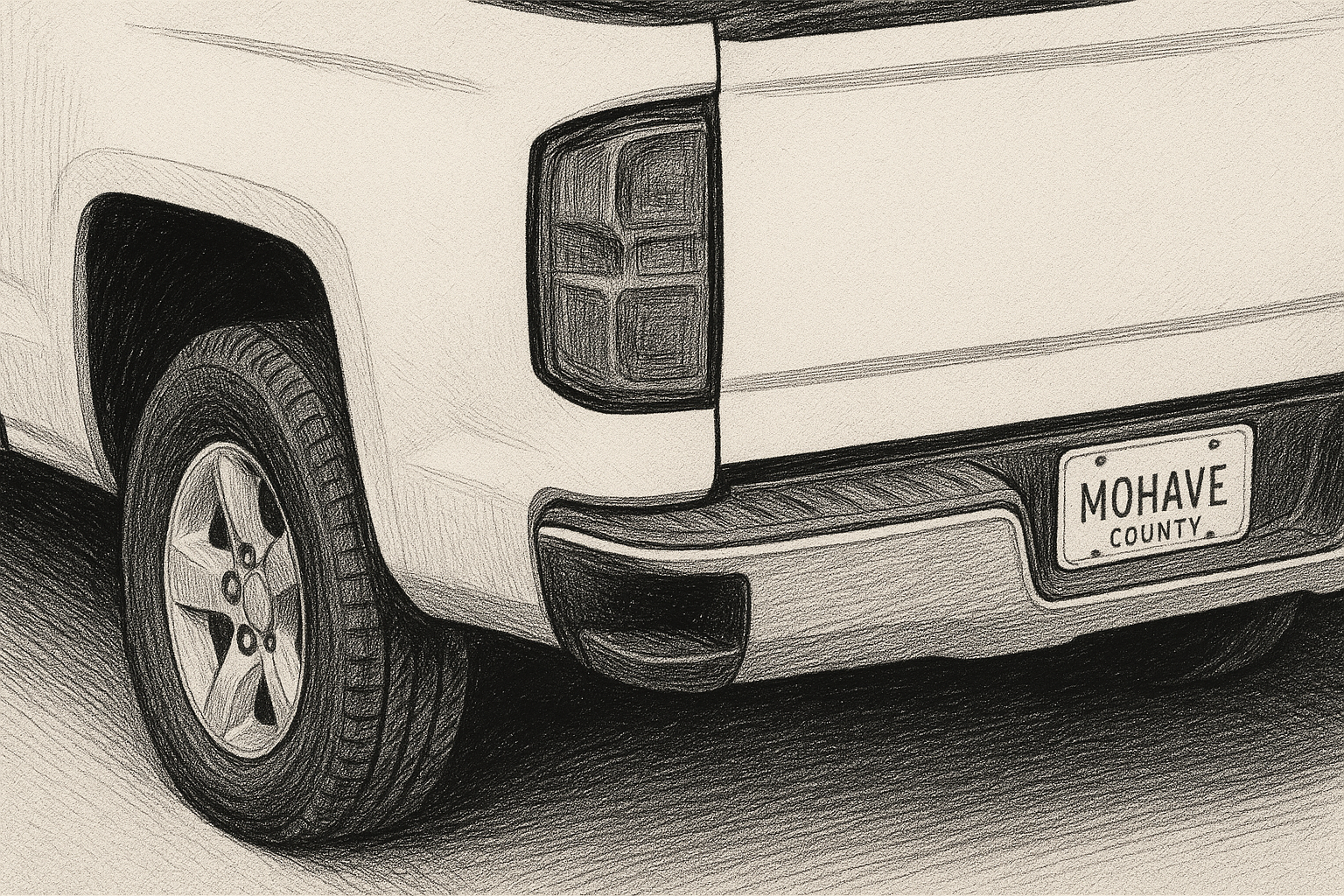
Marva’s driver’s license was current. Her registered vehicle: a 2014 Chevrolet Silverado half-ton, Mohave County plates, pearl white.
Audrey stopped.
She thought about the Silverado in the Jessop driveway on her second visit — the one that hadn’t been there on her first. The Mohave County tags she’d clocked and filed away. Pearl white.
She wrote the plate number down.
Then she wrote the date of the second visit next to it, and the date of the first visit next to that, with a hyphen between them. The Silverado had not been there on day one. The Silverado had come back between day one and day two. She did not write what she was thinking about where it had come from. She wrote the number and the dates.
Then she pulled what the department had on the children.
Eleven of record. The household ran to Brigham and three wives — she pulled Ardeth first because Ardeth was the first wife, and the document confirmed what she had half-registered on her visits: Ardeth Jessop, born 1975, one emergency-room admission at Dixie Regional in 2022 for a cardiac event, released, no further interactions with Utah medical records. The chart said she had declined further intervention at the time. That was not nothing. That was a woman who knew what she was choosing.
The oldest child of record was Sariah’s full brother Caleb, who had left the community at twenty and now lived in Las Vegas, presumably outside Audrey’s jurisdiction and certainly outside her current problem. The youngest was three.
Hannah was in the middle of the file. Hannah Jessop, born May 2012.
Audrey paused on that.
She wrote the date down in her notebook, separately from the other notes. Not because she didn’t know what it meant — she knew what it meant — but because writing it down was the way she kept herself from reading past it too fast. May 2012. Fourteen years and some months. She was old enough.
There was a notation on Hannah’s file — a community calendar entry that had been surfaced in a prior welfare check that Audrey did not have the full record of. The entry said: Hannah Brigham-Jessop, scheduled for placement, pending elder approval, target within the year.
The room’s buzzing light buzzed.
Audrey looked at the date of birth again.
She looked at the household structure — Ardeth’s declining health, Marva in the second wife’s position with the longest tenure at the domestic center of the house, already running the kitchen and the canning and the schedule and the other things that fell to the woman who had quietly taken over because the woman above her could no longer. She thought about what the word placement meant. Not abstractly. She had grown up in this town. She had been to Colorado City three times. Once at twelve, in the back of her father’s truck on a hunting trip that had taken them up through the Strip, past the town’s western edge. Once in her twenties on the way to the North Rim. And once six months ago, on her own, slow, the way you look at a thing you need to understand before you can explain it to yourself. She knew the word. She knew what placement secured and what it didn’t, and what it secured for a mother whose eldest daughter landed well.
She wrote three words in her notebook. She looked at them. She crossed out the second one and wrote a different one. She tore the page out, folded it, and put it in the front pocket of her jacket with the receipt.
She stood up from the desk.
She walked to the water cooler at the end of the room and drew a paper cup and drank it standing up, not fast. Her hands were still doing the faint tremor thing. She was not going to eat anything until this was over, which was a choice she had made before without deciding to and which her body was now annotating.
She went back to the desk.
She looked at the file for another few minutes. Not reading. Looking at the shape of it — the thin interagency record of a woman who had kept her head down for forty-one years in a community designed to keep heads down, and had done it so cleanly that the only deputy who had ever written a word about her had found her cooperative and articulate at the scene of someone else’s accident.
She closed the file.
She drove to Hurricane.
—
She had not called ahead.
She had not called ahead because Linnea had ended the last conversation with the cadence of a woman who was thinking past the next phone call, and something in that cadence had felt like a door already deciding to close, and Audrey had not wanted to push against it from a distance.
She took the 9 north into Hurricane, state street to 100 East, left on 200 South. She parked at the corner and walked the last half block. The neighborhood was quiet in the flat late-morning light — a dog somewhere in a back yard, a sprinkler two houses down running on the wrong schedule for November.
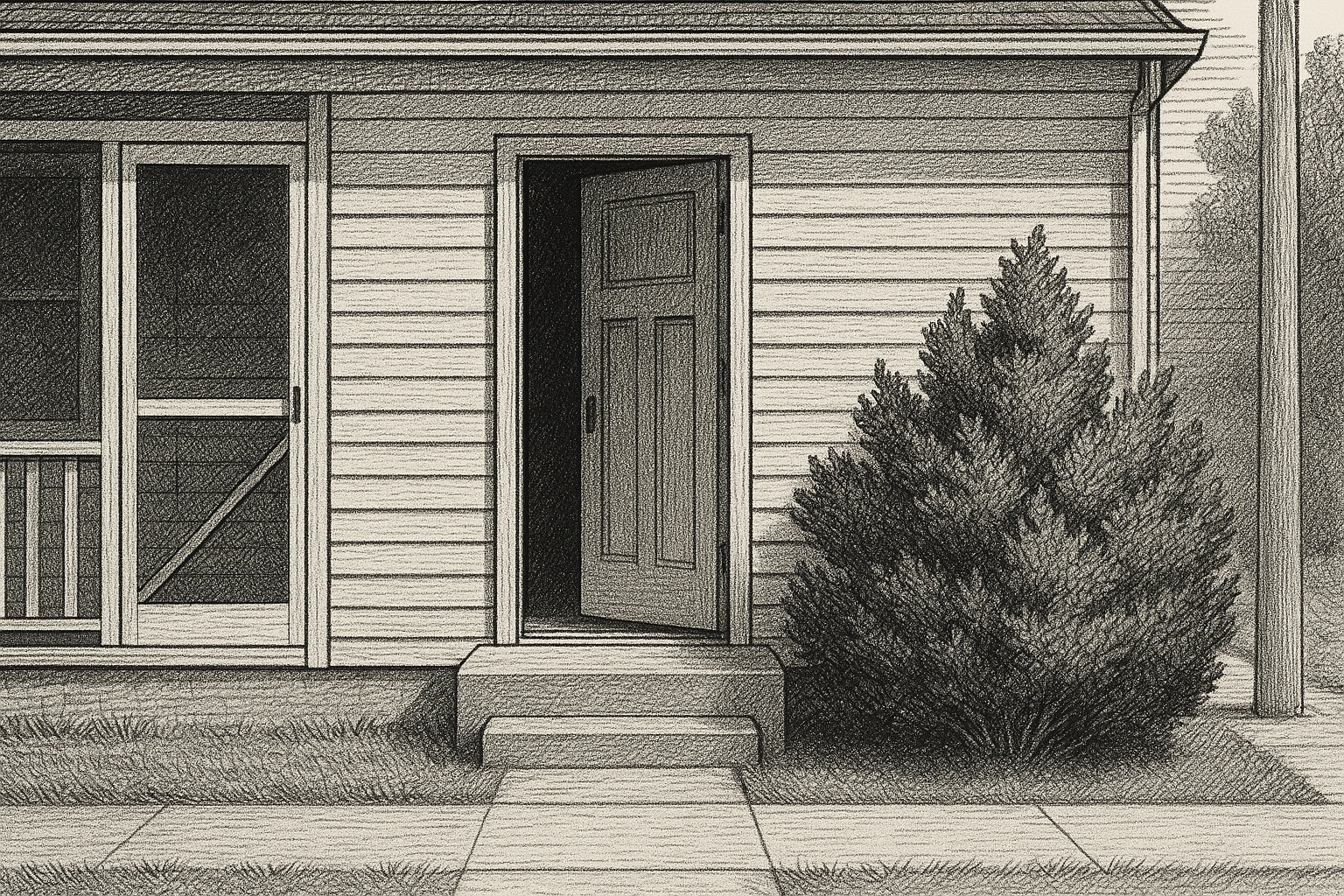
The house was a small yellow rambler. Screened porch. Juniper at the front step, the old kind that came up past the porch rail and smelled like something that had been there long before you arrived.
The front door was open four inches.
Audrey stopped on the sidewalk.
She did not approach. She watched the gap and she listened and she let thirty seconds go by without hurrying them. Nothing moved through the gap. No sound. No air. The juniper did not move because the air was not moving.
She drew her sidearm. She came at the door from the side and pushed it the rest of the way open with her left foot.
Inside: a careful kind of disaster.
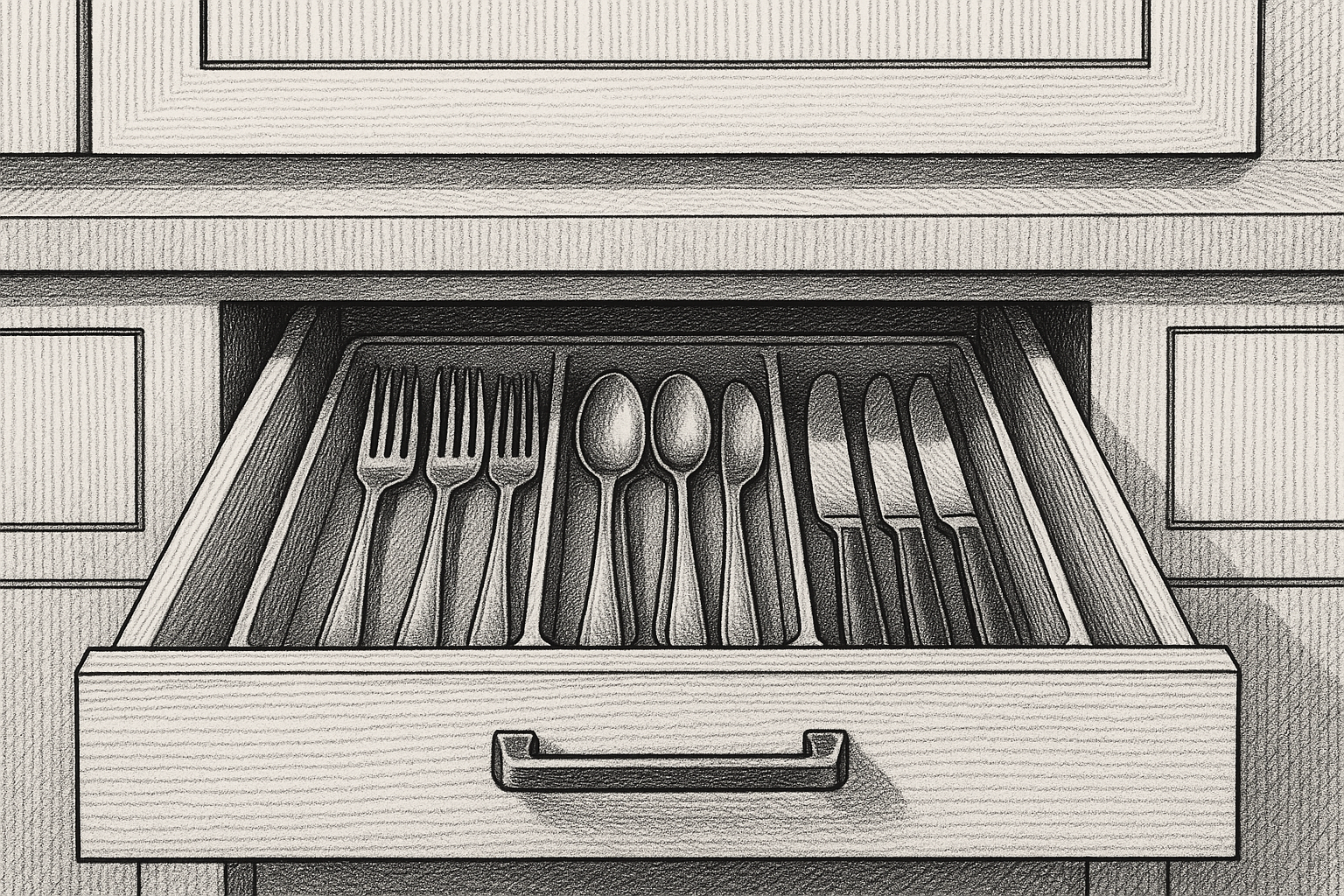
Books on the floor — not all of them, maybe a third of the front-room shelves, pulled out and stacked in three small towers the way someone would set them down if they wanted them found, not tripped over. The chairs at the kitchen table were out at angles, two of them, as if placed by someone who had thought for a moment about the geometry of looking wrong. The silverware drawer stood open exactly halfway. The refrigerator was open six inches.
No Linnea. The bedroom was ordered, the bed made, closet closed, bathroom untouched. The reading room at the back of the house was ordered too, except for a copy of Housekeeping lying face down on the desk, spine cracked in three places.
A Post-it on the cover.
Audrey read it standing up. Linnea’s hand — small, clear, the handwriting of someone who had spent thirty years writing things on blackboards for children to copy.
Audrey — gone to my son’s in Salt Lake. The book club meets Tuesday and I will not. If anyone asks, I am visiting a grandchild. I will come home when there is a home to come home to. — L.
She read it twice. She put it in her front pocket.
She walked back through the house. She did not straighten anything. She did not close the silverware drawer or the refrigerator. She had been in enough tossed apartments in Vegas to know the difference between a search and a performance, and this was a performance. Someone had come through here and left it almost right — left it the way a person leaves a room when they want you to know they were in it and are not afraid to say so. Not threatening, exactly. Just visible.
She pulled the front door until the latch caught.
She walked back to the Tahoe.
—
She sat in the cab with both hands on the wheel and the engine off.
The juniper was in the passenger-side window. Old growth, the kind that goes in three directions at once and doesn’t apologize for any of them.
She had been thinking about a half-tossed house for the last few minutes and now she was done thinking about it. The house was what it was. Linnea was in Salt Lake. The question was not the house; the question had always been Marva, and the house was just one more thing Marva had put in front of her.
She thought about the silverware drawer. The drawer open exactly halfway. Not spilled out, not pushed back in — halfway, which was not what you did if you were in a hurry and not what you did if you didn’t care. It was what you did if you wanted somebody with a good eye to stop and look at it. A deputy’s eye, maybe. A deliberate point.
She turned that over.
Then she stopped turning it over and let it sit.
She thought about Jared’s shirt on the passenger seat of his truck. Folded, not thrown. She thought about the graded gravel rectangle where the second vehicle had been parked, the deliberate smooth of it, prepared in advance.
She thought about the girl at Yellow Knolls. Hair brushed. Hands composed. Clothes smoothed at the collar.
She thought about a woman who worked in that way — methodically, with an eye for arrangement, for the detail that would register in the right set of eyes — and she thought about the Silverado with the Mohave County plates, and she thought about the note Deputy Tollman had written nine years ago about a woman who had been cooperative and articulate at someone else’s accident.
She thought about the kind of careful that goes all the way down.
Then she thought about something she had been not-thinking about for four days.
The first morning. Yellow Knolls, before Hugh arrived, before the sky was fully up. She had been crouched at the rim of the wash at the body when something had crossed the edge of her vision — at the far side of the wash, fifty yards back over her left shoulder. A small bright thing. A flicker. The kind of thing the desert threw at you in the half-light — the mica in the sandstone, a beer can left by a hunter six months ago, the chrome of an old fence wire, the world winking at you to keep you humble. She had not turned. She had been in the middle of a sweep and she had registered the thing and filed it in the category of desert noise and she had kept working.
She had kept working.
She sat in the Tahoe with the engine off and she thought about that.
A woman who had spent four hours composing a body at the rim of a wash in the dark would not, having done that work, simply get back in her truck and drive home. Not the woman behind that arrangement. Not a woman careful enough to brush the hair, fold the hands, smooth the collar. Not a woman careful enough to disable the dome light in the household truck the week before.
She would have needed to know it was found. She would have parked somewhere off the access road and she would have waited for the light, and she would have watched.
Audrey sat with that.
Marva had been there.
She hadn’t decided to think that yet. She was still in the part of thinking where you registered a thing and then looked away and then registered it again. It had happened at Yellow Knolls — something bright in the half-light, too deliberate to be coincidence, too small to be threatening. A mirror. A buckle. The chrome eye of a pair of binoculars, maybe. Something that caught the first eastern light for one beat and was gone.
And she had not turned around.
She sat in the Tahoe in front of Linnea’s tossed house and she understood that she had been watched from the moment she had crouched next to the body. Not followed from somewhere later. Not identified as the investigating deputy after the fact. Watched from the start, from the morning of the first day, from the hour before Hugh arrived, when it had just been Audrey and the girl and the wash and whatever had glinted at the rim in the half-light.
Marva had watched her own work get found.
And since then — the Silverado pulling back into the drive between visits, like something that had been on an errand and come home. Jared’s truck in the broken country, placed, not abandoned. And now a woman’s reading room in a house on 200 South, left in the careful state of something that was a message.
Audrey looked at the juniper.
Jared was at the end of one of those reaches.
Audrey started the Tahoe.
—
She drove home in the last of the afternoon.
The temperature had dropped a full ten degrees since morning, the November air coming in off the Colorado Plateau with that particular edge that reminded you the desert’s warmth was a trick and the cold was the truth. She turned the heat on. Her hands on the wheel were steadier than they’d been this morning, which she took as a sign of something, although she wasn’t sure what. The ache behind her eyes had not gone anywhere. Her stomach, when she thought about food, answered in a way that did not mean yes.
Bluff Street was quiet. The construction crews hadn’t come through yet. She parked, got out, let herself in the back door.
The kitchen was the way she’d left it. She stood at the counter and ate four crackers out of a sleeve and drank a glass of water and stood there for a moment in the quiet. The under-cabinet light was off. She thought about turning it on and didn’t.
She was pulling her jacket off when she saw the TracFone on the kitchen table.
It had been silent for three days.
It was ringing.