Chapter 7
Pyrethroid
The receipt sat in Audrey’s desk drawer for the rest of the day.
She had not looked at it again after she put it there. She did not need to — the word was five letters and she had read them in a cold Catholic gift-shop parking lot and she had them. What she did not have was a case. Hugh had said so the day before, and Hugh had not been wrong, and Audrey could move on a name all day long and the name would still not be evidence.
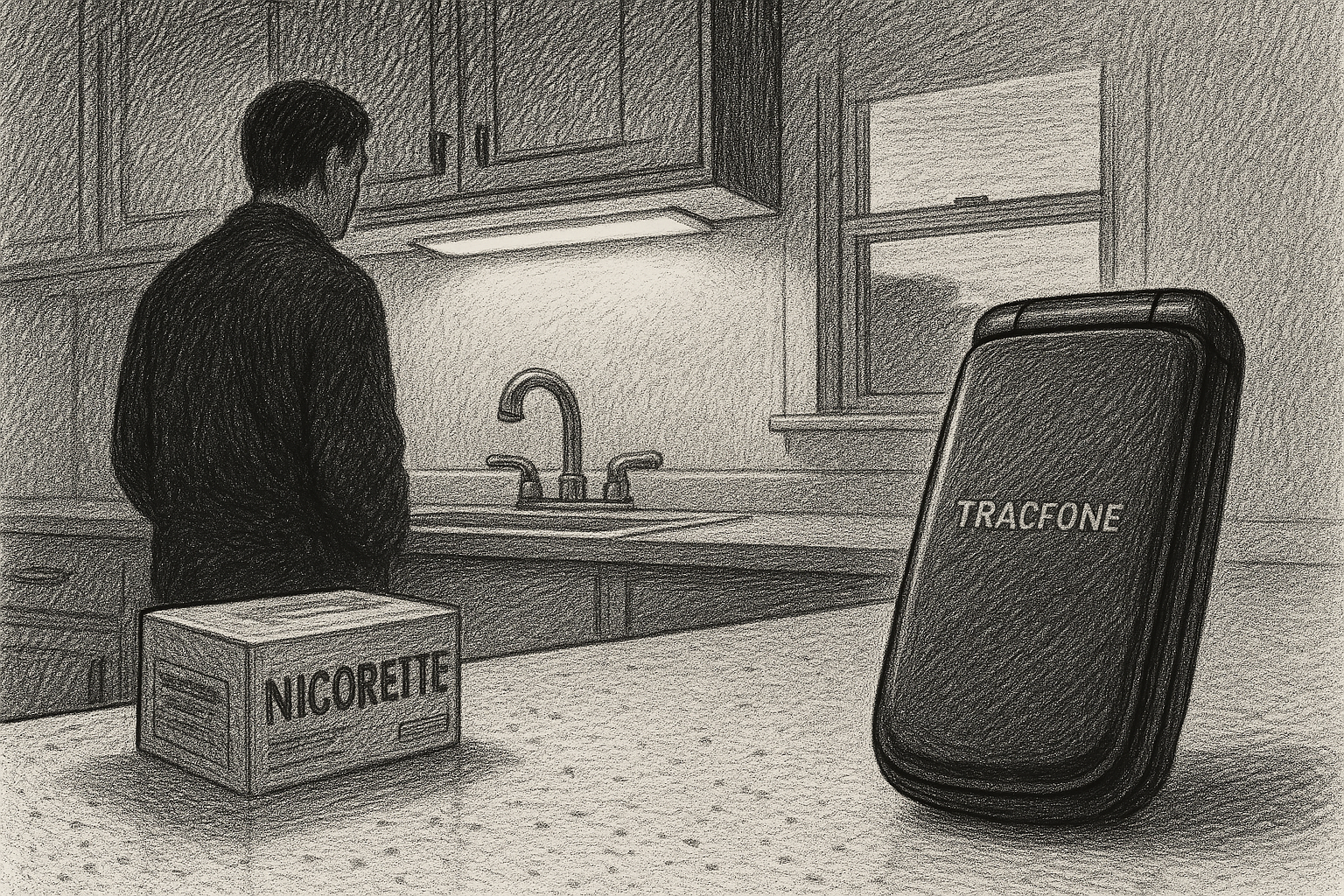
She locked the drawer. She had never locked it before. She put the key in her front pocket next to a stick of Nicorette and forgot about it, and remembered it at two in the afternoon when she put her hand in her pocket for the gum, and forgot about it again.
The TracFone was on the kitchen counter.
She did not look at it straight-on. She looked at it the way you look at something in the periphery of a dark room — not at it, but near it, so the rods in the eye have a chance. Two days since the rodeo grounds. Two days since Jared Jessop had looked at her across the hood of his truck and said they see me leave, that’s a problem, and she had understood, and they had not spoken the rest of it aloud because neither of them had needed to. He would call. He had not said when. He would call before the window closed.
The TracFone did not ring.
She ate something at noon she couldn’t name an hour later. She worked the back bedroom, which had been her mother’s and was now a storage problem she was not going to solve this month, and she moved three boxes from the closet to the hall and looked at them and moved them back. She worked on the report for chapter six — the compound visit, the papers, the next-of-kin notification — and wrote two paragraphs and stopped and looked at the two paragraphs and left them.
She was not going to write down what the girl had put in her pocket. Not yet.
The afternoon flattened out the way afternoons do when you are waiting for a sound. The light in the kitchen went from sharp to dim without her noticing the transition. At some point the under-cabinet strip above the sink clicked on — she had done it without thinking, the same way she left it on at night, a habit she had brought from the house in Henderson where Tom had left the over-stove light on every night of their marriage because he said he liked to come home to a lit kitchen. She had not thought about that in a long time. She thought about it now, standing at the counter, and then she stopped thinking about it, and the under-cabinet strip stayed on.
At six-twelve, Hugh called.
“Tox is in.”
“Tell me.”
“β-cypermethrin. Livestock pyrethroid — the families in Colorado City use it for poultry mites. Bitter at concentration. Orally, ten times the normal dose, you get a long slow sleep and the ME gets no marks, no struggle, nothing dramatic. Just a stopped person.”
“Something a household keeps in a canning shed.”
“Something that household keeps.” A beat. She heard him shift in his seat. “That household, and a hundred like it on the Strip.”
“What else.”
“The aunt. The one who filed the report. Mohave County has her listed as the family contact. Marva Jessop. Forty-one, second wife, she’s been running domestic affairs in the household since the senior wife’s health went bad.” He stopped. “Briggs.”
“I have a piece of paper,” she said. “I’ve had it since yesterday. I needed you to say her name out loud first.”
Silence on the line. Hugh was a man who had been doing this long enough to understand the things you said first and the things you needed somebody else to say first, and why.
“You’re going to behave,” he said. It was not quite a question.
“I’m going to behave.”
“Because if you put her on notice before we have anything to put her on notice with — ”
“I know, Hugh.”
“She runs or she lawyers up or she just looks at you with that particular look these women have that means they have already decided who you are and what you can do to them, and we are three months building this from scratch.”
“I know.”
“You are not going to knock on her door tomorrow.”
“No.”
A pause. “How are you, Briggs.”
It was the kind of question he would not have asked at the beginning of any of this, which meant he had been looking at her across the phone line and had decided something.
“I’m fine.”
“Okay.” He said it the way a person says okay when they are being polite about not believing you. “TracFone’s been quiet.”
“Yes.”
“Two days.”
“Yes.”
“Call me if it rings,” Hugh said. He hung up.
—
The kitchen settled back into its quiet.
She stood at the window above the sink for a long time. The street outside was going orange under the sodium lamps. Bluff Street in early evening was the same as Bluff Street at every other hour — closed curtains, porch lights on, the particular silence of a neighborhood that goes to bed at nine and wakes at five and does not leave its driveways in between. She had grown up three blocks from here. She had walked this street at all hours of the night from age fifteen onward and had never felt watched. She felt watched now. She knew that was not the street’s fault.
She took the Nicorette from her front pocket. She folded a piece between her back teeth and stood there chewing.
The TracFone was on the counter to her left. She did not look at it. She looked at the street.
Jared Jessop was twenty-five. He was tall and lean and he checked his mirrors twice before speaking in a car and he still did not drink coffee after twenty-two years of not believing. He had nine months of his life in the plan to get his sister out, nine months of hiding clothes and buying phones and finding quiet hours to speak to a woman in Hurricane who had done this work before. He had spent it all and the sister was dead and he had come back to that compound and was still in it, which meant he was more afraid of leaving than he was of staying, which meant he believed — or had believed, two days ago — that the thing he was afraid of was behind him and not in front of him.
He had not called.
The TracFone did not ring.
At seven she made coffee. She drank half of it standing at the counter and left the mug there. She got crackers from the cabinet and set them on the table and ate two of them and put the sleeve back.
She tried the report again. She read the two paragraphs she had written that afternoon. She added a sentence. She deleted the sentence. She closed the file.
She walked the kitchen — counter, sink, refrigerator, back door, table, counter. She was doing it again on the second pass before she knew she was doing it. She stopped. She stood in the middle of the kitchen with both hands at her sides and breathed. A sergeant she had had in Vegas years ago had told her that the worst hours of any case were the hours in which you had information the person in danger did not. She had thought about that at the time. She had thought it was true and also not quite right. The worst hours were the hours in which you had the danger in front of you — understood it, could name it — and had no good reason to move yet and no way to know if that was right.
The TracFone was lit.
She crossed to it in two steps, but it was only the screen coming up at a touch — she had caught the corner of it with her sleeve and it had woken. Not a call. The time in the corner read 9:03. She set it down.
Outside, Bluff Street was empty. The construction-crew trucks were gone. A single house had its kitchen light on across and two houses down, and she watched it — watched the particular warm shape of a lit window, a family in there somewhere doing the ordinary things that happen in lit kitchens at nine at night. The light went off. Then the front room at the same house, and then a light at the back of the house, upstairs. Then nothing.
She had not been afraid for Jared Jessop two days ago. She was afraid for him now. The difference was that the clock on it had moved.
She checked the TracFone. 10:47. She was not sure where the hour had gone.
She sat at the table. She put her hands flat on the table. She thought about Hugh’s voice saying two days and the particular weight he had put on the second word, which had been both a statement and a question and something underneath those two things that neither of them had said aloud.
She thought about the two sets of boot prints that were going to walk east into the dark country on the Arizona side.
She did not know she was going to think that. The image arrived whole, the way images arrive at two in the morning after too many hours in a lit kitchen — not summoned, not the product of reasoning, just the mind showing the hand what it has already dealt. Two sets of boot prints in dry ground leading east. She did not know where that image was from. She knew that she trusted it.
She sat with it for a long time.
The clock moved to eleven-fifteen and she was still sitting there.
—
She had a rule about driving south alone at night.
She had made it for herself eighteen months ago and she had held it because the rule made sense — Strip roads in the dark, no backup, no coverage, a deputy who was not, in any formal sense, operating in that jurisdiction. The rule was a practical rule. The rule did not mean she was afraid of the dark. The rule meant she was a person who had lived long enough to know which lines had weight.
She put on her boots.
She put on the denim jacket. She checked the front pocket — receipt still there, behind the Nicorette, buttoned. She picked up both phones and her badge and her sidearm and the keys to the Tahoe.
She turned off the under-cabinet light.
The kitchen went dark.
She stood in the dark kitchen for a moment — not deciding, that was done — and then she went out the back door and locked it behind her.
—
At one-oh-six in the morning, two miles south of the St. George airport, a mule deer stood at the gravel shoulder with both eyes on her headlights. She lifted her foot from the gas. The deer did not move — not a twitch, not a shifted weight. It stood and looked into the light with the particular stillness of a thing that has already made its decision and is waiting for you to make yours. She passed it at thirty miles an hour. She watched it not move in the rearview mirror until the rearview gave her back only dark.
She crossed into Arizona without marking it. She passed Yellow Knolls at one-eighteen. She did not stop.
The BLM track turned off the 91 two miles south of the knolls — not the track that led to the wash but a different one, a track she had driven once, eight years ago, when her father had taken her out this way in October after the heat broke, looking for pronghorn that they had not found. She had not thought about that trip in years. She had thought about it tonight at eleven-forty-five when she was still at the kitchen table. Not the trip — the track. The long washboard heading west, dead-ending at nothing in particular, a few square miles of broken BLM ground where a person could take a truck and not be found by anyone who did not already know to look.
She turned off onto the track.
She drove slow. The Tahoe complained about the road and she let it. After a half mile, then a mile. The headlights caught creosote and red dirt and the pale shimmer of a dry wash cutting the ground to her left, and then the bend in the track, and then the truck.
White Ford F-150. Late-2000s. She stopped fifty yards out. She killed the Tahoe’s engine and sat for a moment in the settled dark.
She got out with her sidearm drawn and at her side.
She walked toward the truck the way she had walked toward Sariah’s body — taking in the distance first. Driver’s door closed. No lights. The F-150 was parked at an angle, half on the shoulder, as if the last driver had not bothered or had not had the chance. The passenger-side window caught her headlights at twenty yards and she could see through it. The cab was empty.
Ten yards out she could see the keys in the ignition.
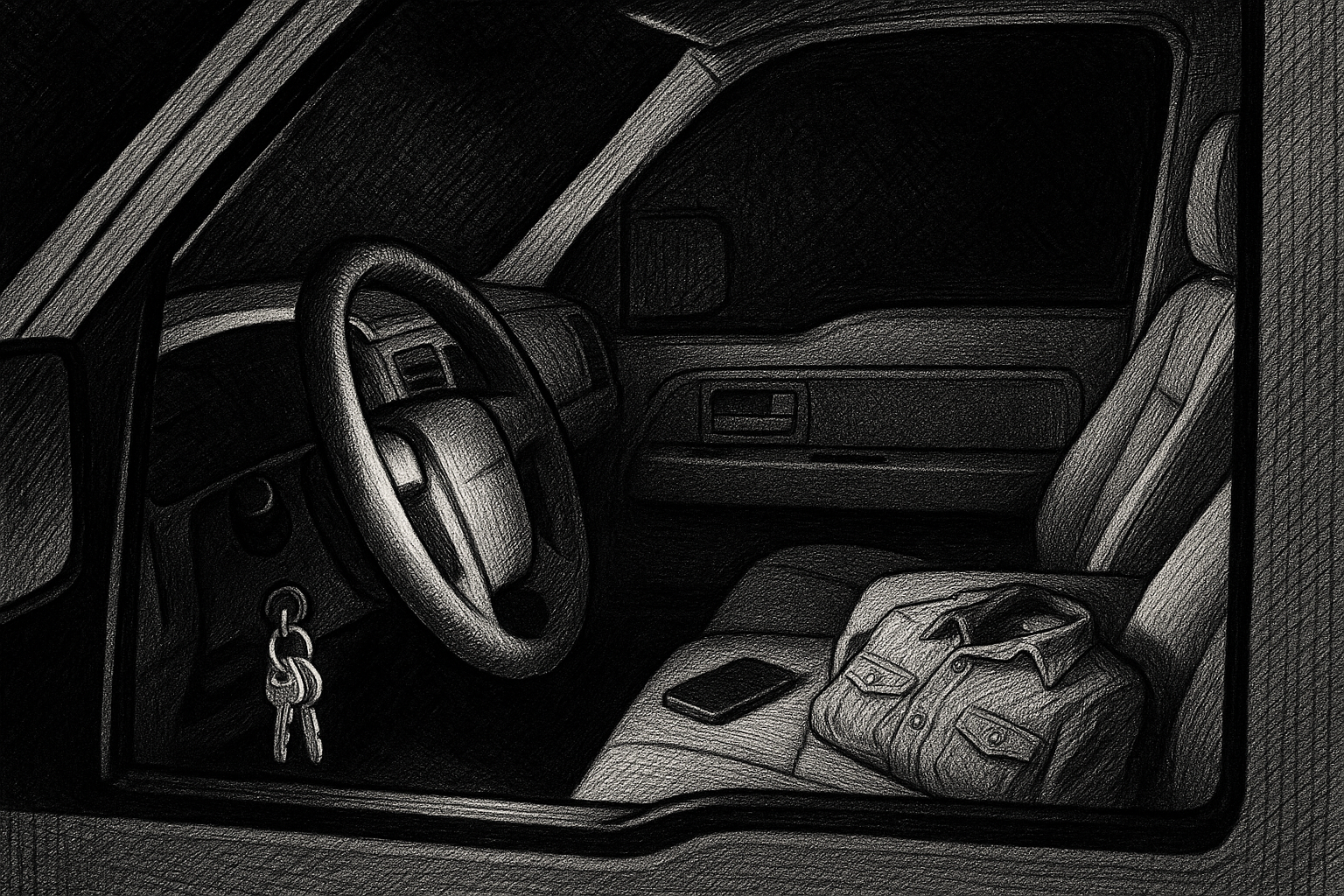
She circled the truck. The bed was empty. No blood, nothing on the ground she could see, no sign of a dispute or a run. On the passenger seat, Jared’s denim work shirt. Folded. Not dropped, not shoved — folded, the way a man folds a shirt on the back of a chair when he expects to come back to it. His phone on the dash.
She looked at the phone and did not touch it.
She turned to the ground on the driver’s side.
Two sets of boot prints. Both sets heading east, walking out past the edge of the track into the open country. For the first five yards the two sets were side by side, maybe two feet apart. Then they were closer. By the tenth yard the prints were one track — two people, one walking inside the other’s stride. A person being walked. Not dragged. Walked.
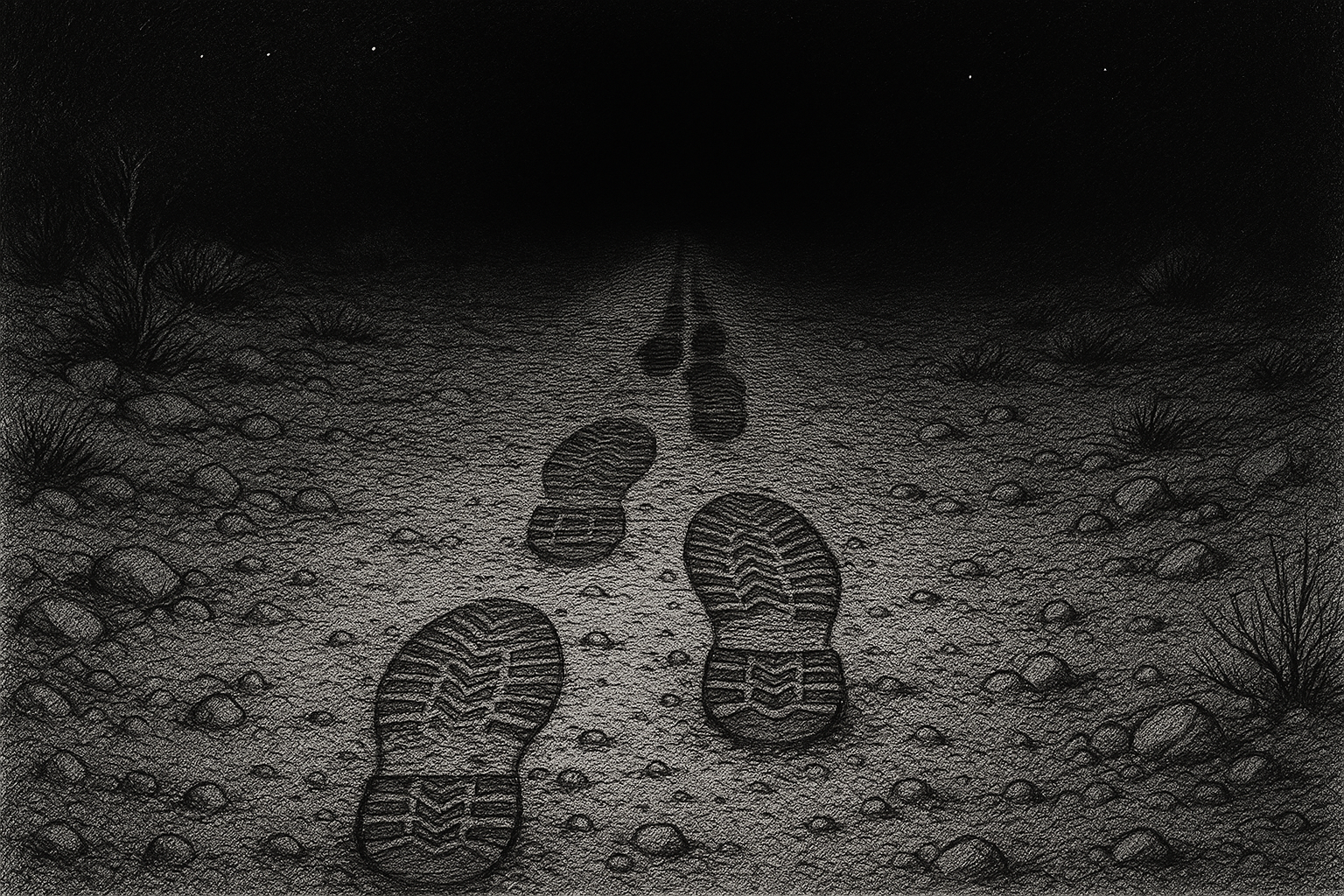
The track went east into the black country and she could not see it anymore.
Audrey stood at the side of the truck. The wind came across the open ground and moved through the creosote in a long dry sound and she let it pass. She breathed once. She put her sidearm away.
She got out her phone.
She looked east for a long moment — at the dark, at the country she had no map for and no headlights for, where two sets of prints had become one and gone somewhere she could not follow tonight. She looked at it the way you look at something that has already happened. Then she dialed Hugh Pinney.
It rang four times. She counted them. She did not look away from the east.
He picked up.
“Briggs.” His voice was rough with sleep, but there was something behind it that was not surprise. A man who had told himself he was sleeping and had not fully managed it.
“I’m on a BLM track off the 91,” she said. “Two miles south of Yellow Knolls. I’ve got Jared’s truck. Keys in the ignition. His phone’s on the dash. His shirt’s folded on the seat like he left it there for later.” She stopped. “Two sets of boot prints walking east. Becomes one set after ten yards.”
A long silence on Hugh’s end.
“How long,” he said.
“I don’t know. The tracks aren’t fresh but the ground’s been dry for three days.”
Another silence. She heard him breathe. She heard something shift — the sound of a large man sitting up in a dark room, adjusting to a world that had just gotten worse while he was trying not to be awake in it.
“Hugh,” she said.
“I’m here.”
“He’s gone.”
A beat. Two. Three.
“Yes,” Hugh said.
“Tell me what we do next,” she said.