Chapter 10
The Ranch
Linnea was at the Hurricane truck stop at twenty past nine, standing outside with her canvas bag by her feet. Her son’s Subaru pulled out before Audrey had even come to a full stop, red taillights shrinking south on the 91.
Linnea got in. She set the bag on the floor between her feet and put a paperback on the dashboard and said, “Drive.”
Audrey drove.
The 91 south of Hurricane runs through country that doesn’t want you. No towns. No real fences. The rock goes red in headlights and black when you look past them, and the night sky out here is the sky the way it was before people put things in it, and you can feel, if you let yourself, how thin the road is and how old everything on either side of it is. Audrey didn’t let herself. She watched the dash clock and she watched the oncoming nothing and she chewed through two pieces of Nicorette.
At quarter past ten she said: “Ruth says Marva comes back tonight at ten or after. We don’t have time to waste when we get there.”
“I’m not going to wait in the truck,” Linnea said. She had said it calmly, the way a woman says something she decided before she got in the car.
“I know.”
“Good.”
Another silence. Audrey thought about Hugh Pinney sitting in Kingman in the dark and decided not to think about it again.
“The man inside,” she said. “Tall. Thirties. I don’t know him. He looked like he’s done this kind of work before.”
“What kind of work.”
“The kind where you watch a door that bolts from the outside.”
Linnea looked out the passenger window. After a moment she said, “What do you want me to do.”
Audrey told her.
—
The graded BLM track was eighteen miles south of the line, gravel and washboard both, and the Tahoe complained the whole way in. Audrey took it slow. Her hands were steady on the wheel. She had the headlights off for the last half mile, navigating by the grade of the track and what was left of the moon, until the single yellow point of the ranch’s propane lamp appeared low on the horizon and gave her something to steer by.
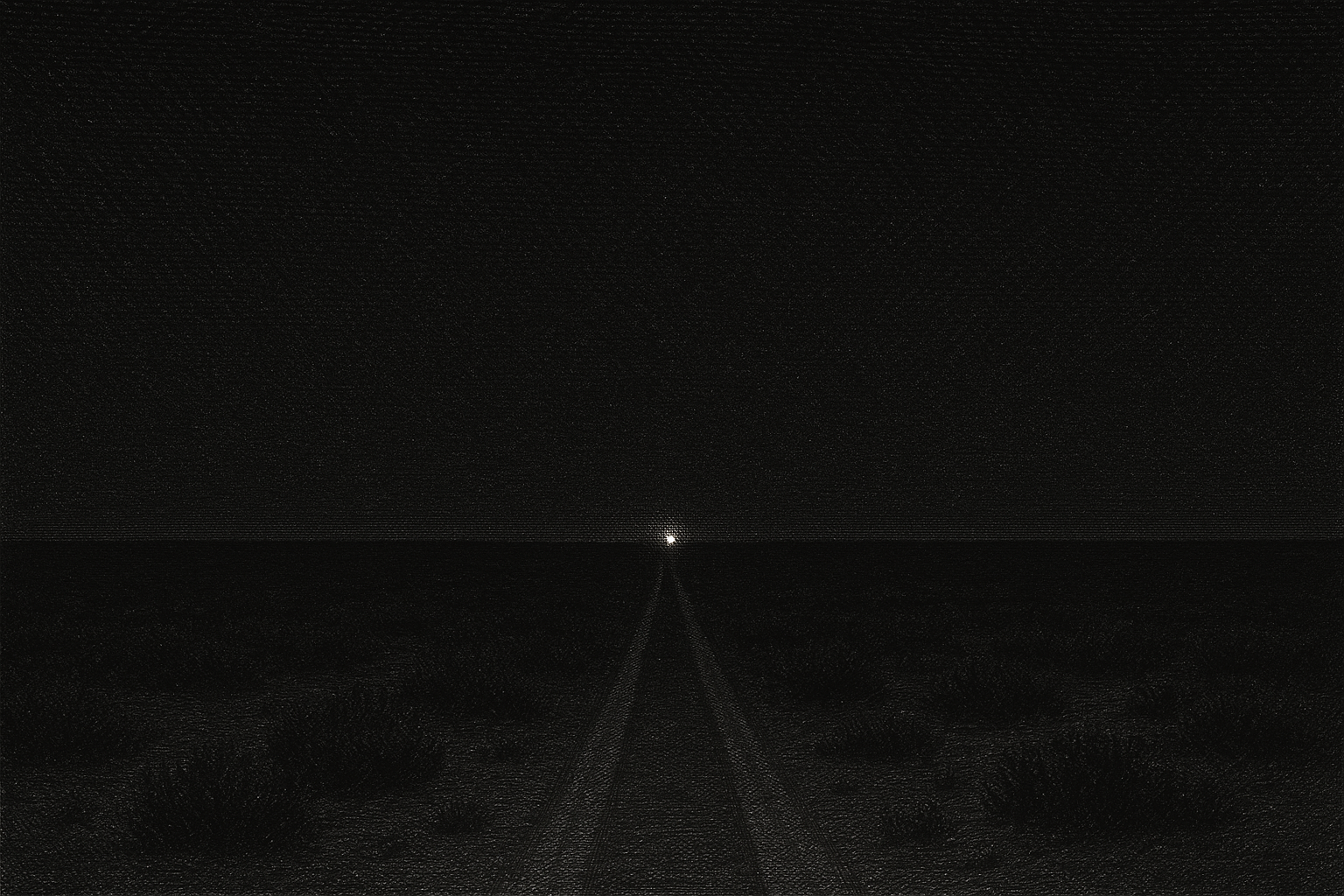
She killed the engine three hundred yards short of the gate. Let the Tahoe roll in neutral until a stand of creosote came up on the driver’s side and she eased into it and stopped.
The night was cold and very quiet. When she got out she could hear the propane generator behind the building, a low thrum like a working muscle. She could hear her own footsteps and Linnea’s, and nothing else.
The chain on the gate was for show. The padlock was a Master 3 and she had Jared’s key — lifted that afternoon from his truck’s glove box, which was in evidence, and she had a paper trail now she had not yet thought all the way through but would have to. The key turned. The chain dropped in the dirt with a small dry clink.
She pushed the gate open and they were on the property.
Fifty yards to the building. She stopped Linnea behind the creosote at the property line.
“One man. Inside. Maybe two, but I’ve seen one.”
“You said the bedroom at the back. The one with no window.”
“The back hallway. Three doors. Bolt on the outside of the smallest one.”
“All right.” Linnea’s voice was level. It was the voice of a woman who had talked scared girls through worse decisions. “Tell me when.”
She moved alone through the scrub to twenty yards from the porch, crouched in the shadow of the building’s corner, and watched. The man’s truck was parked nose-in at the porch — a white Silverado, older, the kind you bought when you needed a truck and not a statement. She could see through the kitchen window, the propane lamp making its warm circle on the inside wall, and the man’s shadow moving past it once, then settling.
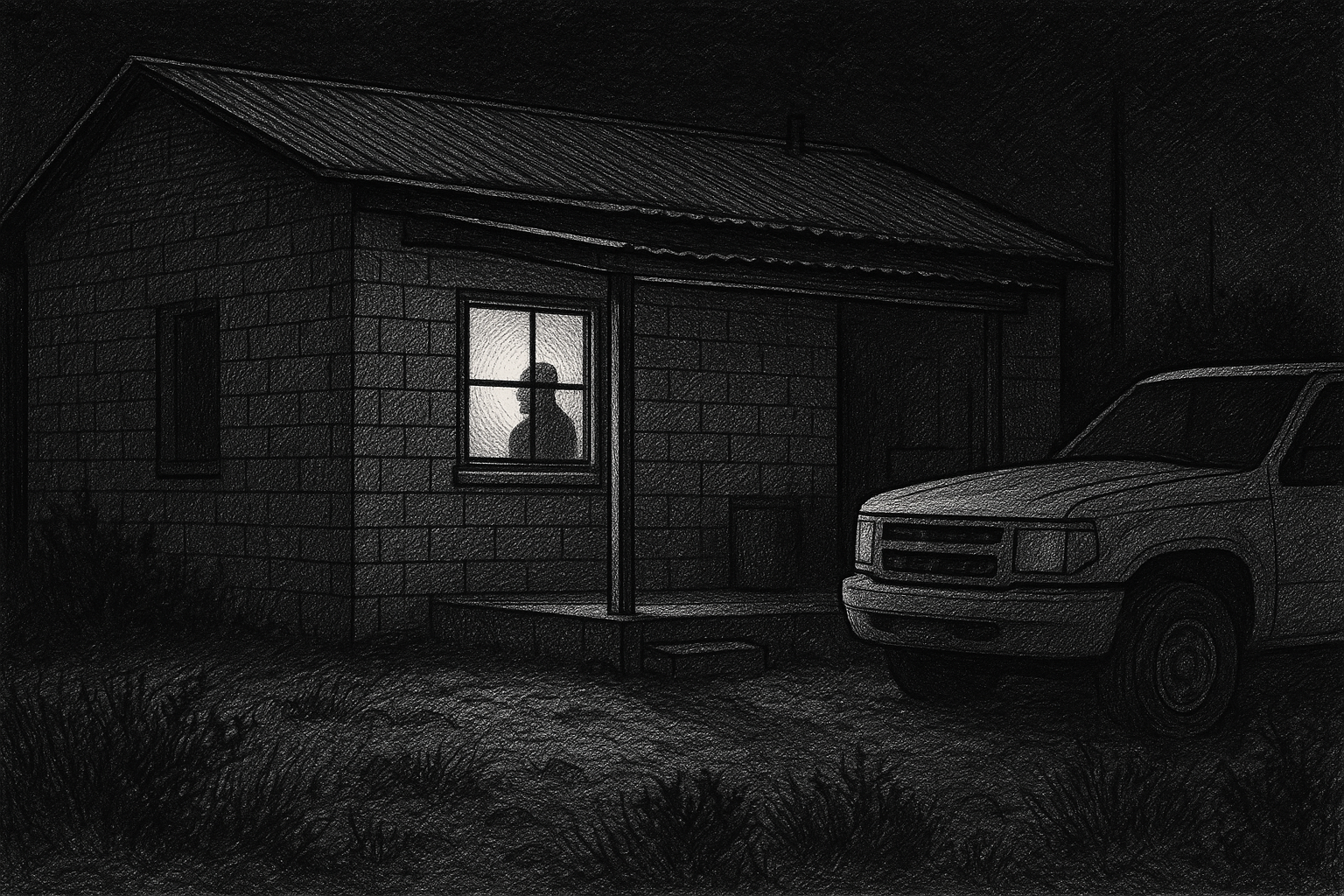
She went back.
“One man. Kitchen window. He’s not watching the door.”
“All right.”
“Sixty seconds after you knock, I’m moving.”
“All right.”
Linnea squared her shoulders once. She tucked the flashlight into her waistband because Audrey had asked her to hold it and she hadn’t been asked not to, and she walked out of the creosote and across the open track toward the porch like a woman who had every reason in the world to be there, her sneakers quiet on the packed dirt, her canvas bag over one arm.
Audrey counted.
At sixty she moved.
The cinder-block wall was cold under her hand. She came around the west side of the building low and fast with her shoulders close to the block. The barn door was set into the west wall — heavy, plywood, on a sliding track, the kind that had served a hundred years of Wyoming homesteaders before whoever built this place decided to copy the design. She lifted the latch. The door opened on a groan that went up into the night like a question and stayed up there. No way to silence it. She didn’t try.
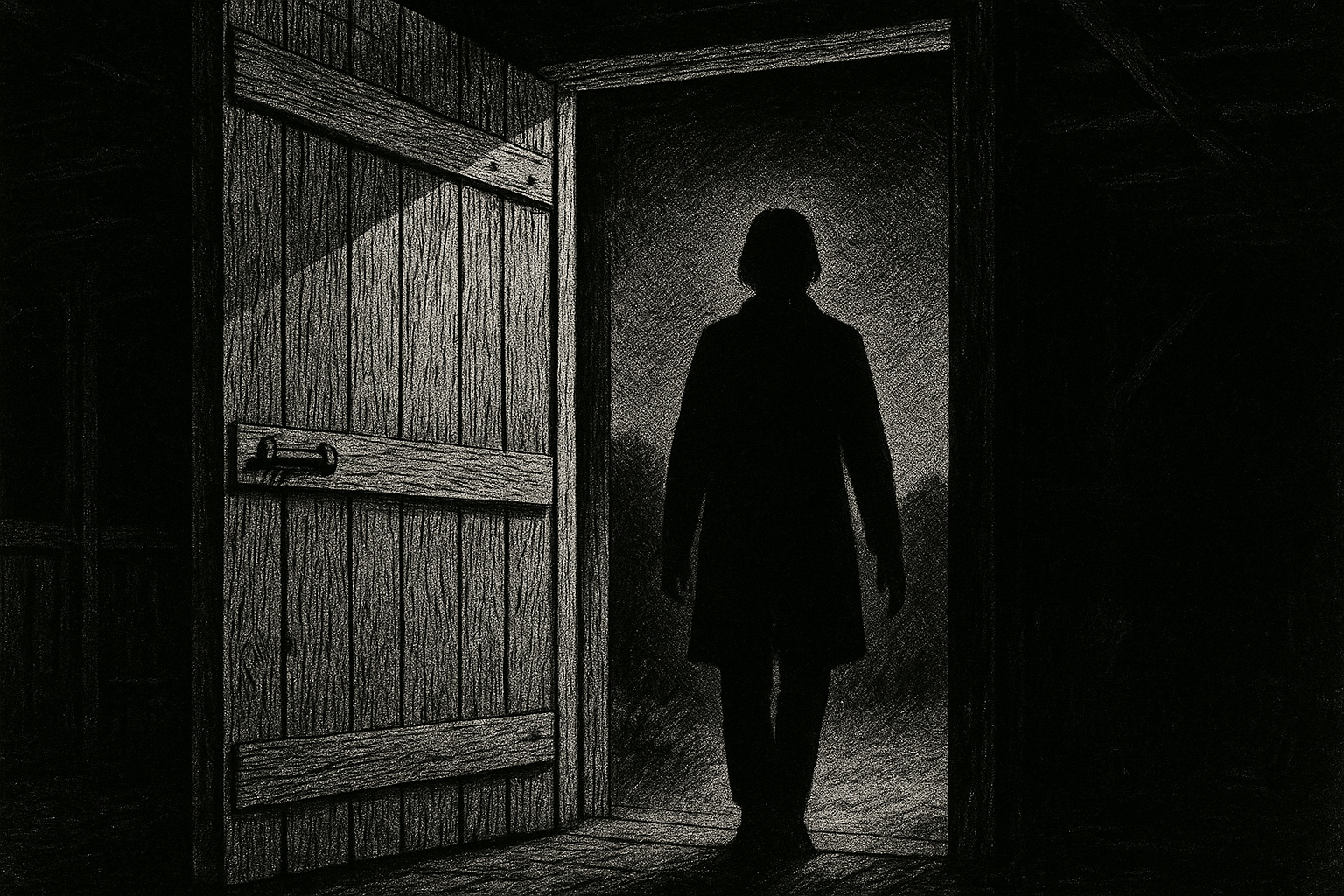
She slid inside.
The barn was dark and smelled of old goat and machine oil. She waited two beats for her eyes. From the far side of the building — the porch side — she could hear Linnea’s voice beginning its work: high, a little shaky, exactly the right kind of lost. Then the man’s voice, lower, asking something. Then Linnea’s voice again with the particular cadence of a woman describing where on the road her car had stopped and how long she had been walking.
Audrey moved.
The door from the barn into the back hallway was unlocked because inside the household the locks were on the people, not the rooms. She opened it. Three doors in the dim. The first two she passed. The third had a sliding bolt on the outside, steel and new-looking, the kind you’d pick up at an Ace Hardware and install yourself.
She drew it. She opened the door.
Jared was on the floor, back against the far wall, knees up, head against the cinder block. He looked up when the light came in and she saw him fully for the first time: left eye swollen shut, lower lip split and crusted, blood down the front of his shirt that had dried brown and gone stiff. His right hand was bandaged with a strip of bed sheet. He was alive. He was looking at her face like a man who had been looking at that door for days and had stopped expecting anyone good to come through it.
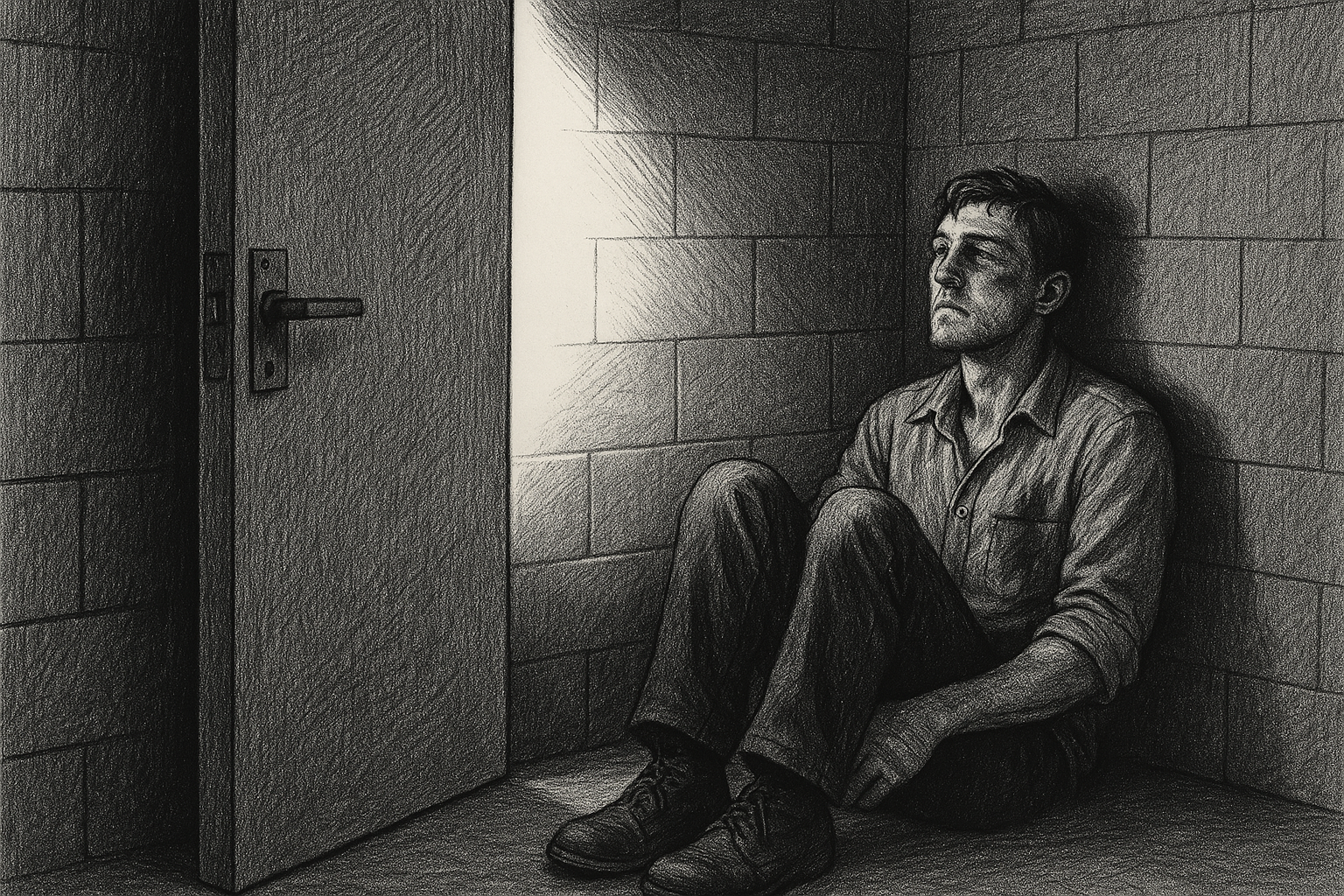
She crouched. She put one finger to her lips.
He nodded once.
She took his left arm across her shoulders and lifted. He made a sound in his throat and did not make another. He came up slow, the way a man comes up when his body is arguing with the project, and she felt his weight and she felt the particular unsteadiness of someone who has been on the floor too long. He could walk. He could walk slow. It would be enough, or it wouldn’t.
She moved him down the hallway and into the barn. From the front of the building she could hear Linnea still talking — the conversation had gotten to the part where Linnea was asking the man to look at the map on her phone, which wasn’t a real map on a real phone, it was the flashlight app she had set to dim, but it would buy them another thirty seconds.
They got to the barn door.
She moved him through it.
The night outside was cold and very wide and she felt it on her face and assessed it in a single sweep: the track clear, the porch visible to the east, the man’s silhouette still inside the kitchen window with Linnea’s flashlight making a small glow on the porch between them. Clear.
They walked.
Sixty yards from the barn door to the creosote stand where the Tahoe was parked. She knew the distance. She had counted it when she rolled the truck in. Sixty yards in open flat ground with a man who was moving at maybe half speed and could not be pushed faster without the sound of him changing.
She walked. Her right hand wanted to go to her sidearm and she let it, let the fingers rest there on the grip without drawing, just contact. Jared was on her left, his weight against her shoulder, his boots finding the ground one at a time. His breathing was careful, the kind of careful that means a rib is talking to you.
Twenty yards.
That was when the headlights came over the eastern ridge.
She saw them before she heard the engine. Two pale bars of light sweeping the scrub, the geometry of headlights on a dirt track that was running to intercept the main track about two hundred yards east of where they were walking. Moving steady. No hurry.
She did not stop moving.
She did not look at Linnea, who had come around the front of the building and was now crossing the track from the porch side, walking on a line that would meet them at the truck. She did not say anything because there was nothing to say that Linnea hadn’t seen.
Linnea had seen it. She was looking at the eastern ridge. She looked back at Audrey and then looked away, and she did not say a word about it, because she knew Audrey had already seen and saying it would not help.
They kept walking.
Thirty yards.
The engine sound came over the scrub now, low and steady, a diesel running in no hurry. The headlights swung as the vehicle made the last curve of the eastern track and leveled out, and for one beat the full wash of them swept the flat ground between the building and the creosote stand and caught the three of them in it — Jared walking, Audrey carrying his weight, Linnea ten yards off to the right and moving toward the truck.
Audrey did not break her stride.
The headlights passed. The vehicle had turned onto the main track heading for the gate. It was moving toward the property. It had not stopped.
Forty yards.
She wanted to run. She did not run. She walked Jared at the speed Jared could walk, and she counted the yards, and she kept her hand on her sidearm, and she kept her eyes forward except for one sweep right and one sweep left the way you were trained to do.
On the sweep left she saw her.
The figure was standing at the fence line, forty yards south of the gate. Still. The headlights of the approaching vehicle were behind the figure now, making a wash of light that came around the shape without illuminating it, so that what Audrey saw was a silhouette with a rim of light around it: medium height, shoulders level, hair pulled back, hands at her sides. Not moving. Not raising her hand. Not signaling anything.
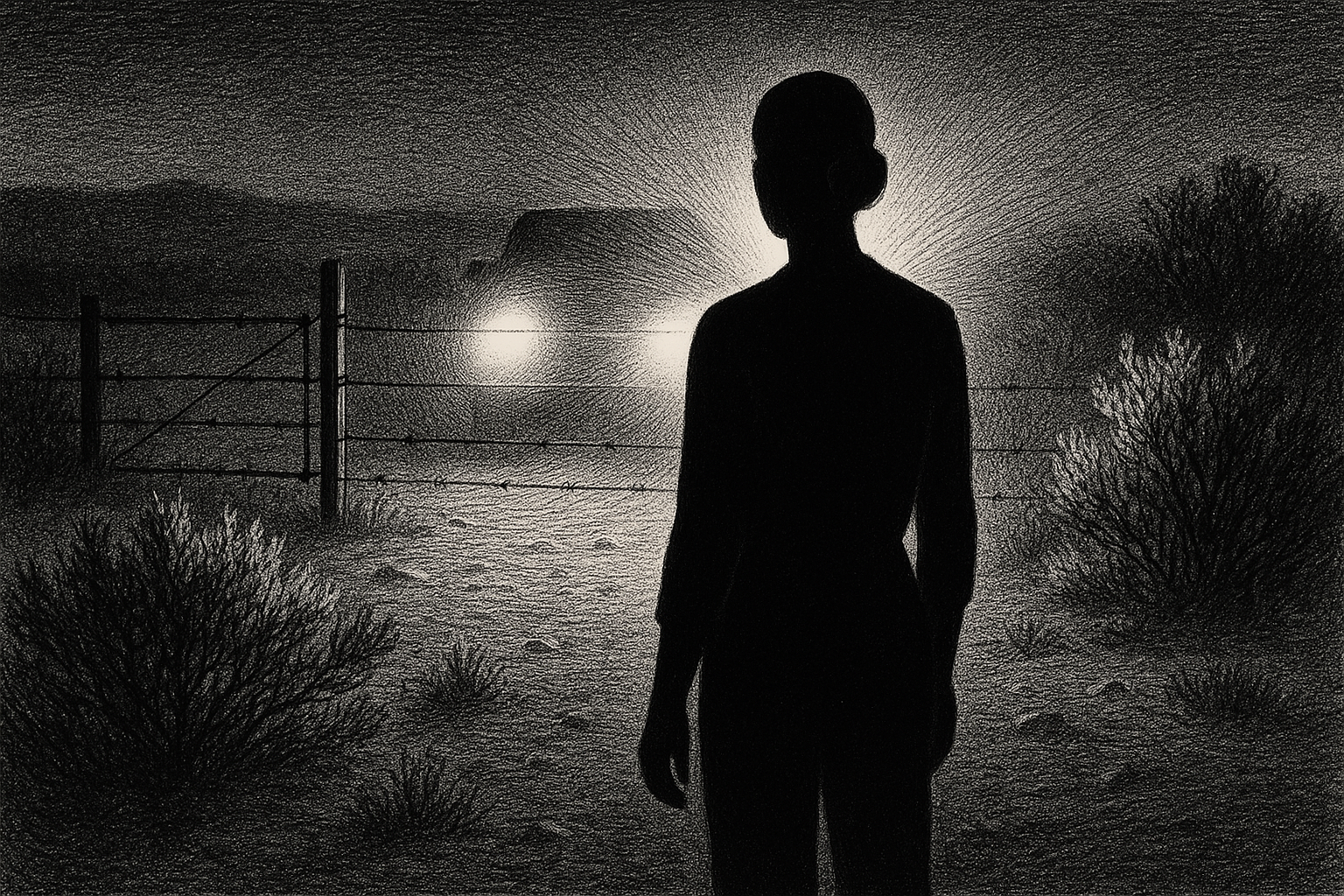
Just standing.
Watching.
Audrey had seen that posture before. She had seen it in the cold open at Yellow Knolls, the shape of a woman composing a girl’s body at the rim of a wash with the patience of someone who was not being watched and knew she was not being watched. The posture of someone doing careful work without an audience. She had not understood, at the time, that she was looking at the quality of the work. She understood it now.
The figure did not move.
Audrey kept walking.
Fifty yards.
She made herself think it through, the way she had learned to think things through in Vegas when the instinct was talking loud and the procedure was talking quiet and you had to hear both and decide which one you could take into court. Marva had come back from the east. Marva had seen them. Marva could have hit the gas. Marva could have brought the truck across the flat to cut them off. Marva had the distance and the angle and at least one man with a vehicle already on the property. Instead Marva had stopped the vehicle at the gate, gotten out, walked to the fence line, and stood.
She was letting them go.
Fifty-five yards.
And that was when Audrey thought about the key.
The key from Jared’s glove box, which she had pulled from the evidence locker that afternoon and put in her jacket pocket and used to open the gate that she had not stopped to relock. The key that was still in her pocket. The key that was logged out of evidence in her name at five-thirty p.m. with no case number attached, no warrant, no sign-out paperwork beyond her badge number and her signature on a line she had not looked at too closely when she wrote it.
She thought about sitting across from Marva in an interrogation room with a recorder running, and Marva’s lawyer reading out the evidence log, and the question of how a deputy had come to possess a key to a private property lock on the night in question. She thought about what Marva’s lawyer would do with that question. She thought about what Marva would do with it — not in the room, not loudly, but in the precise and patient way that a woman who had been methodical about everything else would be methodical about the one gap in the deputy’s chain.
She could go back. Walk back to the gate. Rehang the chain, put the key in the lock, leave it there. The chain being open — the chain being gone — was a fact she could not unwrite, but the key in the lock was evidence she had entered and left on the property. Without it, the sign-out record was irregular but arguable. With it sitting in a dropped chain on a property she had no warrant to enter, it was an unlawful entry on the record she had made herself.
She could go back.
She did not go back.
Sixty yards.
The Tahoe was in front of her, tucked into the creosote, the metal cold in the night air when she reached out and put her hand on the door. She got Jared into the back seat. Linnea was already in the passenger side, moving without hurry, without looking back. Audrey got in the driver’s seat and closed the door, and she put her hand on the key in the ignition and did not turn it.
The key in the evidence locker. The key in her pocket. The key she had decided not to go back for.
She turned the ignition.
On the east side of the property, at the fence line, the figure had not moved.
Audrey backed the Tahoe out of the creosote stand, slow, no headlights. She turned it south on the BLM track and drove. She waited until the building was a single warm point of light behind her before she turned the headlights on, and when she did she did not look in the rearview at the light, because looking at it would not change it.
In the back seat, Jared said, very quietly, “She’s coming.”
“She was already there.”
A silence.
“She let you.”
“Yes.”
Linnea was looking out the passenger window at the scrub going by. Her hands were in her lap. She said nothing, because it was the kind of silence you do not fill.
“Jared.” Audrey kept her eyes on the track. “Hold on. You’re all right.”
“I am.”
He closed his eyes. Linnea put her hand on his knee.
Audrey drove. She thought about the interrogation room she was going to have to walk into with what she had. She thought about the paper trail. She thought about Marva’s stillness at the fence line, the patience of it, the message of it, and what kind of woman stood at a fence in the dark and watched her own work being undone and did not move, because the undoing was part of what she was building.
The kind of woman who had let her leave.
She took the cutoff east toward the 91. They did not see another vehicle on the road. The Strip opened out in front of them, dark and old and wide, and the ranch building’s light went out of the mirror somewhere around mile six, and when she checked the mirror again there was nothing but the road unwinding behind them into the black.
She drove north. She drove toward the light she had left on above the kitchen sink in the house on Bluff Street, the under-cabinet strip she kept burning the way some people kept a television on, for company. She drove and she chewed the last of the Nicorette and she thought about what she still had and what she had just lost and whether they balanced, and she thought about a woman at a fence line who was already three moves ahead of her, and she thought: all right then.
All right.