Chapter 3
The Rodeo Grounds
Jared Jessop walked the fifty yards between his truck and hers without hurrying. The wind had come up a little. Somewhere behind him a piece of loose metal on the bleachers ticked against the pipe-rail in a rhythm that was not quite steady.
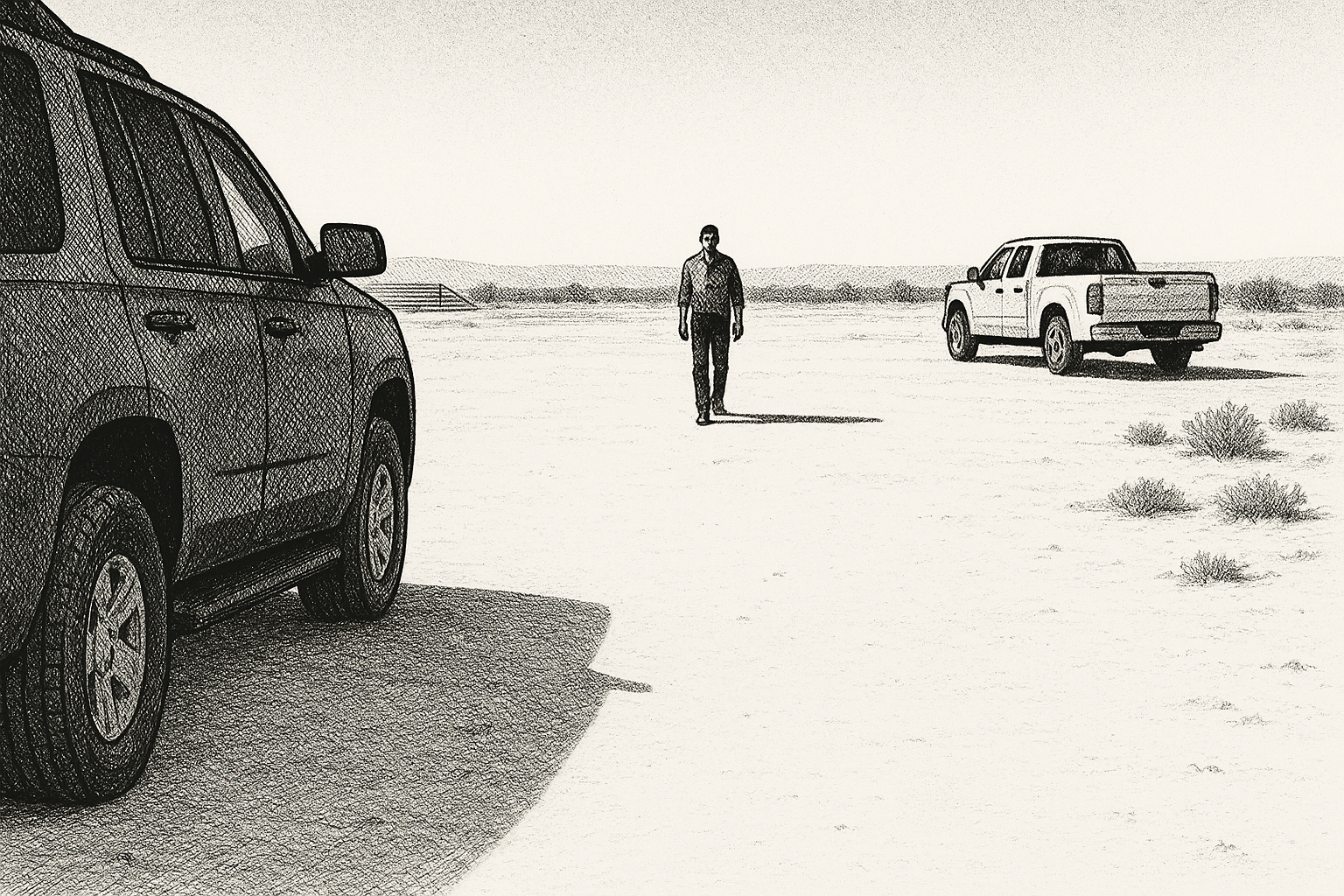
He walked with his hands at his sides and his shoulders low and when he got to her Tahoe he didn’t stop on the driver’s side — he came around to the passenger side and stood there a moment before he tapped the window with one knuckle. She had time to take him in. The denim shirt was the same one from the compound yard two hours ago, the mud on the knees not yet dry. Tall — taller than he’d looked across a yard, the height of a man who worked with lumber and didn’t think about it. His eyes went to the bleachers, to the road behind him, to the road ahead, before they came to her window. Not paranoid. Disciplined. There was a difference.
Audrey leaned across and unlocked the door. He got in and closed it gentle.
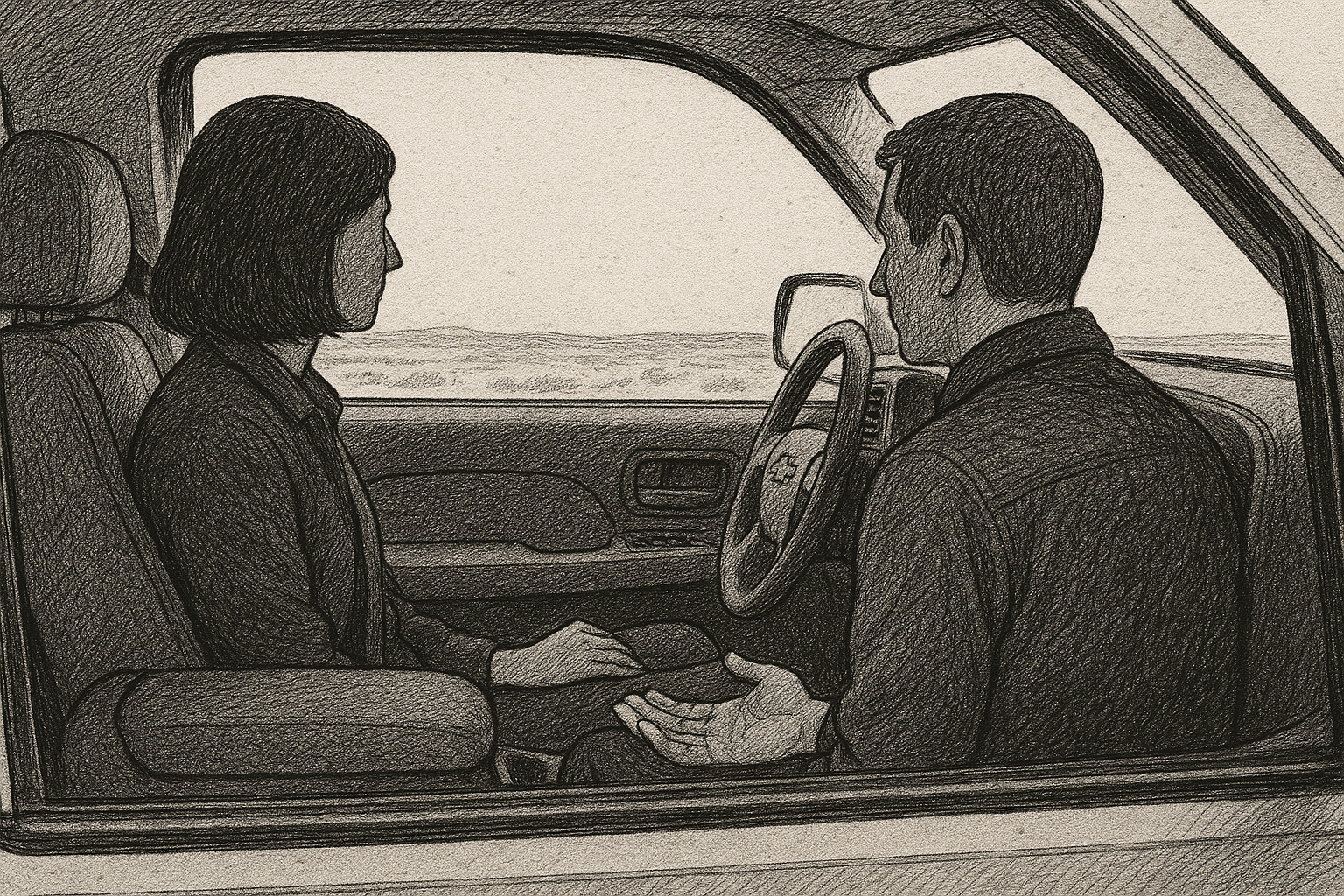
The cab of the Tahoe held the heat of four hours of noon sun through glass. The dash had cracked across the middle third from UV work done over a hundred and eighty thousand miles, a long fault-line from the driver’s side air vent to the passenger side, and the vinyl along it had gone from black to a kind of ashy gray. The smell was Nicorette and old coffee and the specific warmth of a vehicle that belonged to someone who lived in it at least part of each day. Two wrappers in the door pocket on his side. One in hers.
He sat with his hands in his lap. Then he let out a breath that might have been the first one he’d taken in an hour.
“All right,” he said.
“All right,” she said.
They sat.
The bleachers ticked.
“Your truck?”
“My truck.”
“It’s not wired.”
“No.”
He nodded. He looked out through the windshield at the broken stock tank and the mesquite grown up through it. The mesquite threw a scrape of shade onto the gravel but not enough to reach the Tahoe. The sun was directly overhead. Audrey could feel it on the left side of her face through the driver’s window and the back of her neck above the collar. There was no shade at the old rodeo grounds at noon in November. There was not going to be.
A long silence. She didn’t fill it. She had learned in Vegas that the quiet between two people in a vehicle is a resource.
He checked the mirrors. Both of them. One at a time, driver’s and then passenger’s. The same way he’d checked them on the street at the compound, she would have bet, when he crossed the yard to her truck — and he had no mirrors on the street at the compound, which meant it was a thing his body did when it was paying attention, a habit the way her own hands went to her belt when she stood up from a chair even when she wasn’t wearing the holster. You formed those habits in specific conditions and then they stayed long after the conditions changed or didn’t change at all.
“She’d been planning it for nine months,” he said.
“Okay.”
“I helped her. I got her the clothes. Got her the phone. Kept both for her at a place away from the house. She’d come get things from me once a month, maybe less.”
“What kind of phone?”
“Prepaid. TracFone from the Walmart in Hurricane. I bought it with cash at a register with no camera I could see.”
“Number?”
“I’ve got it written down. I’ll give it to you before I go.”
“Who was she in contact with on it?”
He shifted. A small movement of his weight against the door.
“One person. A woman. I don’t know her by sight. Sariah had met her maybe three years ago at some kind of outreach thing — a program at the library in Hurricane, a reading thing for kids, I don’t know the details. This woman stayed in touch with her after. Sent her books. Let her call when she had the phone. Made her a plan.”
“Name?”
“Linnea Aspen.”
Audrey wrote the name in her notebook. The spelling she guessed at. “With a double-n?”
“I don’t know. I only heard Sariah say it.”
She had said the name, Audrey registered. Not this woman or her. The name itself: Linnea. The way a person said the name of someone they had heard about from someone they loved.
“What was the plan?”
“Get her out on a Wednesday night. Three weeks from today. She’d walk to the corner of 900 West and 200 North at eleven fifteen. Aspen would pick her up there. From there, I don’t know. There are places for girls who get out. Shelters. Sariah knew the one she was going to and I didn’t ask.”
“You didn’t ask.”
“No.”
“Why not?”
“Because if they took me — and they might still — I couldn’t tell them what I didn’t know.”
Audrey wrote that down too.
Nine months. She did the arithmetic without meaning to. He had been carrying this for nine months, going to work in Hurricane and St. George and coming back in the evening and sitting down for meals with a household that had done something to his sister, or allowed something to be done, and he didn’t know yet which one it was, and he’d kept coming back anyway. Month by month. The TracFone in a place away from the house. The clothes. The plan. Twenty-five years old and sitting in the community he’d stopped believing in because the alternative was his sisters staying in it without him.
He had stayed in order to get them out. That was the whole of it. She could see it in the way he sat — the deliberateness of a man who had been deliberate for a long time about a single thing, who had narrowed his life to the dimensions of one task, and the task had been interrupted before it finished.
“Jared. Who is they.”
He didn’t answer for a while. The piece of metal on the bleachers kept ticking.
Outside the windshield the broken stock tank caught a glint of sun where the metal had gone bare. The mesquite scraped at the air above it. The chute gate, hanging off its one hinge, moved in the wind and then stilled.
“I don’t know yet. I don’t know for certain. And I’m not going to say a name out loud in your truck on the hope that I’m right. If I’m wrong I’ve burned somebody who doesn’t deserve it, and if I’m right I’ve put myself and two of my sisters in more trouble than we’re already in.”
Two of my sisters.
Audrey wrote nothing. She heard it. The piece of information that had come through the careful syntax of what he said and wasn’t: there was a specific person, not an institution, and that person could reach his sisters the way they had reached Sariah, and one of those sisters was young and already in the range of what this person could do. He had told her that much and refused to tell her the name. She understood both things.
She had sat across from people for nineteen years in Las Vegas and she had been in this cab for thirty-five minutes with Jared Jessop and she knew the difference between a person who was lying by omission and a person who was making a rational decision about what to withhold and when. His hands had been still in his lap since he sat down. He had not touched his face. He had not looked at the door. When he checked the mirrors it was the road he was checking, not the space between himself and the exit. A man who was lying you eventually somewhere — a particular angle of the eyes, a tendency to answer quickly when the quick answer was safest, a compensating stillness that was not the same as natural stillness. He had none of that. What he had was the specific quality of a person doing a hard thing without any pleasure in how hard it was.
She let the unsaid stay unsaid.
“Okay.”
“But I can tell you what I don’t think it is. I don’t think it’s the church. I don’t think this came down from the prophet or from anyone around him. The church would have used the church’s ways. Disappeared her. Moved her across a line into another community. They wouldn’t leave her on the side of a road for you to find.”
“They meant for her to be found.”
“Yes.”
“Somebody who wanted me to know something.”
“Yes.”
“Who.”
“I’m not going to answer that today. I might be able to answer it next week. Ask me again when I have something.”
She nodded. Wrote nothing.
They sat. The sun through the windshield had gotten hot and she rolled her window down two inches. He did the same. A very small wind came through the cab, carrying the smell of the desert — dry grass, mineral, the faint sweetness of whatever bloomed this late in the year on the Arizona side of the line. It was not enough to cool the cab. It was enough to be there.
She watched him without making it visible. He was holding something, and not holding it well, and the not-holding-it-well was the only honest thing in the way he sat. Everything else — the discipline of his eyes, the checks of the mirrors, the care with the door — had been willed. The thing he was holding back had not been. A liar working this hard would be working in the wrong direction. He would be constructing. What she was watching was the opposite: a person who had decided what to say and said it, and was holding back what he hadn’t decided yet rather than anything designed to mislead her.
That was a specific distinction, and it was the one that mattered.
“Can I ask you a thing,” he said.
“Yes.”
“Are you okay.”
She looked at him. He was looking at the dashboard. Not at the crack in it, just — at the dash, at the middle distance between them. The way a person looked when they were asking something they had been deciding whether to ask since they got in the truck.
“I don’t know what you mean.”
“I mean you look like you haven’t slept. I mean your hand has been shaking a little since I got in here. I mean I need to know whether the person I’m talking to is going to do this or fall over, because I don’t have the time or the room to bet on the wrong one.”
The hand. She’d noticed it herself that morning — at the scene, before Hugh arrived, when the light was coming on and she was crouching over the girl in the wash and her right hand had started to do the thing it sometimes did now, the thing she hadn’t had before the garage. She’d noticed it again when she wrote the name. She had thought she’d had it back under control — or controlled enough — and that across a cab in the noon sun it wouldn’t register. She had thought wrong.
She looked down at it. Her right hand, flat on her thigh.
It was steady now. It had been steady for most of the conversation. But there had been a stretch, around the time he first said nine months, when it had picked up again, the faint involuntary tremor she thought of as the cold, even when it was ninety degrees in a truck cab in November, because that was what it felt like from the inside — a cold coming up from somewhere she couldn’t locate, not her hands exactly but from somewhere below them.
She put nothing on her face.
“I’m going to do this.”
“Are you sure.”
She sat with that for a beat. The bleachers ticked once.
It was not a question anyone had asked her in two years, not that way. Not in the voice he’d used — level, waiting, the voice of a person who needed the answer to be true and was not going to pretend otherwise. He was asking because he was going to bet on her and he was not going to be wrong about his bet again. She understood that. She had also sat across from people who asked are you sure because they needed her to perform sureness and were not particularly interested in the truth of it, and this was not that.
She was sure. She had been sure since 4:47 that morning when dispatch said Yellow Knolls and something in her had already answered.
“I’m sure.”
He looked at her then. Not long. Not hard. Just enough to take her at her word, and to let her see that he was taking her at her word, and to let her see that the calculation was deliberate and not automatic.
“Okay.”
He pulled a folded paper out of his shirt pocket and handed it across. Audrey took it. Opened it. An Arizona area code, a seven-digit number under it, and underneath that, in a careful hand, the name Linnea Aspen.
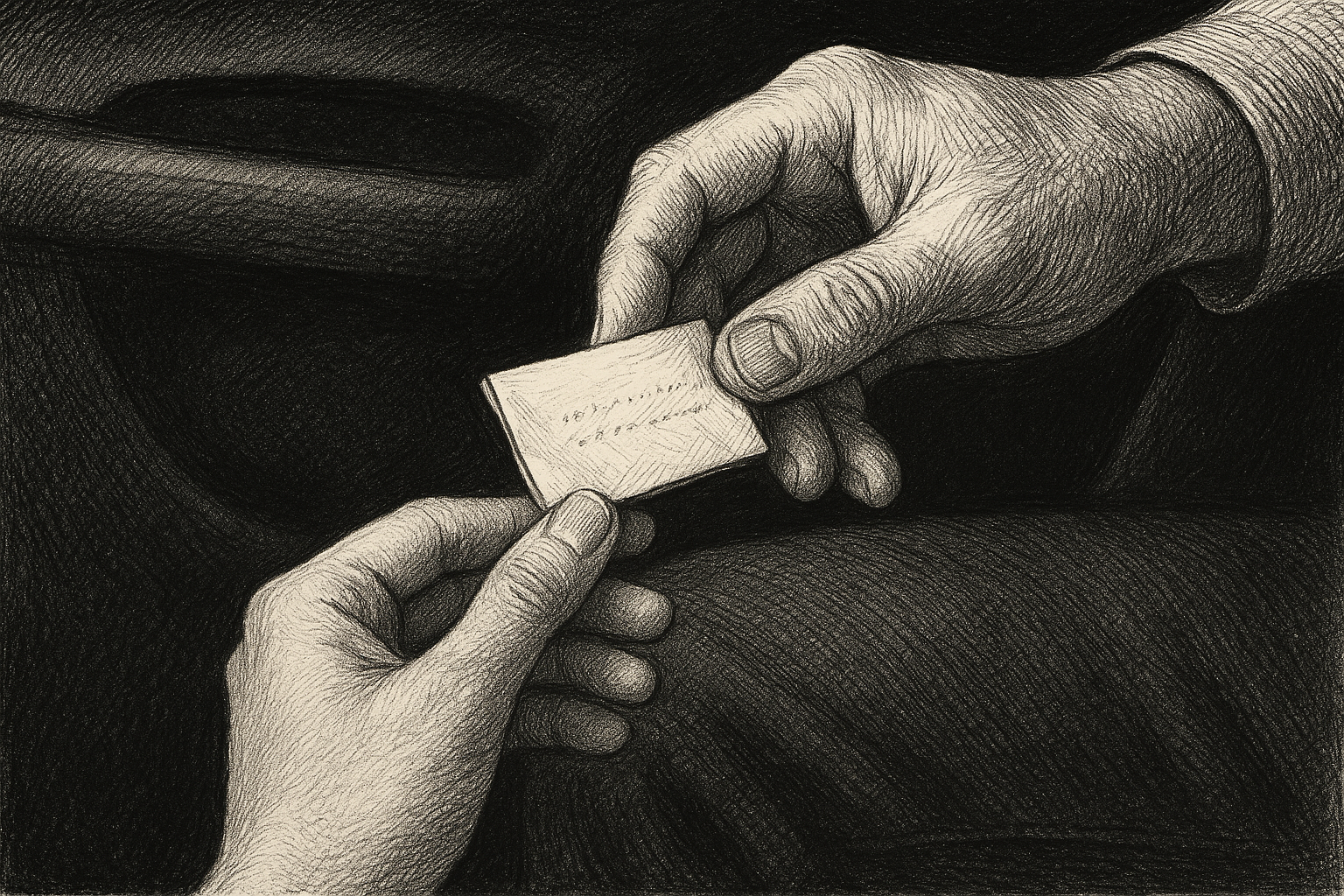
The handwriting was small. Block letters, the kind you learned in a community that didn’t teach cursive the way secular schools did. She had seen that handwriting before — not his, but the style of it. She knew where it came from without having to be told.
“Don’t call her from any phone that traces to you,” he said. “Not your cruiser phone. Not your personal. There are people in this valley who have access to things they shouldn’t have access to. Use a burner or a landline at a motel.”
“I will.”
“And deputy.”
“Yeah.”
“If I call you from a number you don’t recognize, answer it. If I don’t call you for a week, assume I can’t.”
“Jared.”
“I know.”
He put his hand on the door handle. Then he stopped.
She had not expected him to stop.
He was looking at the cracked dash again. At the stock tank and the mesquite through the windshield. At whatever in the middle distance a person looked at when they were deciding whether to say a thing they had decided not to say.
“She kept a journal,” he said. “Not anything they could find. Small. She’d write in it at the corner of the kitchen table when the other women were busy. Ballpoint pen, because a ballpoint you could hide in your bib pocket when somebody came in. She’d go through them pretty fast — she wrote small, but she wrote a lot.”
He stopped. Did not say anything for a moment.
“The ink on her right finger. The side near the nail, where you get it if you grip the pen tight.”
Audrey had photographed those hands. She had looked at them from eight inches away in the wash at Yellow Knolls with the morning light coming on and she had looked at the ink on the right index finger and she had known exactly what it was and where it came from.
“I knew she was still keeping it,” he said. “After they gave her more kitchen work and less time to herself, she was still doing it. I could tell by the ink. I never asked her what she was writing.” A pause. The metal on the bleachers ticked twice. “I figured if I didn’t know, I couldn’t give it to anyone. And I figured she needed something of her own.”
He opened the door and got out. Closed it the same way he’d come in — careful, no slam. He walked the fifty yards of dirt back to his truck without hurrying. Got in. The door of the F-150 closed. She heard the engine turn. He backed up twenty feet, turned the wheel, and drove out the way he had come, the dust from the track rising in a thin column and then settling.
Audrey sat in her truck with the paper in her hand.
The piece of metal on the bleachers ticked.
She looked at the paper. She folded it back along the crease he’d made — the same crease, precisely — and put it in her breast pocket. She looked at the notebook. She didn’t open it yet.
The stock tank was maybe thirty years gone to rot. The mesquite had come up through it the way mesquite came up through everything out here that stopped resisting — concrete, tin, hardpan, anything that had a crack. The chute gate swung and stilled and swung again. An old rodeo ground in November looked about the same as an old rodeo ground in any other month, which was to say: done, worked over, returned to whatever the Strip was when nobody was using it for anything.
She opened her notebook and wrote down everything she could remember of the conversation, because her training told her to.
She worked in order. She did not try to reconstruct it by significance. You worked in order because the significant things were not always the ones that felt significant when you were in them, and because significance was a thing you applied after, not during. During, you recorded. She wrote down the TracFone and the Walmart in Hurricane. She wrote down the clothes, the place away from the house, the once-a-month collection. She wrote down nine months and underlined it. She wrote down Linnea Aspen again in full, guessing the spelling again. She wrote down the plan — 900 West, 200 North, eleven fifteen on a Wednesday, three weeks from today — and noted that three weeks from today the girl had already been in the wash for six hours when Audrey got the radio call. She wrote down church’s ways / not church. She wrote down meant to be found / somebody who wanted me to know. She wrote two of my sisters and circled it.
She wrote down ink on right index finger / ballpoint / small journal / wrote a lot.
She put the pen down.
The sun was past the Tahoe’s center now and the light through the driver’s window had moved off her face. The heat in the cab had gone from hot to very hot while she wrote. She became aware of it all at once, the way you became aware of something after you’d been ignoring it long enough.
She sat.
The bleachers ticked.
She had been sitting in this truck for a long time now and there was no reason to keep sitting in it. The Tahoe’s engine would be hot when she started it. The air conditioner would do its inadequate work on the highway and she would be back in St. George in forty minutes with a piece of paper and a notebook and a case that was not technically hers. There was no reason to stay.
She stayed.
The drive back was going to take forty-five minutes. She had the paper in her breast pocket. She had the notebook. She had a name, a phone number, a plan that had been three weeks too slow, and a detail about a girl she hadn’t known who wrote in a journal with a ballpoint pen at the corner of a kitchen table while the other women were busy.
A person did not do that unless writing mattered to them more than the risk of being caught doing it.
She thought about the ink. The side of the finger near the nail, where it got heavy if you held the pen tight. She had been working vice for nineteen years and she had handled plenty of people who were one discovered thing away from losing everything and she knew the way they held onto what was keeping them going — held on hard, gripped it, pressed in. You gripped what you were going to lose. You pressed the ink in until the finger stained.
And she thought about him, walking back to that truck without hurrying. She thought about the nine months. She thought about what nine months in a house with those people looked like from inside — the table, the meals, the daily inventory of who was watching and what they knew, the slow adding-up of what they didn’t know yet. He had been doing that every day for nine months and nobody in that household had any idea what he had been doing. Or they hadn’t. He didn’t know what they knew now.
If I don’t call you for a week, assume I can’t.
She understood what that meant. She had been in vice for nineteen years and she understood exactly what that meant and she was going to have to work fast enough that it didn’t happen.
She put her hand flat on the dashboard and looked at it.
Still.
She started the truck.
She drove back to St. George the way she had come.