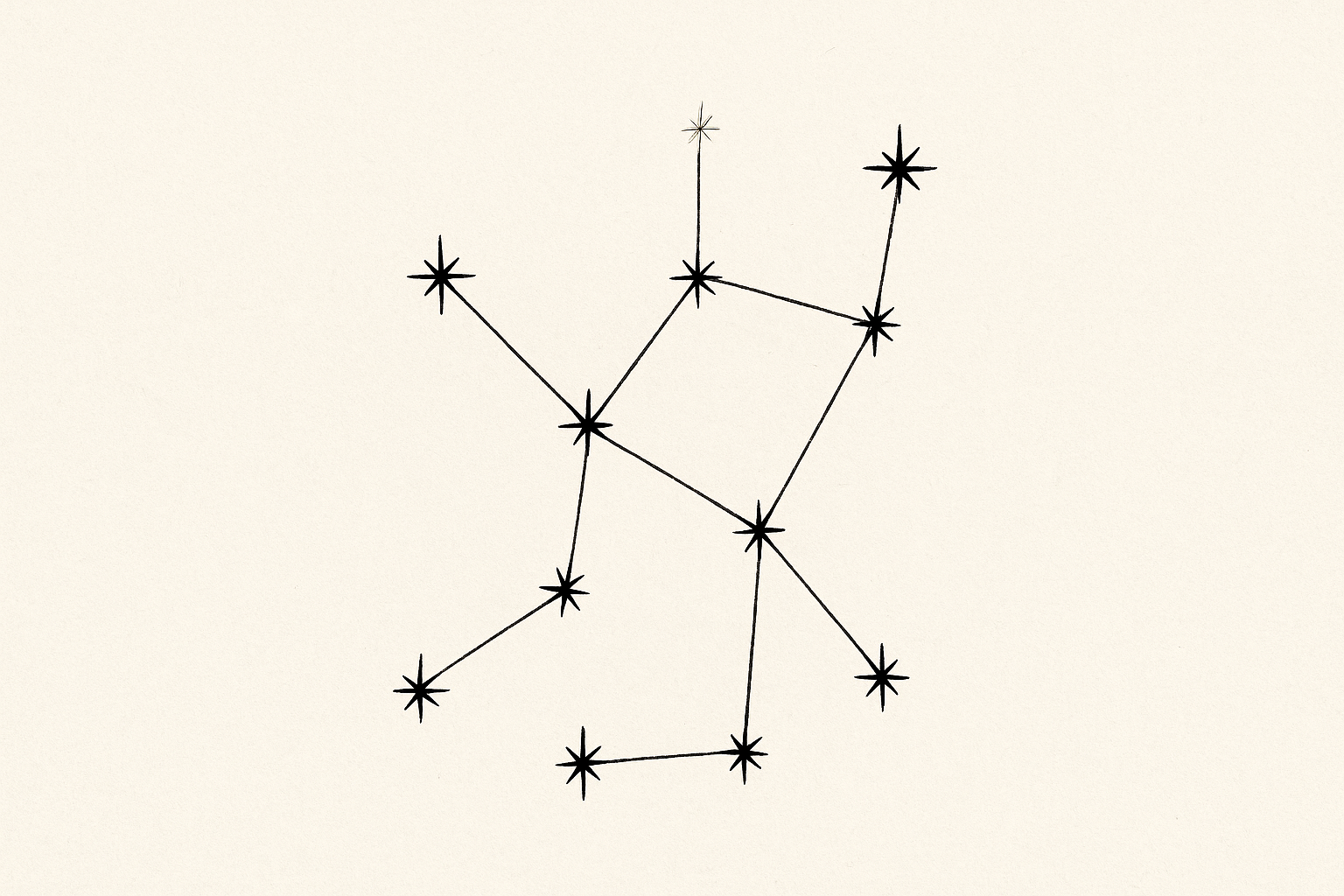
The Constellation post went through editing, rendering, and publishing over roughly 36 hours. It named five plugins that did not yet exist — great-engineers, great-designers, great-operators, great-counsels, great-researchers — and described them as stars not yet lit. By the time the post was live, all five had shipped. The gap the essay described had been closed while the essay was being written.
That is not a triumph. It is a data point. What it demonstrates is that the pattern established by the trilogy was genuinely reusable — not in the way that a template is reusable, but in the way that a learned procedure is. You can perform it without reinventing it each time. The question is what performed it.
The five
great-engineers covers the craft of building software: the nine personas running from John Carmack — the writer of engines who found the minimum computational surface needed to produce a given experience — through Grace Hopper's discipline of making the abstract concrete, through Don Knuth's precision about what an algorithm actually costs, through Linus Torvalds's intolerance for approximation, through Sandi Metz's clarity about the objects that carry the work. The conspicuous absence in the original constellation. Margaret Hamilton stays in great-minds — cross-dispatchable into any engineering session that needs her register, which is not code craft but systems accountability at the scale where a failure cannot be debugged after the fact.
great-designers covers hands-on product craft: Dieter Rams's ten principles as a constraint system, Don Norman on why the world is full of objects that do not explain themselves, Susan Kare on the invention of a visual vocabulary that millions of people learned without instruction. Nine personas total, including Julie Zhuo, Jared Spool, Paula Scher, and Edward Tufte, whose register is the representation of information rather than its aesthetics. Jony Ive stays in great-minds — his register is strategic design, the room where Apple decided what the product was, not the bench where it was refined.
great-operators covers the craft of running things: Tim Cook before he was Apple's CEO, when he was the person who looked at a supply chain that could be disrupted by a hundred variables and rebuilt it to move faster than a competitor's product cycle. Andy Grove at Intel, scaling a manufacturing discipline without losing what made it good at smaller scale. Nine personas: Munger, McCord, Deming, Ohno, Horowitz, Walton, Kelleher. Warren Buffett stays in great-minds — his register is strategic capital allocation, not operational craft.
great-counsels covers the "should we?" register: Lawrence Lessig on the architecture of networks as policy; Ruth Bader Ginsburg on constitutional reasoning; Tim Wu on what concentrated power in a network does to everyone who depends on it. Nine personas including Thurgood Marshall, Antonin Scalia, Louis Brandeis, Cass Sunstein, John Rawls. Marcus Aurelius stays in great-minds — his is Stoic mediation, not legal or policy craft. Hannah Arendt, however, moves in two directions: she lives in great-counsels as a political-philosophy register, and she is cross-dispatched into great-researchers when a research document needs that same register applied to evidence.
great-researchers covers research craft: Carl Sagan's ability to explain the distance between galaxies to someone who had never considered it, accurately and without condescension. Stephen Jay Gould, Oliver Sacks, Atul Gawande, Jared Diamond, E.O. Wilson, Rebecca Skloot, Robert Caro. Nine personas. The register is close to great-authors but distinct in one dimension: the authors write from voice, the researchers write from evidence, and the evidence must be traceable. The citation is not optional. Don Knuth is cross-dispatched from great-engineers into this plugin for technical-mathematical writing rigor — a register that lives in engineering but is needed in research.
Who wrote them
Nine authors drafted the five plugins. One editor reviewed every file.
The nine were the great-authors roster in rotation: Hemingway, Morrison, McPhee, Orwell, King, Le Guin, Wallace, Didion, Baldwin. Each author drafted one persona per plugin, working via cross-plugin orchestration — a great-authors skill dispatching into great-engineers, great-designers, great-operators, great-counsels, great-researchers as a sub-agent through the Agent tool. The assignments were not random. McPhee wrote John Carmack — the writer who approaches a system the way a journalist approaches a place, with patience and structural curiosity, trying to understand what it actually is before deciding what to say. Didion wrote Susan Kare — a sensibility for the image that carries more than it shows, for the gesture that works because it has been stripped to its minimum. Wallace wrote Sandi Metz, whose clarity about objects is the clarity of someone who has thought all the way through to what the reader needs to understand.
Robert Gottlieb edited every persona file across all five plugins. One editor, one pass, the same eye that spent forty years watching writers explain what the scene had already shown. The persona files are not prose in the ordinary sense — they are instruction documents, role definitions, principle sets. But the same failure appears in them that appears in fiction: the writer who does not trust the reader to understand what has been demonstrated. Gottlieb found it and cut it, file by file.
This is the architecture working as designed. The trilogy established the persona-file shape: identity paragraph, voice section, core principles, primary utility, working procedure, cross-references, things you never do. The great-authors writers had been living inside that shape for months. When five new plugins needed persona files, the writers were the natural drafters — not because they were the most technically qualified to describe Carmack's approach to rendering, but because they knew the shape and could fill it accurately and without padding. The pattern was reusable. The reuse happened through the people who had internalized it.
The system produced its own specialists. Not by design, exactly. By having built the right pattern and the right practitioners first.
The decision rule that emerged
As the five plugins were being drafted, a sorting problem appeared. Several personas had claims on more than one plugin. Margaret Hamilton's register spans engineering and strategy. Jony Ive's spans design and executive vision. Warren Buffett's spans operations and capital allocation. Hannah Arendt's spans ethics, political philosophy, and research. Knuth's spans engineering and the rigorous analysis that research sometimes needs.
The instinct was to duplicate: put Hamilton in both great-minds and great-engineers, put Buffett in both great-minds and great-operators. Duplication produces drift — two files for the same persona, maintained in parallel, diverging silently. A persona whose primary value is a specific craft skill belongs in the craft plugin and is borrowed by others when needed. A persona whose primary value is cross-domain judgment belongs in great-minds and is dispatched via the Agent tool when that judgment is needed in a craft context.
The rule is: register names home.
A persona lives where their register lives. They are borrowed when their register is needed somewhere else. The canonical file is in one place only. The cross-dispatch travels to it. This is the same shape the credentials essay described: one file, one source command, every consumer reads from the same place. The mechanism for preventing drift is always the same — one authoritative location, everything else points to it.
Useful rules tend to be discovered this way. The work runs long enough to produce the cases that reveal the pattern. The pattern is named after the fact. Naming it is what makes the next decision faster.
The umbrella
After the ten plugins shipped, a single repository arrived to hold them: great-minds-constellation. Its description reads: Unified marketplace for the Great Minds constellation: 10 plugins, ~111 personas, ~71 skills. Install only the plugins your project needs.
The structure is simple: a plugins/ directory with each of the ten plugins as a subdirectory, and a .claude-plugin/marketplace.json as the marketplace manifest. One add command makes all ten discoverable:
claude /plugin marketplace add github:sethshoultes/great-minds-constellationEach project then installs only what it needs. Each installed plugin loads roughly 150–250 tokens of agent metadata at startup; all ten together is approximately 19,000 tokens per session, even when only two or three personas will be invoked. You pay the full constellation tax only for the project that is actually orchestrating the constellation. Casual sessions stay lean.
This is the moment the constellation became one thing rather than ten. Before the umbrella repo, the full set required ten separate marketplace-add commands. After it, those ten collapse to one, and individual installs remain per-project. The chart can now be added to a project's tools. It is no longer merely a thing to look at on a wall.
What the 36 hours prove
The Toll Dropped essay made an argument about velocity at the personal scale: zero contributions in 2022, zero in 2023, 9,297 in the rolling twelve months through April 2026. The argument was not about ambition. It was about arithmetic — the ratio between what a project costs in daily attention and what it returns, and what happens when that ratio changes. The capacity was not new. The arithmetic was.
The constellation completing in 36 hours is the same argument at the architectural scale. The capacity to build five plugins was present before the Constellation post was written. The pattern for building them — the persona-file shape, the cross-plugin orchestration, the bible-reads-first protocol, the cross-dispatch rule — was the thing that had to exist first. Once it existed, the five plugins were not five separate projects. They were five iterations of a known procedure. The cost of the fifth iteration was not meaningfully higher than the cost of the first.
What the velocity records is not energy. It is the presence of a repeatable pattern and the absence of the friction that makes repetition expensive.
Ten plugins now. ~111 personas. ~71 skills. The constellation is complete at v0.1 — which means it is complete enough to be used, not finished in any permanent sense. The work now is use. The use will find what the v0.1 does not yet do.
The stars were always there. They needed someone to draw the lines between them, and names for the lines, and a procedure that could be followed again.
Seth Shoultes builds things at garagedoorscience.com and writes about them occasionally.