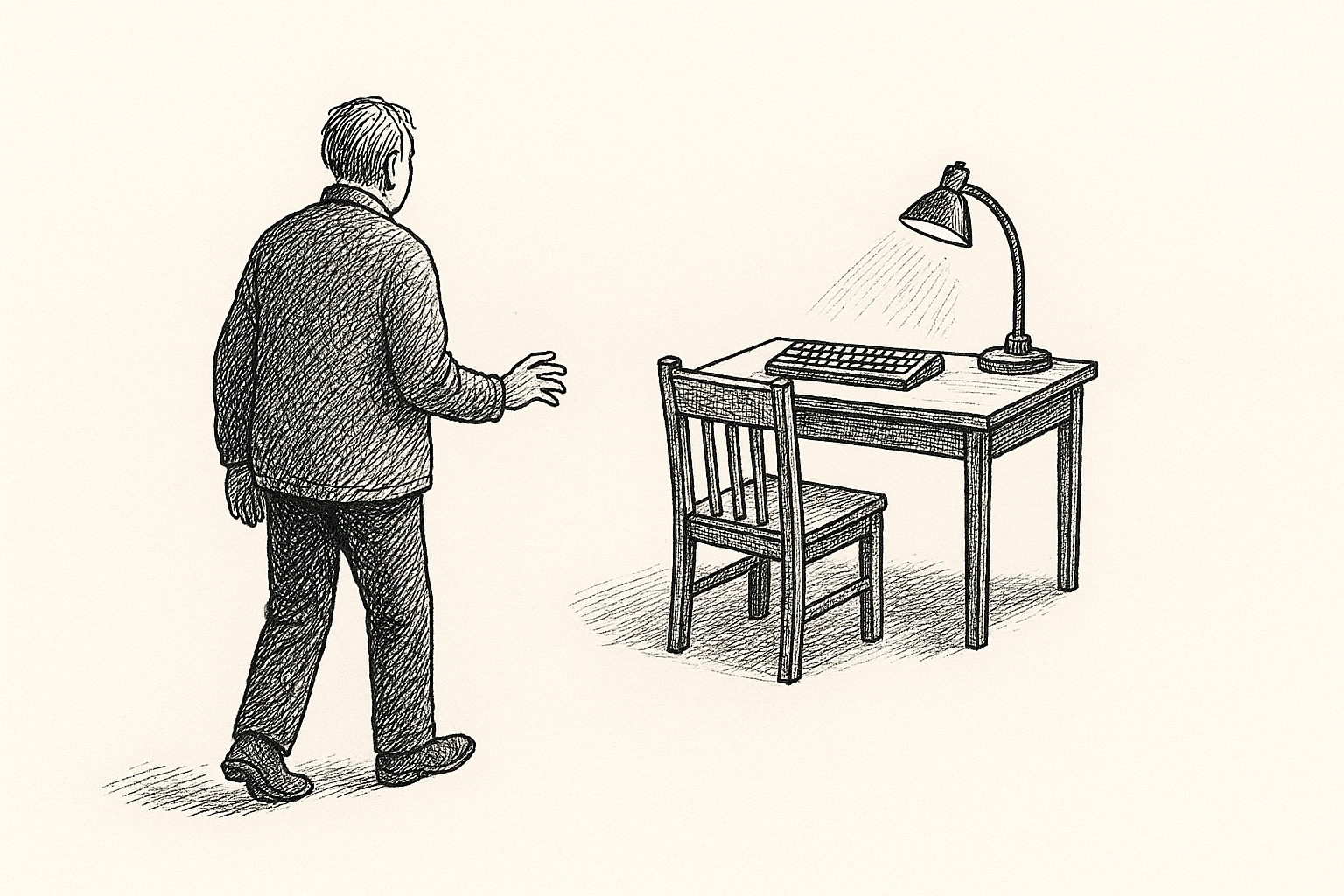
In 2022, there were zero contributions. Every square in the GitHub graph dark grey, from January through December. In 2023, the same: zero. Two years of dark grey.
In the rolling twelve months from May 2025 through April 2026, there were 9,297.
What the years before contained
Twenty-five years of building software. The first decade at Event Espresso — event registration for WordPress, built with a co-founder from a spare room, scaling to a plugin used on tens of thousands of sites, winning the Utah Entrepreneur Challenge in 2011 for $40,000 and spending the next decade finding out what it cost to maintain something people depended on. Then product roles at AccessAlly, MemberMouse, Wishlist Member, PrettyLinks — membership platforms, plugin ecosystems, the infrastructure of the independent web. The kind of work that does not have a clean beginning or end, where the code from three years ago is still running in someone's production environment and you know it because they file a support ticket about it.
In 2021, he retired. Not because the work had gone wrong. Because twenty-five years was enough of one kind of attention, and he had paid it.
2022. 2023.
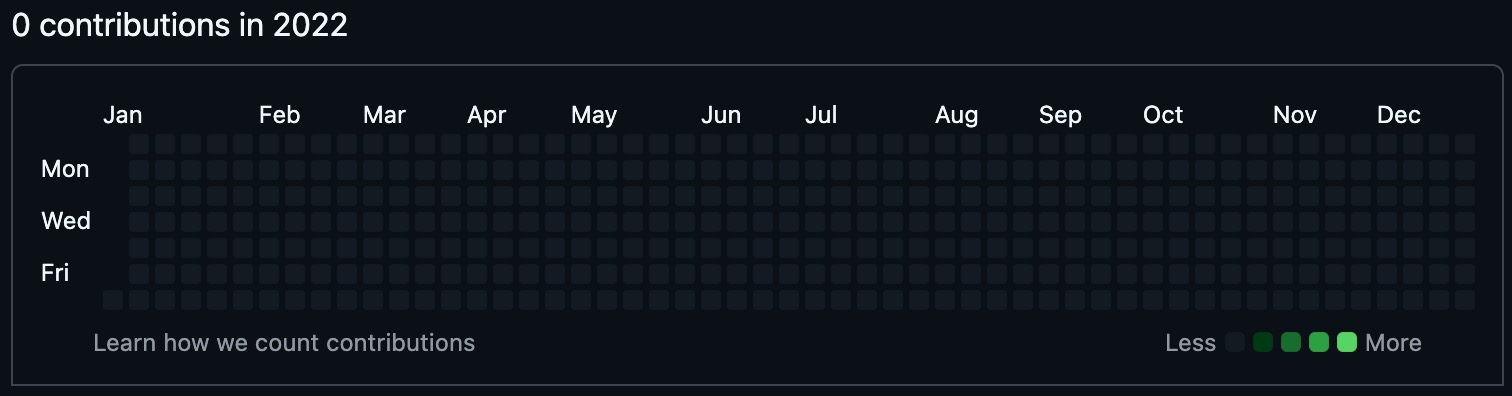
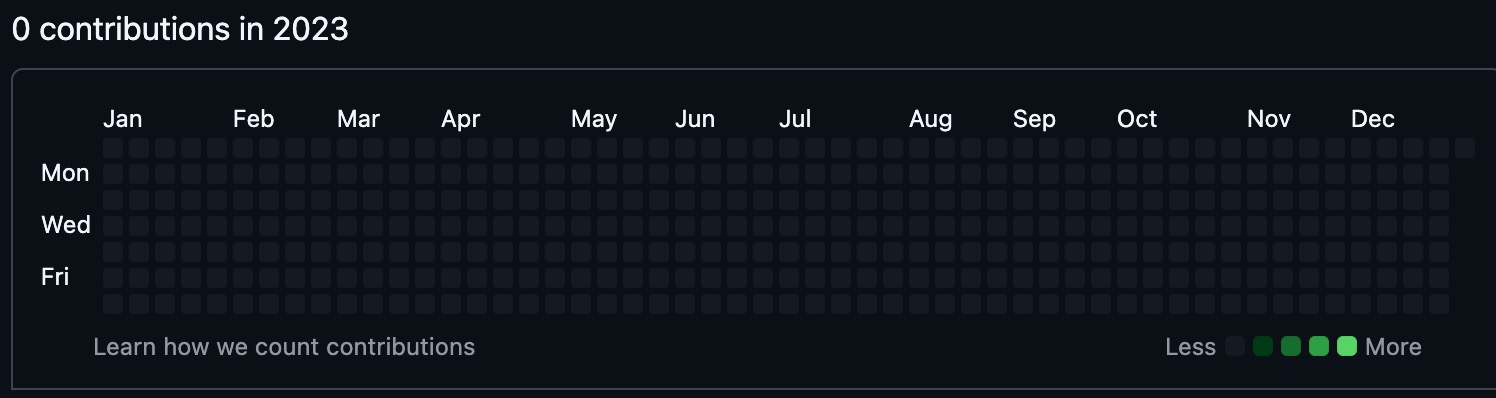
The graphs for 2022 and 2023 are identical. No green at all. The header on each reads zero. Two full years, 730 days, and not a single commit.
This is not a programmer who had forgotten how to program. It is not a person who had run out of ideas. What it is, exactly, is harder to say from the outside — the numbers do not record what was going through someone's mind while the grid stayed dark. But the person whose grid it is offered this:
I've pretty much been retired since 2021. There was no contributions in 2022 or 2023. I attribute most of this to AI and Claude Code. Kind of interesting thoughts.
What those two years felt like from the inside is not in the graphs. But the graphs record something real. A 25-year veteran of building software who did not write a single commit for two years is a person for whom the friction-to-output ratio had become, by some private calculation, not worth paying.
That is a specific thing. Not burnout in the clinical sense, not failure, not the absence of ideas. A specific arithmetic: what a project costs in attention and iteration and debugging and maintenance, against what it returns. For two years, that arithmetic did not clear.
2024: 633
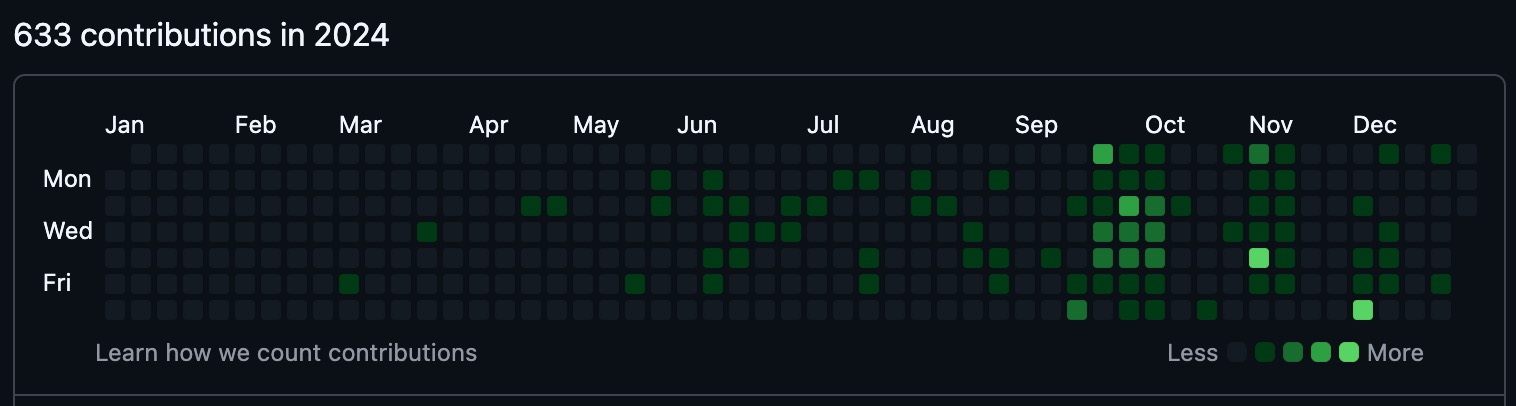
The 2024 graph tells the specific story of a change in progress. The first half of the year is dark. Through January, February, March, April, May — almost nothing. The green begins in June, tentative: scattered squares, a day here, a day there. It thickens through September. October and November show something like a real cadence.
633 contributions across twelve months. That is not an active year by any professional measure. It is, however, a year in which someone got back to the keyboard.
Claude Code arrived in the picture during this period. Not as a revelation and not as a productivity tool in the sense of software that makes existing work faster. As something that changed the arithmetic. The time between having an idea for a thing and having a working version of it began, slowly at first, to compress. The part of building that had always been load-bearing — getting the code right, managing the surface area, carrying the cognitive overhead of the system in your head — started to shift.
633 is the sound of someone finding out whether the arithmetic had changed.
2025: 5,246
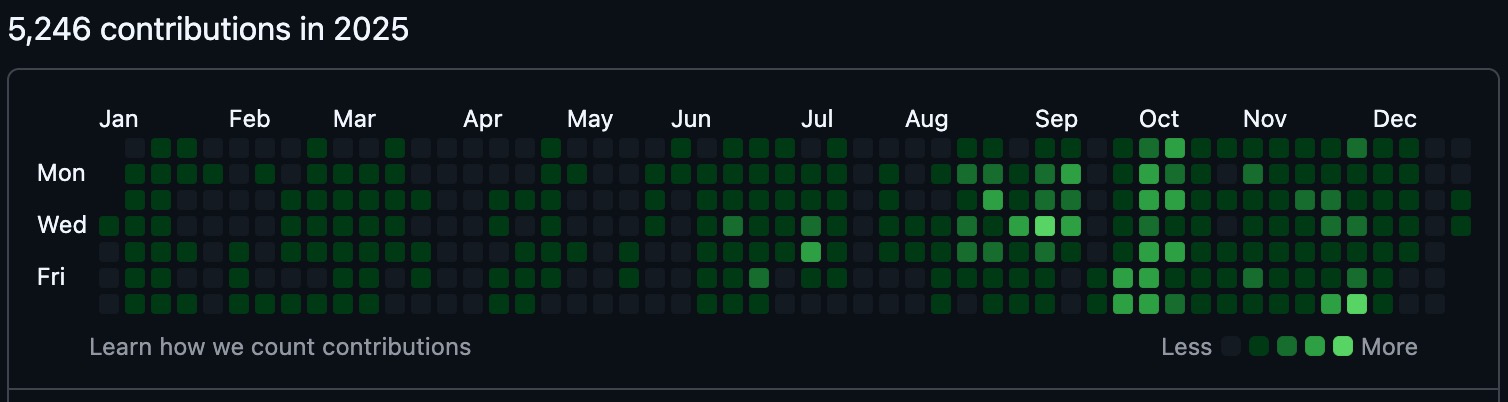
The 2025 graph does not look like the 2024 graph. The 2024 graph has a story — you can read the hesitation in it, the left side dark and the right side filling. The 2025 graph has no story in that sense. It is dense from January through December. There are thin weeks in the spring. Otherwise it is continuous.
5,246 contributions. That number is larger than any single year of the original twenty-five. The Event Espresso decade was not unproductive — it produced a plugin on tens of thousands of sites — but it did not produce a contribution graph that looks like this, because it could not. The tools did not exist to reduce the cost of building to the point where one person, no longer employed, can exceed his own career output in a calendar year.
What built up inside those 5,246 squares: the garagedoorscience.com platform, the great-minds and great-authors and great-filmmakers and great-publishers and great-marketers plugins, the novel, the editorial pipeline that publishes for thirty-five cents an article, the voice agent that answers diagnostic questions in real time, the constellation architecture described in the post published yesterday. None of that would have existed at this speed in 2022, not because the ideas were absent but because the cost of execution was too high to pay without a team.
The rolling year: 9,297
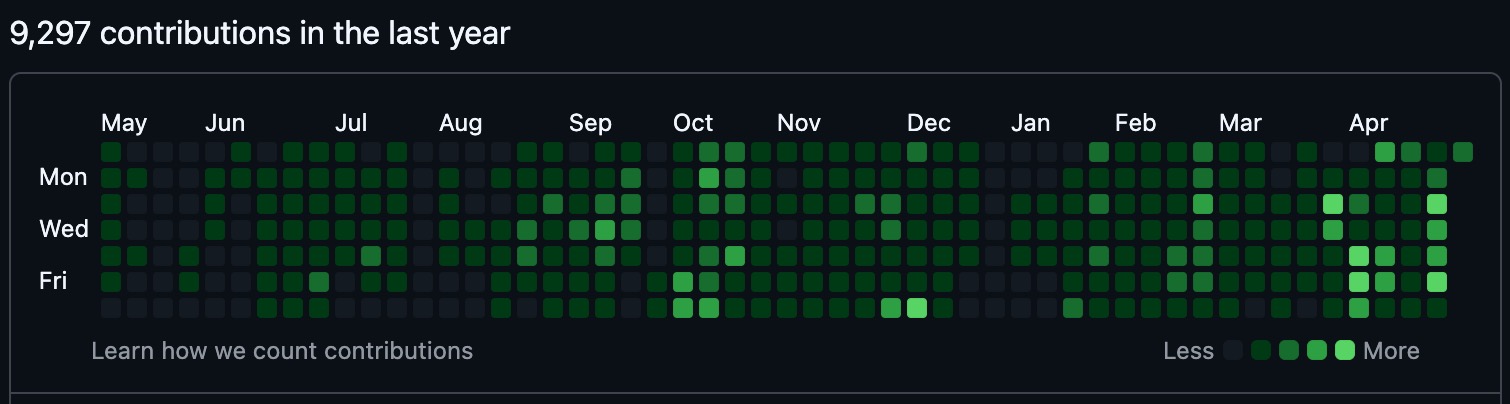
The rolling twelve-month graph — May 2025 through April 2026 — reads 9,297. The right edge of the graph, the April 2026 column, is brighter than anything to the left of it. More saturated. The individual squares carry more weight. This is because in the twenty-six days of April 2026 through the date of this writing, the contribution count for those days equals roughly half of the rolling-year total. In twenty-six days: as much as in the prior eight months combined.
9,297 in twelve months. Zero in each of the two years before 2024. The only way to hold those numbers together without resorting to a before-and-after narrative — the triumphant kind, the kind that explains what it all means — is to look at what changed and what did not.
What did not change: the 25-year accumulation of judgment about what products should do, how systems should be structured, which decisions need to be made slowly and which ones will not survive slow deliberation. That judgment was present in 2022 and 2023. It was not deployed.
What changed: the cost of deployment.
What the toll was
Building software at any meaningful scale is a ratio problem. On one side of the ratio: what you want to exist in the world. On the other: what it costs to make that thing real — the iteration cycles, the debugging sessions, the maintenance surface, the time spent carrying the cognitive model of a system while you move slowly through it. For twenty-five years, that ratio had a floor. The floor was set by the fact that a person can only hold so much in their head at once, can only move through code at the speed their hands allow, can only manage so much surface area before the overhead of the system exceeds the pleasure of building it.
In 2022 and 2023, for reasons that the graphs record but do not explain, the floor was too high. The cost of starting a new project — not the financial cost, not the strategic cost, but the daily weight of it, the attention it would require, the maintenance it would create — was not a cost worth paying without a team or a revenue motive or some other external lever.
The external lever, when it arrived, was not a motivational intervention. It was not the rediscovery of passion, or a new idea large enough to justify the old costs. It was a change in the ratio. Claude Code lowered the toll. The cost of getting from an idea to a working version of it dropped, then kept dropping, until the floor that had been too high for two years was not the floor anymore.
What was on the other side of that toll — what had been waiting for two years while the arithmetic didn't clear — was a 25-year veteran whose curiosity had not retired with him.
9,297 contributions in twelve months. The capacity was not new. The arithmetic was.
Seth Shoultes builds things at garagedoorscience.com and writes about them occasionally.