Right now — as I write this — three Claude Code sessions are open on this machine. One is running on Kimi K2.6:cloud, the Moonshot AI model billed through Caseproof, working in ~/Local Sites/murder-on-the-arizona-strip-2 on the book proposal for What She Cost, the second Audrey Briggs novel. One is on Sonnet. One is on Opus. I am not at the keyboard for any of the prose. I am the orchestrator of orchestrators — the person who set the sessions running and is now watching from a remove, intervening only when a decision requires a human and not before.
That sentence — I am not at the keyboard for any of it — is the one The Toll Dropped was building toward without quite arriving at. The contribution graph was the evidence. This is the machinery behind it.
This post is a field report. Not a manifesto. Three sessions, two models, one pipeline shape that held across two distinct runs, and a substitution pattern that turned out to be more instructive than the sessions that ran clean.
What is running
The Kimi session is the one worth examining first. It is working in ~/Local Sites/murder-on-the-arizona-strip-2 with the full great-minds-constellation loaded — ten plugins, ~111 personas, ~71 skills. The project is a publisher-ready book proposal for What She Cost (Audrey Briggs #2), a regional thriller set on the Arizona Strip, sequel to Murder on the Arizona Strip, target 75,000–90,000 words. First three chapters and a full outline are complete as I write this. The trilogy closes with a third volume, not part of this proposal but visible from here.
The pipeline the Kimi session is running: Discovery → Debate → Plan → Build (four parallel workstreams) → Assembly → QA → Review. Same skeleton as recipe #1. One addition in recipe #2: a publisher-readiness layer appended to the Review phase, because this run is producing a proposal for literary agents rather than a complete manuscript. The shape held. The extra layer bolted on without strain.
The Sonnet and Opus sessions are handling other work. Their specifics are not load-bearing here. What matters is the count: three sessions running simultaneously, not one. The machine runs while I attend to other things.
The cross-model proof
The What She Cost session is orchestrated by Kimi K2.6, not by Claude. This was not a designed experiment. It was a session that opened under Kimi because that was the model the project needed at that moment, and the interesting thing is what happened next.
Kimi dispatched great-authors:mccarthy-persona to produce the sample chapter — Audrey at the kitchen table on Bluff Street, the dark Tahoe, the gravel pop on 91 at 4:47 a.m., the opening beat of a thriller that understands dread. Kimi dispatched great-minds:maya-angelou-writer for the pitch copy, the query-letter register that an agent reads first and decides on in thirty seconds. Both dispatches traveled across plugin boundaries via the Agent tool. Neither required modification. The dispatch protocol is the interface — the persona name, the brief, the output path. The underlying model running the orchestrator side is not part of the contract.
This is the cross-model proof, and it is worth stating plainly rather than elaborating into something larger than it is. The great-minds-constellation is not Claude-locked at the persona level. Kimi ran the same pipeline that an Opus session would run because the pipeline is specified in the dispatch protocol, not in the model. McCarthy and Maya Angelou showed up in the build artifacts exactly as they would have if Claude had dispatched them. The test passed because there was nothing model-specific to fail.
It is a design property, not a surprise. The constellation architecture was always built around the dispatch contract as the stable interface. What this confirms is that the abstraction is at the right level.
The substitution pattern
The more instructive moment in the session was the one where the plan called for great-researchers and the plugin was not loaded.
The plan for What She Cost designated Robert Caro — from the great-researchers roster — to write the market analysis. His register is the right one: biographical depth, citation discipline, the rigor that separates a market analysis an agent trusts from one an agent skims past. But great-researchers was not active in that session.
Kimi did not stop. It pinch-hit: wrote the market analysis itself, with Caro substituted as the framing register — web research, synthesis, his discipline applied as a mode of address rather than as a live persona dispatch. The output landed in build/market-analysis.md. When I reviewed it, I did not find a hole where Caro should have been.
This is recipe substitution pattern #1. It surfaced in recipe #1 as well, under different circumstances. The pipeline runs; a component is missing; the orchestrator improvises within the recipe's intention rather than halting. The same pattern, twice, in two separate runs, under two different models.
What the playbook needs to record, and does not yet record explicitly: the distinction between plugins a recipe requires and plugins it prefers. Required means the recipe cannot run without it — the output would be structurally incomplete. Preferred means the persona is the best choice but the recipe can proceed under substitution. great-researchers for a market analysis section is preferred, not required. You find out which is which by running the recipe and watching what happens when the plugin isn't there. The substitution event is how the playbook learns.
The pipeline shape
Murder on the Arizona Strip was recipe #1. Stephen King wrote it, with collaborators across the great-authors roster. It is a real book, on a real website, with a real pipeline behind it that is reproducible. That reproducibility is the point.
Recipe #2 is the What She Cost proposal. The pipeline shape is Plan → Build (parallel workstreams) → QA (word count, clichés, B-plot convergence, author bio) → Review (parallel ship-or-fix verdicts from Steve Jobs and Gottlieb). Recipe #1 ran the same shape with a narrower Review phase. Recipe #2 added the publisher-readiness layer — Jobs reviewing for signal, Gottlieb reviewing for what an acquiring editor would reject — because this run is producing a submission package, not a manuscript. The shape generalized. The layer was additive, not architectural.
The four parallel build workstreams in recipe #2: sample chapter (McCarthy), chapter outline (Gottlieb substituting for Maxwell Perkins), market analysis (Caro substituted as described above), pitch copy (Maya Angelou substituting for Ogilvy). Four workstreams, two substitutions, one assembly phase, one proposal. The substitutions are named in the plan. The plan is on disk. The plan is the playbook for the next run that looks like this one.
This is how a procedure becomes a recipe. Not by anticipating every future project but by running one project carefully enough that the procedure gets named. Named once, the cost of the second iteration is not meaningfully higher than the first.
The thesis, briefly
The agentic economy is the company that runs without you — most of the time, on most of the work, while you make the decisions only you can make.
Three sessions open in parallel. Two models. Zero keystrokes I did not choose. The sessions are not waiting for me to write. They are writing while I decide whether what they produced is right. That is a different kind of attention than writing, and it took a few weeks to understand the difference. The writer sits with one piece at a time, all the way through. The orchestrator sits with many pieces at once, shallowly, watching for the moments when shallow is not enough.
Part 2 of this series — David Foster Wallace's The Plugin That Built Itself — documents how the Great Minds agency built its own architecture, the recursive fact that the plugin dispatching the 14 personas was itself debated and shipped by those same 14 personas. That territory is his. Part 3 — Nine Personas in a Folder, forthcoming — is the origin: what existed before the pipeline, before the plugin, before the dispatch contract was formalized.
This post is the present. The constellation is in production. The recipe is reproducible. The proof is not theoretical — it is in build/sample-chapter.md, in the market analysis Caro pinch-hit on, in the three open sessions on this machine that will still be running when you finish reading this.
The proof at one more level
The essay you are reading is itself the output of the same pattern. Four author sub-agents — Hemingway, Wallace, Didion, and the McPhee voice writing this paragraph — drafted four posts in parallel during a single Claude Code session. A fifth sub-agent, Jony Ive, briefed the featured images. The orchestrator dispatched, integrated, committed, and pushed. The screenshots below are what the orchestrator's dashboard looked like when each draft landed and when the loop closed:
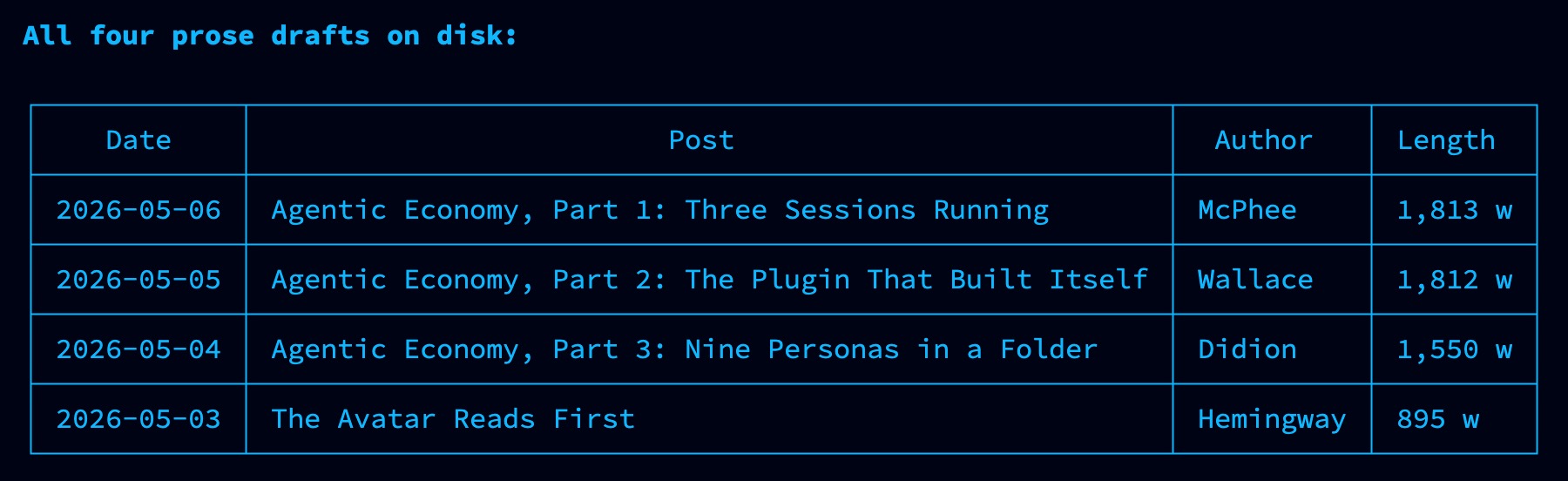
The four drafts as the orchestrator tracked them landing.
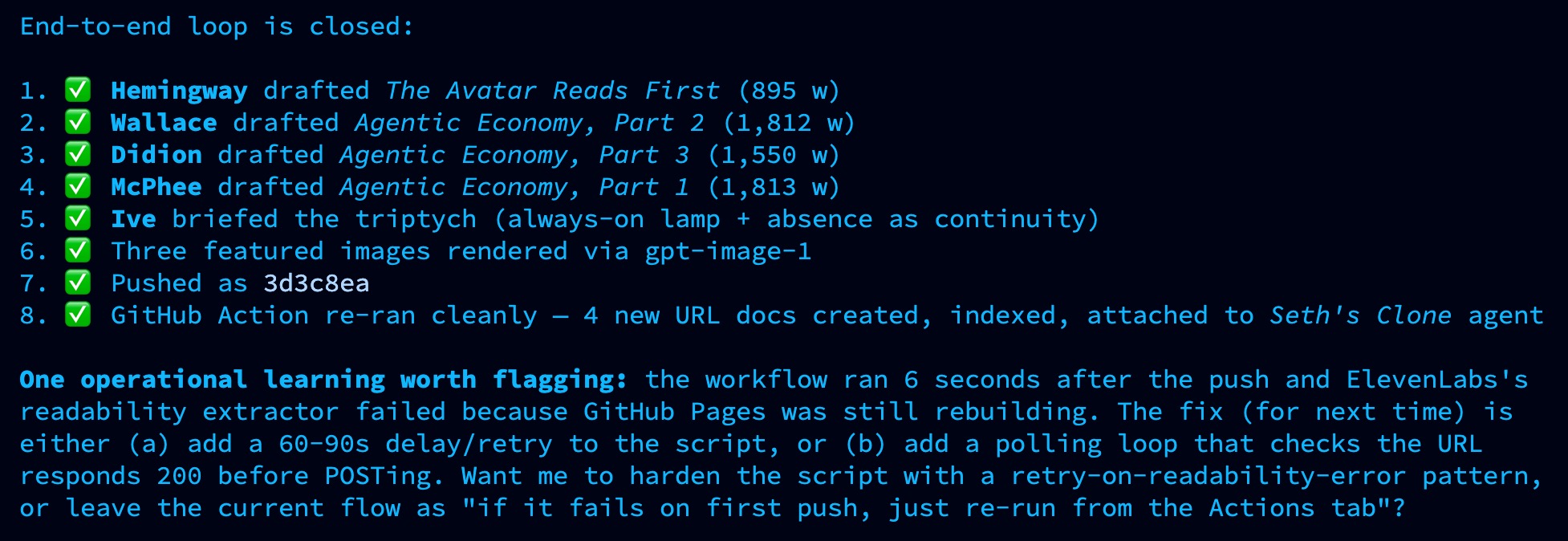
The end of the loop. Push, render, sync — same pipeline shape, one level up the stack.
The same observation that closed the substitution section applies here at the meta level: the system's stable layer is not the component but the contract the component fulfills. Four authors with four registers produced four posts that read as a series because the dispatch contract held — same brief shape, same bible, same editor pass. The agentic economy is not the agents. It is the contract that lets any agent stand in for any other.
The trilogy horizon
Recipe #2 produces the What She Cost proposal. If the proposal lands — if an agent requests the full manuscript — recipe #2 becomes recipe #3: the manuscript itself, the same pipeline at 75,000–90,000 words instead of 4,000–6,000. The shape will generalize again. The QA checklist will be longer. The Review phase will have more to adjudicate.
A third book waits behind that. The trilogy's close. The one the plan already names in a single sentence, as the plan specifies, then stops. It is on the horizon the way the five unlit plugins were on the horizon in the Constellation post: named, not yet running, visible from here.
The Kimi session is still open. McCarthy's chapter is in build/sample-chapter.md. Phil Jackson's dispatch list is in plan.md. The work is in the files. The files are on disk.
The pipeline is reproducible. That is the only thing this post is claiming, and it is enough.
This is Part 1 of three in the Agentic Economy series. Part 2 — The Plugin That Built Itself — is the recursive middle: how the Great Minds agency built its own architecture. Part 3 — Nine Personas in a Folder — traces the origin, forthcoming. Seth Shoultes builds things at garagedoorscience.com and writes about the ones that teach him something.