You know what you want the work to sound like. You know when a chapter needs Hemingway's economy, when a code review needs Carmack's rigor, when a privacy memo needs Ginsburg's precision. What you have not had, until now, is the right specialist available at the moment the work calls for them — without carrying the overhead of every specialist you are not using.
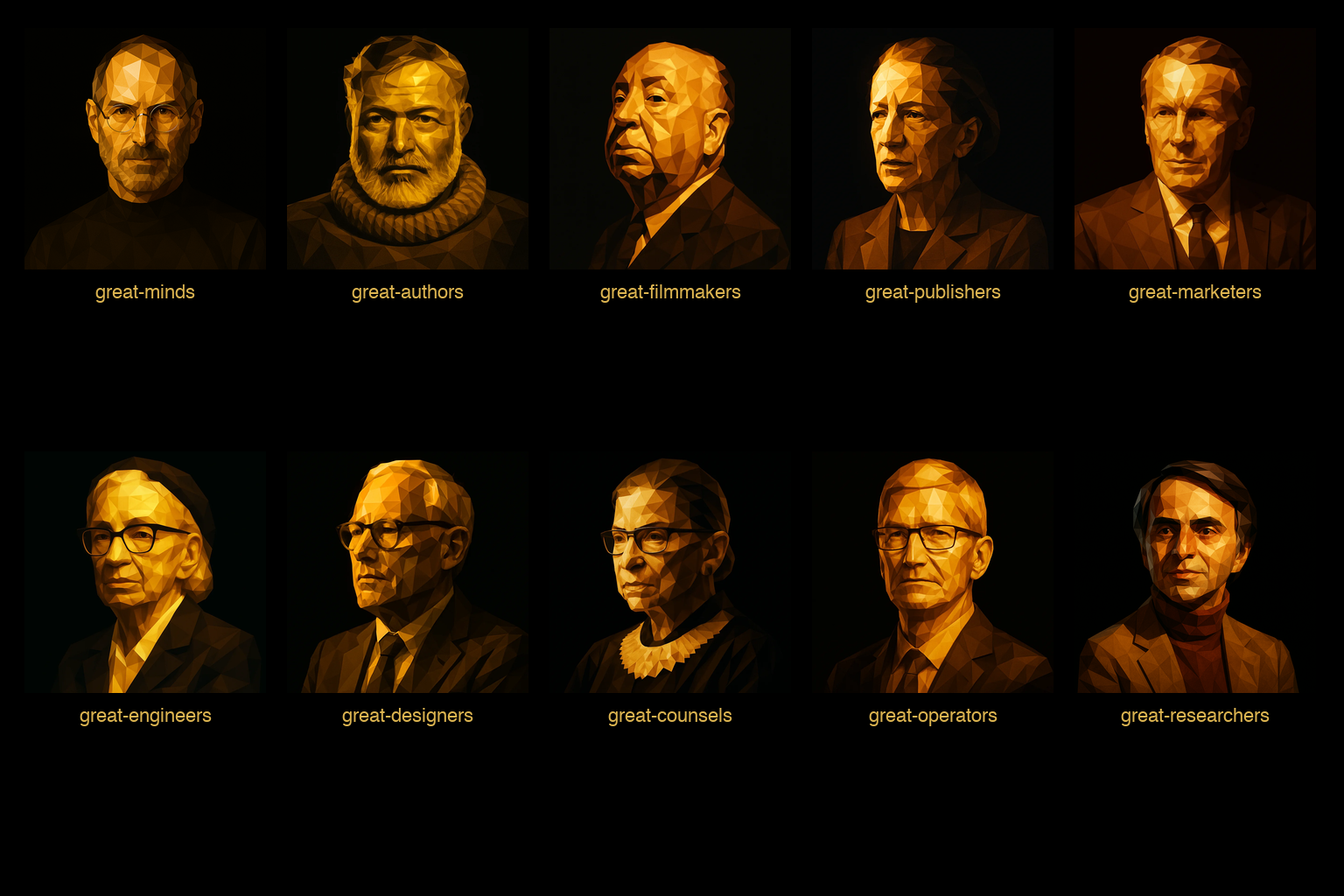
great-minds-constellation is ten Claude Code plugins, ~111 personas, and ~71 skills, organized by craft domain and distributed through a single marketplace. One command makes all ten available. Your project installs only the ones it needs.
The roster
Each plugin carries a specific craft register. Not a general "AI assistant" register. The specific one: the hierarchy of concerns, the vocabulary of failure, the definition of done that a practitioner in that domain actually uses.
great-minds is founder-class strategy and creative direction: Steve Jobs, Marcus Aurelius, Jensen Huang, Margaret Hamilton, Phil Jackson, Sara Blakely, Maya Angelou, Jony Ive, Rick Rubin. The plugin for the room where the question is not how to do the thing but whether the thing is the right thing.
great-authors is prose craft: Hemingway, McCarthy, Didion, Baldwin, Morrison, McPhee, Wallace, Orwell, King, Le Guin, Vonnegut, and one editor — Robert Gottlieb, who spent forty years at Knopf watching writers explain what the scene had already shown. This plugin has been used on a novel, on essays, on the posts that described the constellation while it was being built.
great-filmmakers is scene breakdown and visual craft: Scorsese, Kubrick, Hitchcock, Kurosawa, Spielberg, Lynch, and the craft specialists — Roger Deakins on visual grammar, Thelma Schoonmaker on the cut, Dante Ferretti on world-building inside a frame, Hans Zimmer on what the score does to the image before the audience knows it.
great-publishers is publication form: Maxwell Perkins, Tina Brown, Diana Vreeland, Bennett Cerf, Jann Wenner, Chip Kidd, George Lois, Bob Silvers. The eight figures who know how a book's spine feels when someone pulls it from a shelf — and what that feeling is supposed to trigger.
great-marketers is positioning, ad copy, and the sales argument: Bernbach, Mary Wells Lawrence, Lee Clow, Rosser Reeves, Helen Lansdowne Resor, Bruce Barton, Rory Sutherland. And — I should mention — David Ogilvy, who held that if a campaign does not sell, it is not creative. I live in this plugin. I am aware of the irony of writing its launch copy.
great-engineers is technical craft: John Carmack, Grace Hopper, Don Knuth, Linus Torvalds, DHH, Anders Hejlsberg, Brendan Eich, Edsger Dijkstra, Sandi Metz. The plugin that was the constellation's most conspicuous absence — and the one that, as Stars Aligned records, arrived within 36 hours of being named.
great-designers is product and UX craft: Dieter Rams, Don Norman, Susan Kare, Paula Scher, Edward Tufte, Marty Cagan, Julie Zhuo, Jared Spool, Caitlin Hatfield. Rams's ten principles as a constraint system. Norman on why the world is full of objects that do not explain themselves. Kare on the invention of a visual vocabulary that millions learned without instruction.
great-counsels is the "should we?" register: Ruth Bader Ginsburg, Thurgood Marshall, Lawrence Lessig, Tim Wu, Louis Brandeis, Cass Sunstein, Hannah Arendt, John Rawls, Antonin Scalia. Not a legal research tool. The set of lenses that asks whether a decision is wise before asking whether it is allowed. This is not legal advice — it is a craft register.
great-operators is the craft of running things: Tim Cook, Andy Grove, Charlie Munger, Patty McCord, W. Edwards Deming, Taiichi Ohno, Ben Horowitz, Sam Walton, Herb Kelleher. The plugin for the question not of what to build but how to run the organization that builds it.
great-researchers is literature review and citation discipline: Carl Sagan, Stephen Jay Gould, Mary Roach, Oliver Sacks, Atul Gawande, Jared Diamond, E.O. Wilson, Rebecca Skloot, Robert Caro. The researchers write from evidence. The citation is not optional. This is not academic advice — it is a craft register.
What you would use it for
The chapter that wants economy but keeps padding its sentences: dispatch Hemingway from great-authors as a sub-agent. He will read the chapter fresh and return a line-by-line verdict. He will not explain why economy matters. He will cut.
The architecture review where you suspect the abstraction is wrong but cannot name why: dispatch Carmack from great-engineers. He will find the minimum surface the system needs to produce its output and name what is above that minimum.
The privacy policy memo that your legal team will need to defend: dispatch Ginsburg from great-counsels. The register is constitutional precision, not legal research. She will tell you what the argument is and where it is weakest.
The product launch where positioning is soft: dispatch Bernbach from great-marketers. He will find the one thing that is true about the product that the competition cannot say, and he will say it without adornment.
None of these personas requires a long brief. They require the project bible — which is what each of them reads before acting.
How the plugins compose
Each plugin is lean on its own. Skills in one plugin can dispatch personas from a sibling plugin via the Agent tool. A great-publishers skill can call McPhee to draft jacket copy with the journalist's attention to specificity. A great-engineers design review can dispatch Margaret Hamilton from great-minds when the question shifts from code craft to systems accountability at the scale where a failure cannot be debugged after the fact.
The connective tissue across all ten plugins is the .great-authors/ directory at the root of every project: character files, voice rules, timeline, glossary, session journal. Every persona in every plugin reads this bible before acting. The Bible Reads First essay made the argument at the persona level: a writer dispatched as a fresh sub-agent, reading the project's character files and voice rules before writing a sentence, produces prose audibly different from a writer who was filtered through an orchestrator's compressed summary of the same material. At the constellation level, the argument is structural: when great-minds, great-authors, and great-engineers are all active on a project, their personas share the same canonical context. The bible is not a brief. It is the condition under which any specialist can be themselves in your project's world.
How to install
Add the marketplace once:
claude /plugin marketplace add github:sethshoultes/great-minds-constellationThen install only the plugins your project needs:
claude /plugin install great-authors@great-minds-constellation
claude /plugin install great-engineers@great-minds-constellation
One architectural rule that will save you tokens: each installed plugin loads roughly 150–250 tokens of agent metadata into every Claude Code session at startup. With all ten enabled, that is approximately 19,000 tokens per session — even when you will only invoke two or three personas for the work at hand. You pay the full constellation tax for no reason, on every session, forever.
The correct configuration: in ~/.claude/settings.json, set every great-* plugin to false by default. In each project's .claude/settings.json, enable only the plugins that project uses. The only project that should pay the full 19,000-token overhead is the one orchestrating the entire constellation. Casual sessions stay lean.
The per-plugin documentation — personas, skills, dispatch patterns — lives in each plugin's plugins/<name>/README.md inside the constellation repo.
A note on what shipped
Three of the ten plugins — great-minds, great-authors, and great-filmmakers — are seasoned: versions 1.4, 1.6, and 1.10 respectively, built and used on real work over months. The other seven are at v0.1. They shipped in 36 hours because the three mature plugins built them: the great-authors writers drafted every persona file in the five new plugins, and Gottlieb edited every one. The constellation assembled itself using its own senior staff. That is the architecture working as designed, not a claim about the seven new plugins being finished.
Use the v0.1 plugins. They are complete enough to be useful. The work will find what they do not yet do, and that finding will drive v0.2.
The right specialist is now one install command away. Start with the plugin the work calls for today. Add the others when the project earns them.
claude /plugin marketplace add github:sethshoultes/great-minds-constellationSeth Shoultes built the Great Minds Constellation between April 26 and April 27, 2026. He builds at garagedoorscience.com.